
Islamic Quiz for Kids
How the Scales are Structured
Who Usually Takes This Test?
See How You Compare
Below is a preview of how scores are typically distributed across each scale.
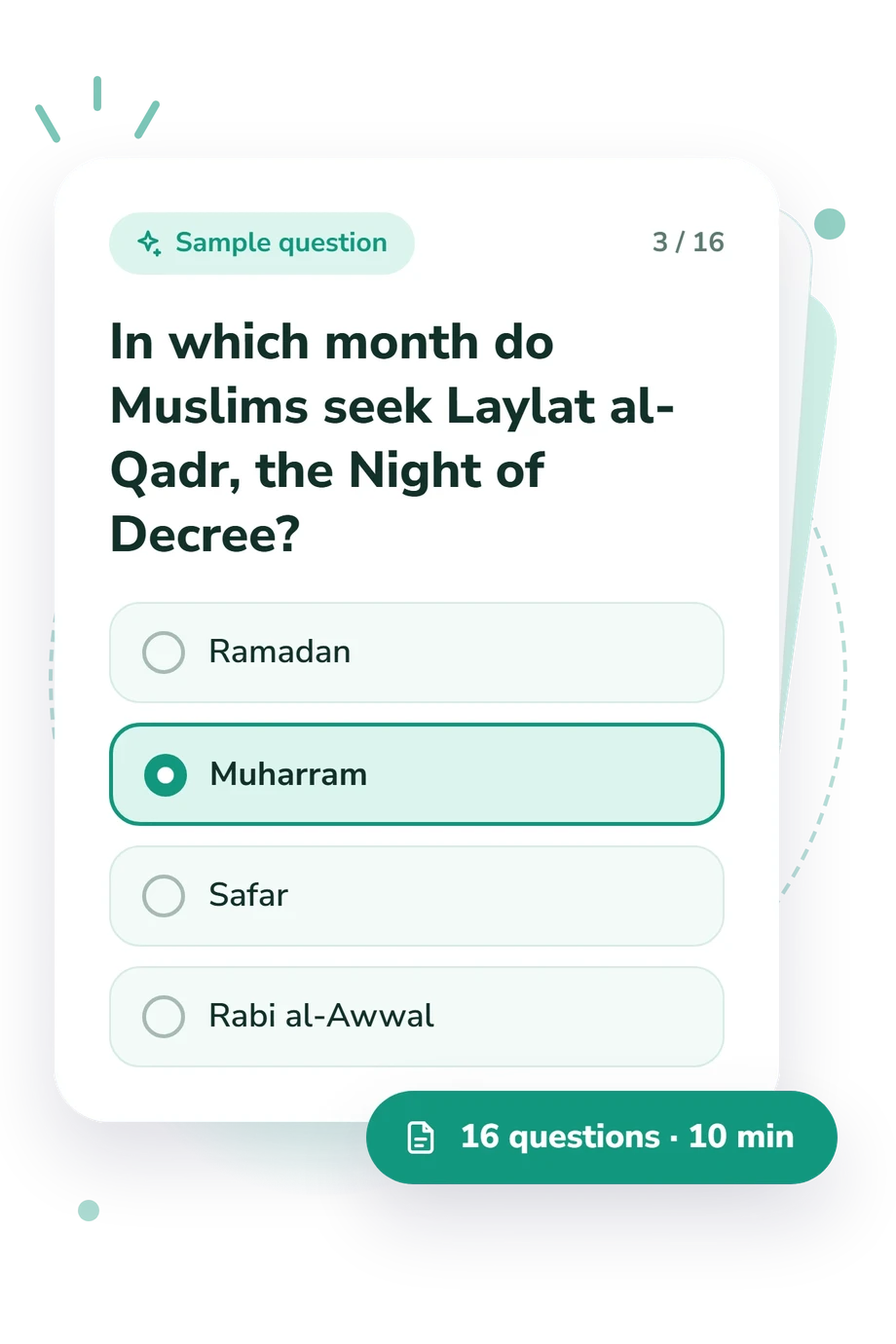
Example Questions From the Test
- Adhan
- Zakat
- Wudu
- Khutbah
- Alhamdulillah
- Assalamu alaykum
- Bismillah
- Wa alaykum as-salam
- Ramadan
- Muharram
- Safar
- Rabi al-Awwal
Islamic Quiz for Kids - Description and methodology of the test
Families, teachers, and young learners who want to review essential Islamic concepts can use this assessment as a structured starting point. The Islamic Quiz for Kids presents familiar situations and vocabulary without treating religious knowledge as a measure of faith. As an Islamic quiz for children, it can prompt discussion of unfamiliar answers or topics needing another explanation.
What This Assessment Explores
The questionnaire measures recognition of foundational concepts from ordinary religious learning. Items cover ritual preparation, duties, sacred months and celebrations, prophets, scripture, mosque vocabulary, greetings, prayer direction, and respectful conduct. The result reflects selected knowledge topics, not devotion or day-to-day observance.
The questions group into three areas:
- Worship and sacred time show how well the respondent recognizes prayer preparation, duties, fasting, pilgrimage, celebrations, and calendar terms.
- Prophets and scripture show recall of important figures, the Quran, and vocabulary used for its chapters.
- Mosque language and manners show understanding of greetings, the adhan, the qiblah, and considerate conduct.
Families or teachers may use an Islamic quiz for 10 year olds to discuss unfamiliar answers. The displayed scale is Islamic Knowledge (0-16), with Starting Knowledge (0-6), Developing Knowledge (7-12), and Strong Knowledge (13-16). These bands describe familiarity with the tested basics, not religious commitment.
Methodology and Evidence Base
Each item presents a factual prompt or everyday situation with four answer choices. Selecting the best response samples recognition and recall rather than opinion or self-description. The topics span worship, vocabulary, sacred history, calendar knowledge, and mosque practice, creating a compact learning snapshot.
The questionnaire reports one score and assigns it to the displayed descriptive band for the Islamic basics covered by these items. As an Islamic knowledge quiz, it is most useful when uncertain answers prompt rereading, explanation, or discussion with a trusted adult.
Content is conceptually consistent with the IBRK described by Arip and colleagues (2012), which organizes foundational religious knowledge for assessment. It can also be considered alongside Alghorani's 2008 KPMIR, a measure connecting Islamic knowledge and practice. These sources clarify the subject matter; the questionnaire is conceptually consistent with the IBRK and KPMIR and is not presented as either published instrument.
The result is a general learning score for the Islamic basics covered, offering a snapshot of the selected items rather than a complete account of religious learning or practice. Memory, language familiarity, wording, guessing, and current context can affect answers, so broader teaching and discussion still matter.
- Arip, Mohammad Aziz Shah Mohamed, Samsiah Mohd Jais, Aniza Benu, Mohd Safuan Zakaria, Nur Hazwani Zahariman, and Norehan Ishak. (2012). Construction, Validity and Reliability of the Inventory of Basic Religious Knowledge (IBRK). Asian Journal of Assessment in Teaching and Learning, 2, 86-94.
- Alghorani, Mohammad Adnan. (2008). Knowledge-practice measure of Islamic religiosity (KPMIR): A case of high school Muslim students in the United States. Journal of Muslim Mental Health, 3(1), 25-36. 10.1080/15564900802035169
Updated: