
Finish the Saying Quiz
How the Scales are Structured
Who Usually Takes This Test?
See How You Compare
Below is a preview of how scores are typically distributed across each scale.
Example Questions From the Test
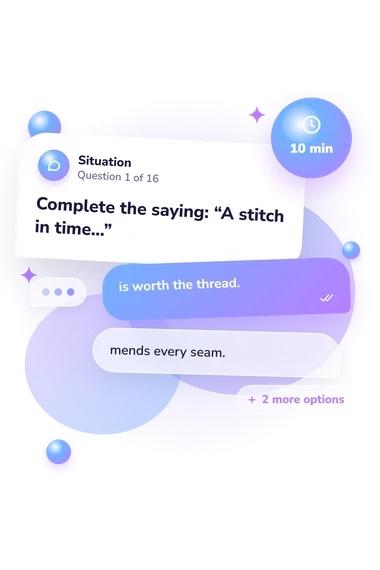
- is worth the thread.
- mends every seam.
- saves nine.
- keeps trouble away.
- Great minds think alike.
- Two heads are better than one.
- Birds of a feather flock together.
- If it isn’t broken, don’t fix it.
- when guided by wisdom.
- than the loudest voice.
- in the hands of a scholar.
- than the sword.
Finish the Saying Quiz - Description and methodology of the test
Readers who enjoy language or everyday expressions can use the Finish the Saying Quiz with Answers to check how accurately they recognize familiar proverbs and match them to practical situations. The format combines completing sayings with choosing the expression that fits an everyday situation, making it a focused language-trivia activity rather than a measure of broad verbal ability. The result gives a concise profile of saying knowledge and highlights expressions worth revisiting.
What This Assessment Explores
This assessment examines knowledge of familiar English proverbs and sayings. Some items remove an expression’s ending, while others describe an everyday situation and ask which saying fits. Its complete-the-saying quiz format combines verbal recall with contextual matching rather than personal opinion.
The situations involve cooperation, local customs, patience, preparation, risk management, appearance versus evidence, and accepting what cannot be changed. They test wording recognition and a saying’s everyday principle.
The result is organized as Finish the Saying Knowledge (0-16), with these displayed bands:
- Building familiarity (0-6) indicates some recognition, with occasional confusion about wording or meaning.
- Developing knowledge (7-12) indicates recognition of many common phrases, with some gaps among similar expressions.
- Strong knowledge (13-16) indicates accurate completion and interpretation of most included sayings.
It is trivia, not a measure of intelligence or overall language ability.
Methodology and Evidence Base
Each item uses a multiple-choice response format with one familiar saying or scenario followed by four answer choices. The task is to select the completion or interpretation that best matches the established expression; distractors are plausible alternatives, so knowing a related proverb is not always enough. Results are reported on the displayed knowledge scale, with the bands above describing increasing performance; the questionnaire does not state a separate weighting rule.
The closest support is the proverb-comprehension study by Nippold and Haq, which examined how familiarity and concreteness affect proverb comprehension. A related study by Nippold, Uhden, and Schwarz connects proverb explanation with development across adolescence and adulthood. Their findings make familiarity, contextual interpretation, and everyday proverb meaning relevant lenses here; this quiz is conceptually consistent with those studies, not an adaptation of either.
Viewed in context, the questionnaire functions as a proverb knowledge test and focused exercise in everyday saying recognition. It is not presented as norm-standardized, and results may vary with cultural exposure, education, memory, current attention, and familiarity with the expressions. Reviewing missed items gives the profile its main self-reflective value.
- Nippold, Marilyn A., and Faridah Serajul Haq. “Proverb Comprehension in Youth: The Role of Concreteness and Familiarity.” Journal of Speech and Hearing Research, vol. 39, no. 1, 1996, pp. 166-176. 10.1044/jshr.3901.166
- Nippold, Marilyn A., Linda D. Uhden, and Ilsa E. Schwarz. “Proverb Explanation Through the Lifespan: A Developmental Study of Adolescents and Adults.” Journal of Speech, Language, and Hearing Research, vol. 40, no. 2, 1997, pp. 245-253. 10.1044/jslhr.4002.245
- Gorham, Donald R. “Use of the Proverbs Test for Differentiating Schizophrenics from Normals.” Journal of Consulting Psychology, vol. 20, no. 6, 1956, pp. 435-440. 10.1037/h0042949
Updated: