
Social Studies Quiz
How the Scales are Structured
Who Usually Takes This Test?
See How You Compare
Below is a preview of how scores are typically distributed across each scale.
Example Questions From the Test
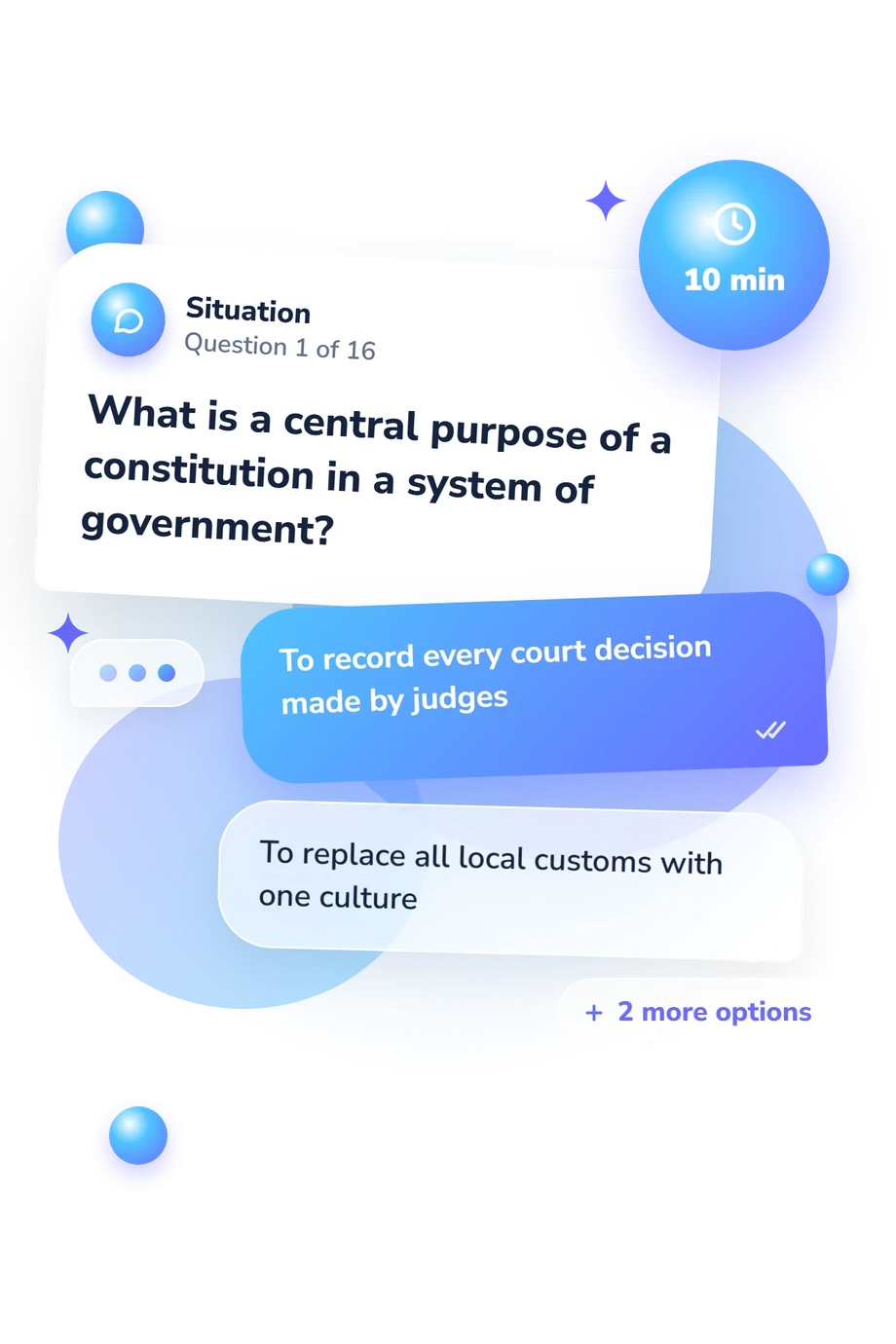
- To record every court decision made by judges
- To replace all local customs with one culture
- To set prices for all goods sold in the country
- To establish government powers, structures, and limits
- Rivers guaranteed that settlements would never experience floods
- River valleys prevented all contact with neighboring societies
- Rivers provided water, transportation routes, and fertile soil
- River locations eliminated the need for farming and trade
- A general rise in prices that reduces money's purchasing power
- A permanent increase in the quality of every product
- A sustained decrease in the number of available jobs
- A decline in trade between two particular businesses
Social Studies Quiz - Description and methodology of the test
Students, adult learners, and curious readers who want a structured check of foundational knowledge can use this social studies quiz to see how well they understand the material and where their learning stands. The online format lets this social studies online quiz combine recall with application, evidence evaluation, and short-scenario reasoning.
What This Assessment Explores
Questions cover four connected areas rather than one narrow subject. This questionnaire, presented as a social studies practice test, checks whether concepts transfer to short situations, evidence judgments, and practical examples. Its thematic groups are:
- Civics shows how well you recognize government structures, constitutional principles, participation, and rule of law.
- History shows how you use chronology, sources, perspective, and cause-and-effect reasoning.
- Geography shows whether you can apply coordinates, hemispheres, movement, and place relationships.
- Economics shows how you understand scarcity, opportunity cost, inflation, supply, demand, and market effects.
The result is reported as Social Studies Knowledge: 0-16. Building Basics (0-6) means core concepts would benefit from further review and practice; Developing Knowledge (7-12) reflects many foundational ideas with some gaps; Strong Foundation (13-16) indicates consistently accurate understanding across the sampled material. These descriptors are educational, not a formal grade-level assessment.
Methodology and Evidence Base
Each item presents a short question or scenario with four answer choices. The tasks ask respondents to identify constitutional principles, interpret historical evidence, apply economic concepts, and use geographic terms. The score summarizes performance across the items; higher bands indicate more consistently accurate responses, while no separate domain scores are reported.
Swiggett and Tannenbaum (2011) offer the closest supporting comparison because they treat social studies competence as content knowledge combined with reasoning demands. This questionnaire is conceptually consistent with that work, but it is not an adaptation of the licensure assessment. The C3 Framework connects civics, economics, geography, and history with inquiry, evidence, and disciplinary thinking, supporting the cross-domain structure.
As a social studies assessment, this questionnaire is interpreted with general guidance from the AERA, APA, and NCME Standards; Plake and Wise (2014) likewise emphasize that interpretations should fit an assessment’s purpose and evidence. The displayed bands are educational categories for this questionnaire. Guessing, reading comprehension, prior instruction, and current familiarity can affect self-administered results, and a single total score cannot show which subject area caused the outcome.
- Swiggett, Wanda D., and Richard J. Tannenbaum. Validity Evidence to Support the Revision of a Licensure Assessment for Middle School Social Studies Teachers: A Job-Analytic Approach. ETS Research Memorandum No. RM-11-11. Princeton, NJ: Educational Testing Service, 2011.
- Swan, Kathy, Susan Griffin, S. G. Grant, and John Lee. The College, Career, and Civic Life (C3) Framework for Social Studies State Standards: Guidance for Enhancing the Rigor of K-12 Civics, Economics, Geography, and History. Silver Spring, MD: National Council for the Social Studies, 2013.
- American Educational Research Association, American Psychological Association, and National Council on Measurement in Education. Standards for Educational and Psychological Testing. Washington, DC: American Educational Research Association, 2014.
- Plake, Barbara S., and Lauress L. Wise. What Is the Role and Importance of the Revised AERA, APA, NCME Standards for Educational and Psychological Testing? Educational Measurement: Issues and Practice, 33(4), 4-12, 2014. 10.1111/emip.12045
Updated: