
PAD Quiz
How the Scales are Structured
Who Usually Takes This Test?
See How You Compare
Below is a preview of how scores are typically distributed across each scale.
Example Questions From the Test
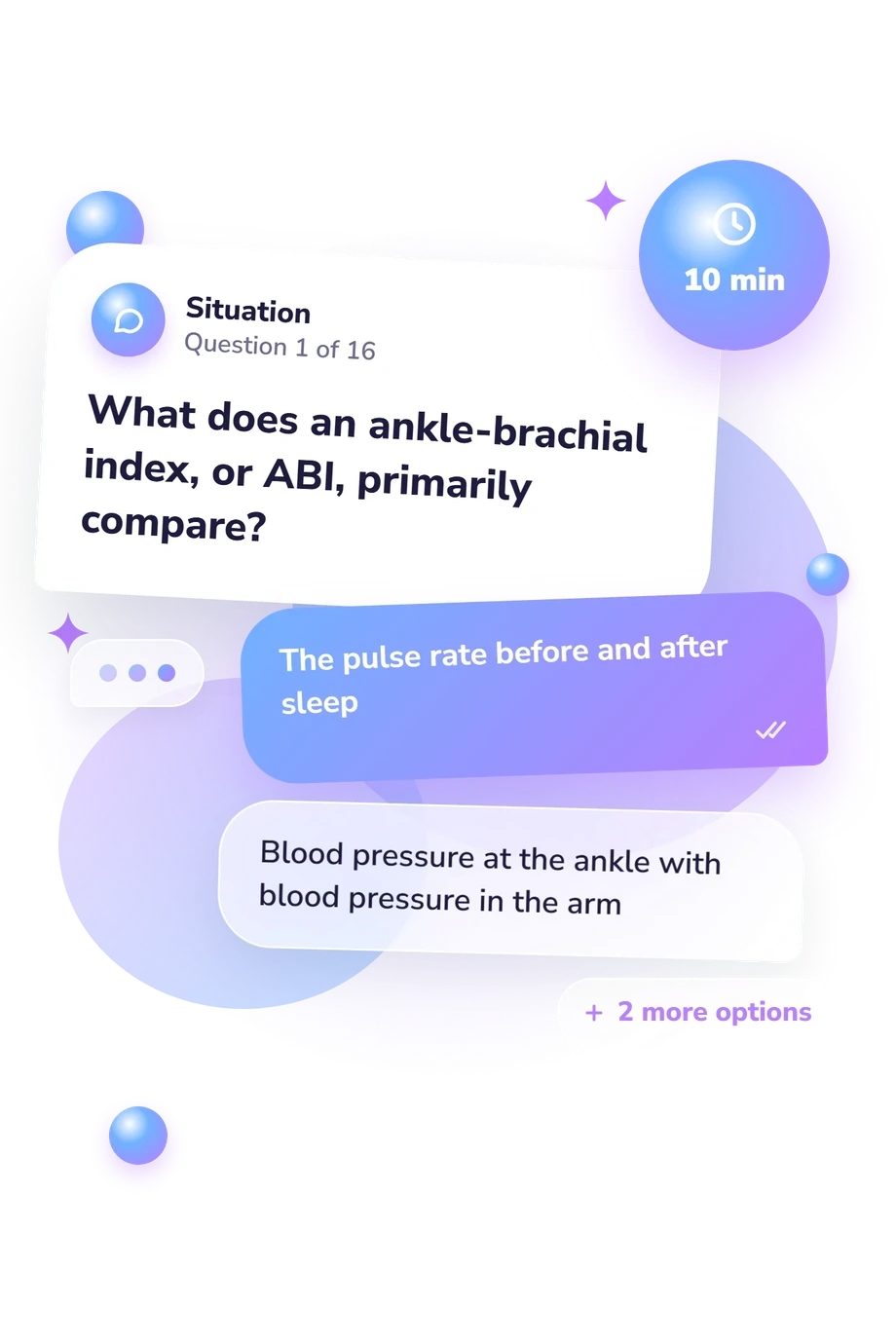
- The pulse rate before and after sleep
- Blood pressure at the ankle with blood pressure in the arm
- The circumference of the ankle and upper arm
- Blood oxygen in the fingers with oxygen in the toes
- Cover it and ignore it unless it becomes painful
- Arrange prompt assessment by a healthcare professional
- Walk barefoot to expose it to the air
- Apply strong heat directly to increase circulation
- Normal-looking skin completely rules out PAD
- PAD always causes severe pain from its earliest stage
- PAD symptoms occur only in people older than 80
- Some people with PAD have no noticeable leg symptoms
PAD Quiz - Description and methodology of the test
People preparing for a clinician conversation may use this PAD knowledge test to organize questions about symptoms, tests, or prevention. The PAD Quiz suits readers deciding what to review before discussing a concern with a clinician. Its focused format keeps the decision practical, whether the reader is learning about PAD for the first time or revisiting familiar information.
What This Assessment Explores
Peripheral artery disease affects arteries supplying the limbs, and these questions focus on how reduced arterial flow presents and why it matters beyond the legs. This peripheral artery disease quiz tests practical understanding of PAD rather than taking a medical history.
Topics include ABI, claudication, asymptomatic disease, foot findings, atherosclerosis, modifiable risks, walking therapy, revascularization, foot care, and urgent signs of acute limb ischemia. The items also test whether the respondent can identify appropriate next steps.
The result is organized under one educational scale, Peripheral Artery Disease Knowledge (0-16). Its displayed bands are:
- Foundation to build (0-6) indicates that the respondent should review PAD’s causes, characteristic symptoms, testing, and urgent warning signs.
- Developing knowledge (7-12) indicates that many essentials are understood, while prevention, symptom patterns, or treatment may need review.
- Strong knowledge (13-16) indicates a well-rounded understanding of PAD and responses.
Methodology and Scientific Basis
Each item presents a clinical or educational scenario, definition, or factual question with four answer choices. Selecting the best option samples recognition and decision-oriented knowledge across PAD topics rather than symptoms directly. The output is an educational score, not a norm-referenced clinical measurement.
PADKQ (Pedras et al., 2023) is the closest named knowledge reference. This questionnaire is an educational knowledge check conceptually consistent with that work and with Felix et al.’s (2024) discussion of PAD awareness and disease-related knowledge, not a validated adaptation of either source. The 2024 ACC/AHA multisociety guideline supports the clinical framing of ABI, risk-factor management, exercise, foot protection, revascularization, and emergency symptoms.
For self-reflection, this PAD knowledge assessment can help a reader choose topics for a clinician conversation. The questionnaire has no stated validated normative standardization or clinical scoring algorithm; interpretation stays with the answers represented in its educational score. Honest responses, current context, and familiarity with medical terms can affect performance. The result is unvalidated and is not a diagnosis or personal risk assessment.
- Susana Pedras, Rafaela Oliveira, Carlos Veiga, Ivone Silva. What Do Patients Know About Peripheral Arterial Disease? A Knowledge Questionnaire. Portuguese Journal of Cardiac Thoracic and Vascular Surgery. 2023;29(4):31-41. 10.48729/pjctvs.263
- Carolina Machado de Melo Felix, Danielle Aparecida Gomes Pereira, Maureen Pakosh, Lilian Pinto da Silva, Gabriela Lima de Melo Ghisi. A Scoping Review of Measurement Tools Evaluating Awareness and Disease-Related Knowledge in Peripheral Arterial Disease Patients. Journal of Clinical Medicine. 2024;13(1):107. 10.3390/jcm13010107
- Heather L. Gornik, Herbert D. Aronow, Philip P. Goodney, Shipra Arya, Luke Packard Brewster, Lori Byrd, Venita Chandra, Douglas E. Drachman, Jennifer M. Eaves, Jonathan K. Ehrman, John N. Evans, Thomas S. D. Getchius, J. Antonio Gutiérrez, Beau M. Hawkins, Connie N. Hess, Karen J. Ho, W. Schuyler Jones, Esther S. H. Kim, Scott Kinlay, Lee Kirksey, Debra Kohlman-Trigogoff, Chandler A. Long, Amy West Pollak, Saher S. Sabri, Lawrence B. Sadwin, Eric A. Secemsky, Maya Serhal, Mehdi H. Shishehbor, Diane Treat-Jacobson, Luke R. Wilkins. 2024 ACC/AHA/AACVPR/APMA/ABC/SCAI/SVM/SVN/SVS/SIR/VESS Guideline for the Management of Lower Extremity Peripheral Artery Disease: A Report of the American College of Cardiology/American Heart Association Joint Committee on Clinical Practice Guidelines. Circulation. 2024;149(24):e1313-e1410. 10.1161/CIR.0000000000001251
Updated: