
Arteries Quiz
How the Scales are Structured
Who Usually Takes This Test?
See How You Compare
Below is a preview of how scores are typically distributed across each scale.
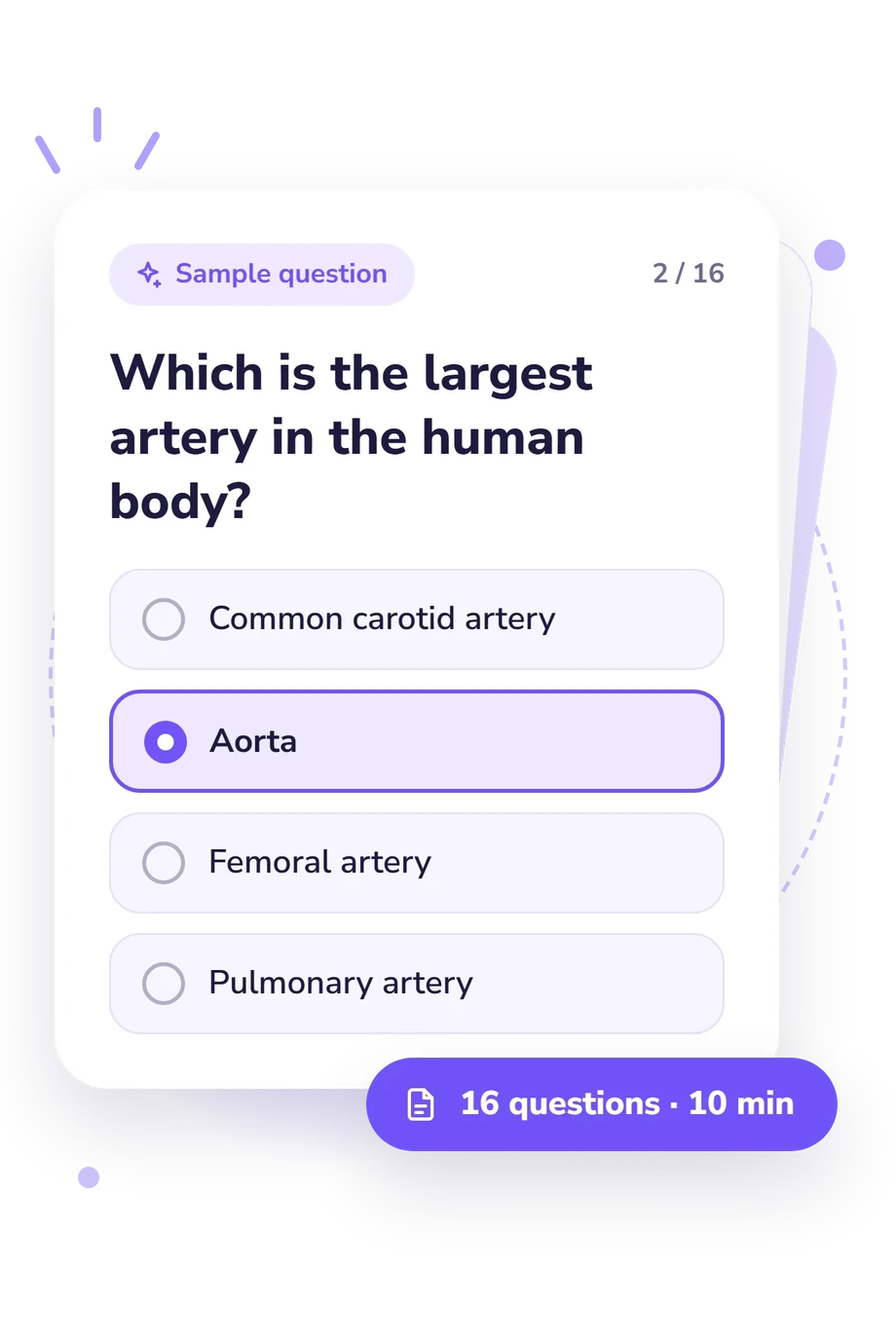
Example Questions From the Test
- Common carotid artery
- Aorta
- Femoral artery
- Pulmonary artery
- The forearm and hand
- The abdominal wall
- The brain and eye
- The lower leg and foot
- A vessel that returns blood from tissues to the heart
- A vessel that always carries oxygen-rich blood
- A vessel that carries blood away from the heart
- A microscopic vessel where most gas exchange occurs
Arteries Quiz - Description and methodology of the test
Students, trainees, and curious learners who want to check their grasp of arterial anatomy can use Arteries Quiz as a focused review of how major vessels are named, connected, and located. The result turns that review into a record of which topics were answered correctly and which may merit further attention. It also works as an artery anatomy quiz for revisiting routes from the heart to regional tissues.
What the Questionnaire Measures
The assessment focuses on structural and regional knowledge, not symptoms or personal health. Questions move from arterial flow and vessel-wall layers to the aorta, pulmonary arteries, coronary circulation, carotid supply, limb vessels, leg pathways, and collateral connections such as the Circle of Willis. In this quiz about the arteries of the body, learners connect names with locations, branches, continuations, and pulse sites.
These are the result levels for Arteries Knowledge, which ranges from 0 to 16 correct responses:
- Foundations to build (0-6) indicates that basic vessel structure, routes, or major branches need further review.
- Developing knowledge (7-12) indicates that many core relationships are understood, with some anatomical gaps remaining.
- Strong knowledge (13-16) indicates a well-developed grasp of major arterial anatomy and common practical applications.
Together, these levels help learners choose whether to review foundations, trace branches, or apply anatomy.
Methodology and Scientific Basis
Each item uses a single-best-answer format with four alternatives. Prompts ask the learner to define an artery, identify a vessel's origin or continuation, locate it in a body region, or apply an anatomical relationship to a practical situation. In practice, this arteries labeling quiz tests vessel names and pathways, not labels on an annotated image.
The displayed result counts correct responses and describes performance on the arterial knowledge tested here. It directs review toward identifying arteries, tracing branches, and relating vessels to body regions rather than measuring complete anatomical ability.
Gray's Anatomy for Students is a content reference for vessel walls, branches, regional relationships, and circulation; it does not provide validation evidence for this questionnaire. An anatomy-assessment study by Vasan and colleagues compares multiple-choice with open-ended assessment, offering general context about formats rather than validation, norms, or authorship of this questionnaire.
Interpretation stays tied to performance on tested items involving major vessels, routes, branches, and relationships. Memory, preparation, wording, and attention affect performance, so a strong result reflects knowledge shown in this format, not clinical competence.
- Richard L. Drake, A. Wayne Vogl, and Adam W. M. Mitchell. Gray's Anatomy for Students. 5th ed. Elsevier; 2023.
- Cheryl A. Melovitz Vasan, David O. DeFouw, Bart K. Holland, and Nagaswami S. Vasan. Analysis of testing with multiple choice versus open-ended questions: Outcome-based observations in an anatomy course. Anatomical Sciences Education. 2018;11(3):254-261. 10.1002/ase.1739
Updated: