
What Is My Vibe Quiz
How the Scales are Structured
Who Usually Takes This Test?
See How You Compare
Below is a preview of how scores are typically distributed across each scale.
Example Questions From the Test
- A textured cardigan in an earthy shade
- A tailored coat with clean lines and minimal detailing
- An oversized knit that feels soft and reassuring
- A sharply colored jacket with an unexpected silhouette
- A recognizable shape with one surprising color or detail
- Soft texture and the feeling that it will age comfortably
- An unconventional form, intense color, or dramatic pattern
- Subtle construction that blends easily with what I own
- A lamp with a plain geometric form and no visible ornament
- A colorful lamp shaped like an unexpected object
- A clean-lined lamp softened by a subtle texture or warm finish
- A traditional lamp with a fabric shade and familiar detailing
What Is My Vibe Quiz - Description and methodology of the test
For readers who want to understand the visual impression they create, the What Is My Vibe Quiz turns an abstract sense of style into a readable profile. It works as a vibe quiz for comparing preferences in rooms, clothing, objects, lighting, and imagery. The result shows which qualities feel central and which appear occasionally, giving self-reflection a more concrete shape without treating style as a fixed identity.
What This Assessment Explores
Rather than measuring artistic skill or personality broadly, the questionnaire samples visual preference through choices about interiors, clothing, objects, lighting, and atmosphere. If you are wondering what vibe you give off, the profile identifies qualities that recur across your selections.
The result is organized around four dimensions:
- Bold & Expressive (0-12) measures visible self-expression and contrast: Quiet Impact (0-4), Selective Statement (5-8), Bold Signature (9-12).
- Clean & Minimal (0-12) measures clarity and open space: Layered Preference (0-4), Edited Balance (5-8), Minimal Core (9-12).
- Cozy & Grounded (0-12) measures warmth and tactile comfort: Comfort as an Accent (0-4), Inviting Balance (5-8), Cozy Core (9-12).
- Dreamy & Romantic (0-12) measures nostalgia and imagination: Occasional Whimsy (0-4), Soft Imagination (5-8), Dreamy Core (9-12).
Together, these dimensions answer what's my vibe with room for a blended profile rather than one fixed style.
Methodology and Scientific Basis
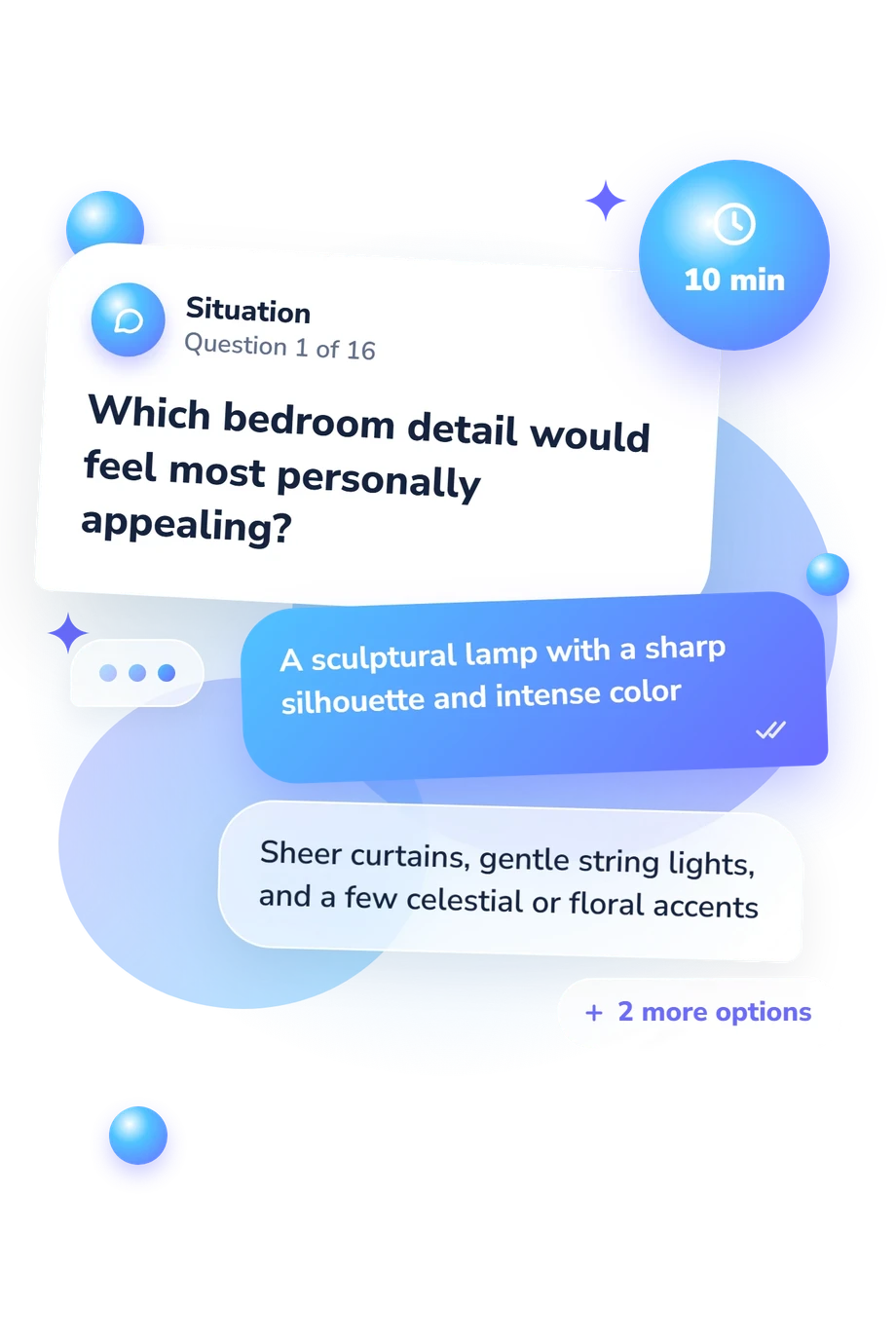
Each item presents a brief visual or lifestyle situation followed by four distinct answer choices. Selecting the option that feels most appealing makes this a self-report questionnaire: the displayed result summarizes the pattern of choices and assigns the corresponding catalogue band. The range shown for a scale does not establish an additional points rule.
Conceptually, the questionnaire is consistent with Coburn et al. (2020), which links interior preferences with psychological responses to spatial qualities. Eysenck and Hawker (1994) contributes an empirical taxonomy of visual aesthetic preferences, while Blijlevens et al. (2017) examines aesthetic pleasure in designed artifacts. These sources support the focus on visual preference, but the questionnaire is not presented as an adaptation of any one of them.
As a way to explore what's your vibe, the tool is most useful for comparing tendencies across situations. It provides descriptive bands, not population norms, and has no stated standardized norming. Answers may shift with mood, context, recent experiences, and self-perception, so the result is a current snapshot rather than a permanent identity.
- Coburn, A., Vartanian, O., Kenett, Y. N., Nadal, M., Hartung, F., Hayn-Leichsenring, G., Navarrete, G., González-Mora, J. L., & Chatterjee, A. (2020). Psychological and neural responses to architectural interiors. Cortex, 126, 217-241. 10.1016/j.cortex.2020.01.009
- Eysenck, H. J., & Hawker, G. W. (1994). The taxonomy of visual aesthetic preferences: An empirical study. Empirical Studies of the Arts, 12(1), 95-101. 10.2190/53UF-QC5K-QGF4-6WXB
- Blijlevens, J., Hekkert, P., Thurgood, C., Chen, L.-L., & Allen Whitfield, T. W. (2017). The aesthetic pleasure in design scale: The development of a scale to measure aesthetic pleasure for designed artifacts. Psychology of Aesthetics, Creativity, and the Arts, 11(1), 86-98. 10.1037/aca0000098
Updated: