
What Drink Am I Quiz
How the Scales are Structured
Who Usually Takes This Test?
See How You Compare
Below is a preview of how scores are typically distributed across each scale.
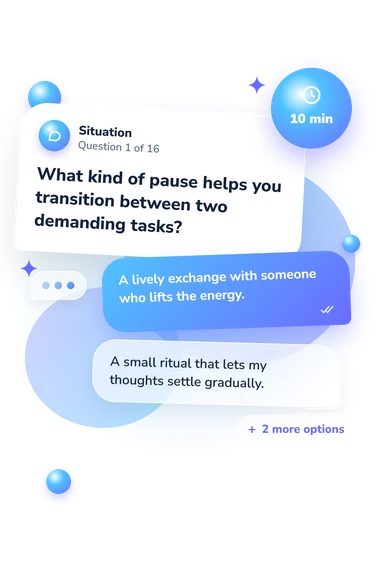
Example Questions From the Test
- A lively exchange with someone who lifts the energy.
- A small ritual that lets my thoughts settle gradually.
- A brief stretch or change of surroundings.
- A tidy reset of my space and priorities.
- A nuanced conversation that explores several interpretations.
- A short list of concrete strengths and concerns.
- A direct verdict that helps me decide my next move.
- A few imaginative possibilities I had not considered.
- Sketch several possible routes before committing to one.
- Choose the most important target and push it forward immediately.
- Pause until the missing context becomes clearer.
- Gather the group and assign a few quick priorities.
What Drink Am I Quiz - Description and methodology of the test
Readers who enjoy personality-style questionnaires can use the What Drink Am I Quiz to compare how they respond across ordinary situations. In this drink personality quiz, the result organizes patterns in pace, social contact, experimentation, decisiveness, and calm routines, helping a person notice which responses recur and which appear more situational.
What This Assessment Explores
As a what drink are you quiz, the assessment explores four drink profiles. Prompts cover pace, novelty, social contact, action, reflection, and presentation. The highest affinity leads; scores within one point create a blend.
The four result dimensions are:
- Espresso 0-12 measures concentrated energy and directness; Background Note 0-4, Clear Accent 5-8, and Signature Match 9-12 show increasing fit with decisive action.
- Smoothie 0-12 measures mix-and-match energy and useful variety; Background Note 0-4, Clear Accent 5-8, and Signature Match 9-12 show increasing fit with experimentation.
- Sparkling Mocktail 0-12 measures social creativity, playful presentation, and celebratory flourishes; Background Note 0-4, Clear Accent 5-8, and Signature Match 9-12 show increasing fit with those qualities.
- Tea 0-12 measures thoughtful pacing, attentive listening, nuance, and restorative rituals; Background Note 0-4, Clear Accent 5-8, and Signature Match 9-12 show increasing fit with these qualities.
Methodology and Evidence Base
That structure makes this questionnaire a what kind of drink am i quiz about which drink best reflects your usual responses, while turning situational self-report into a comparative profile. Each prompt offers four response options describing a plausible preference or reaction. Choose the option closest to your usual tendency. The display reports four affinity totals; it does not establish a universal point value for each answer.
The four-profile format can be compared only broadly with trait approaches such as the Big Five Inventory-2 (Soto & John, 2017) and the framework discussed by John, Naumann, and Soto (2008); those sources do not validate, standardize, or explain these drink profiles. This questionnaire is not the BFI-2 or an adaptation of it. Brown and Maydeu-Olivares (2011) note that forced-choice formats require careful interpretation.
Read the result as a current self-report snapshot: the displayed bands indicate relative fit within this questionnaire rather than clinical severity thresholds, while mood, context, self-awareness, and response style can affect answers.
- Soto, Christopher J., & John, Oliver P. (2017). The next Big Five Inventory (BFI-2): Developing and assessing a hierarchical model with 15 facets to enhance bandwidth, fidelity, and predictive power. Journal of Personality and Social Psychology, 113(1), 117-143. 10.1037/pspp0000096
- John, Oliver P., Naumann, Laura P., & Soto, Christopher J. (2008). Paradigm shift to the integrative Big Five trait taxonomy: History, measurement, and conceptual issues. In Oliver P. John, Richard W. Robins, & Lawrence A. Pervin (Eds.), Handbook of Personality: Theory and Research (3rd ed., pp. 114-158). Guilford Press.
- Brown, Anna, & Maydeu-Olivares, Alberto. (2011). Item Response Modeling of Forced-Choice Questionnaires. Educational and Psychological Measurement, 71(3), 460-502. 10.1177/0013164410375112