
6th Grade Quiz
How the Scales are Structured
Who Usually Takes This Test?
See How You Compare
Below is a preview of how scores are typically distributed across each scale.
Example Questions From the Test
- Liquid water passing through tiny openings in the glass
- Ice inside the glass melting through its solid surface
- Oxygen in the surrounding air changing into liquid water
- Water vapor in the air condensing on the cold surface
- The Andes Mountains
- The Nile River
- The Gobi Desert
- The Tigris River
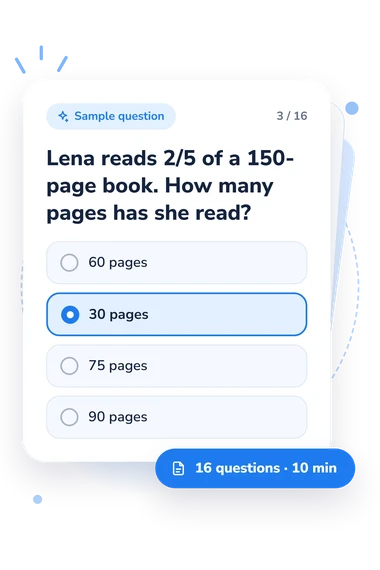
- 60 pages
- 30 pages
- 75 pages
- 90 pages
6th Grade Quiz - Description and methodology of the test
Learners, parents, and educators can use this 6th grade quiz to review performance on sampled middle-school concepts across several subjects. Before further practice, classroom discussion, or study planning, this quiz for 6th graders lets learners work through the sampled items. The result summarizes performance across sampled concepts without identifying separate subject scores.
What This Assessment Measures
The questionnaire samples knowledge rather than extended writing. Items cover mathematics, science, English language arts, and social studies, asking learners to calculate, interpret, recall, classify, or apply concepts. Together, questions for a 6th-grade quiz offer a compact overview of sampled knowledge, not a complete academic record.
The result appears on the 6th Grade Knowledge scale, ranging from 0-16. Its bands are Foundations to build (0-6), Developing knowledge (7-12), and Strong knowledge (13-16). The catalogue treats this as a snapshot, not formal grade-level placement or a subject-by-subject assessment.
The questions represent these broad content areas:
- Mathematics items sample fractions, ratios, area, signed numbers, and quantitative reasoning.
- Science items cover physical processes, seasons, ecosystems, variables, and cause-and-effect relationships.
- English language arts items address grammar, vocabulary, main ideas, and figurative language.
- Social studies items sample geography, ancient civilizations, government, and economic decisions.
Methodology and Content Frameworks
Each item in this quiz for grade 6 presents a short prompt and four answer choices, asking the respondent to select the best option rather than write an extended response. The selected answers combine performance across domains into one displayed score; the questionnaire states no further weighting or per-answer scoring rule.
The content frameworks supporting this quiz for grade 6 are Common Core State Standards (2010), the National Research Council framework, and the C3 Framework. Common Core addresses mathematics and language expectations, while the latter frameworks cover science and social studies. They support item coverage, not this questionnaire's format or empirical quality. Mislevy, Steinberg, and Almond (2003) describe evidence assembled across multiple tasks, but that model does not validate this online questionnaire.
This online selected-response questionnaire has no published norming or validation study. Its displayed bands are descriptive, not norm-referenced. Interpret the selected answers to 6th-grade quiz questions as performance on sampled concepts: a higher result suggests stronger performance, while a lower one points to review. Prior exposure to the content, reading fluency, attention, and test-taking conditions can affect choices, so use the score to guide review rather than define overall attainment.
- National Governors Association Center for Best Practices, Council of Chief State School Officers. Common Core State Standards for Mathematics; Common Core State Standards for English Language Arts & Literacy in History/Social Studies, Science, and Technical Subjects. Washington, DC: National Governors Association Center for Best Practices and Council of Chief State School Officers, 2010.
- National Research Council. A Framework for K-12 Science Education: Practices, Crosscutting Concepts, and Core Ideas. Washington, DC: The National Academies Press, 2012. 10.17226/13165
- Swan, Kathy, Keith C. Barton, Stephen Buckles, Flannery Burke, Jim Charkins, S. G. Grant, Susan W. Hardwick, John Lee, Peter Levine, Meira Levinson, Anand Marri, Chauncey Monte-Sano, Robert Morrill, Karen Thomas-Brown, Cynthia Tyson, Bruce VanSledright, and Merry Wiesner-Hanks. The College, Career, and Civic Life (C3) Framework for Social Studies State Standards: Guidance for Enhancing the Rigor of K-12 Civics, Economics, Geography, and History. Silver Spring, MD: National Council for the Social Studies, 2013.
- Mislevy, Robert J., Linda S. Steinberg, and Russell G. Almond. “On the Structure of Educational Assessments.” Measurement: Interdisciplinary Research and Perspectives 1, no. 1 (2003): 3-62. 10.1207/S15366359MEA0101_02
Updated: