
Genetics Quiz
How the Scales are Structured
Who Usually Takes This Test?
See How You Compare
Below is a preview of how scores are typically distributed across each scale.
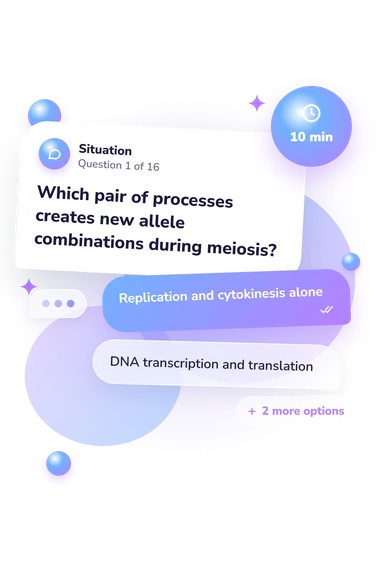
Example Questions From the Test
- Replication and cytokinesis alone
- DNA transcription and translation
- Binary fission and budding
- Crossing over and independent assortment
- 23
- 46
- 92
- 44
- Two genetically identical diploid cells
- Four haploid products with genetic variation
- One diploid cell with twice as much DNA
- Two haploid products that are always genetically identical
Genetics Quiz - Description and methodology of the test
People who want to check their understanding of introductory heredity can use the genetics quiz as a focused learning exercise, whether they are studying biology or revisiting school-level concepts. It is intended for readers who want a clear snapshot of what they can apply, not just recognize. As a biology quiz on genetics, it can reveal strengths and suggest topics that deserve another look.
What This Assessment Explores
The questions connect molecular genetics with inheritance. They ask respondents to distinguish genes, alleles, genotypes, phenotypes, chromosomes, DNA, and mRNA; reason through meiosis and independent assortment; solve simple probability problems; and separate inherited variation from environmental effects or body-cell mutations. The assessment therefore suits learners checking foundational biology knowledge.
The result works as a genetics knowledge test by showing which concepts are secure and which merit review. It is organized as Genetics Knowledge (0-16), with these displayed bands:
- Foundations to Build (0-6) indicates that genes, alleles, cell division, or inheritance patterns need review.
- Developing Knowledge (7-12) indicates that many core concepts are understood, although some distinctions need reinforcement.
- Strong Knowledge (13-16) indicates solid command of introductory genetics and accurate application of key principles.
These are educational performance descriptions, not measures of medical condition, genetic risk, or overall biology ability.
Methodology and Scientific Basis
Each item uses a fixed-choice question stem with four answer choices and one best response. The topics move among definitions, comparisons, inheritance calculations, sequence reasoning, and applied scenarios, so the result reflects conceptual understanding rather than confidence or familiarity with terminology.
The closest conceptual reference is Genetics Concept Assessment (Smith et al., 2008). The content also overlaps with Bowling et al. (2008) on genetics literacy and with Kalas et al. (2013) on meiosis concepts. These works serve as comparison points for content and construct; this online questionnaire should not be described as a reproduction or adaptation of those published instruments.
Scoring is presented as a total from the keyed responses and mapped to the displayed bands. This online version has no stated standardized norm group or published reliability estimate, so the bands function as educational descriptors rather than population cutoffs. Current study context, reading precision, and guessing can affect performance. As a genetics online quiz, it is most useful for directing review toward concepts that need practice.
- Smith, Michelle K., William B. Wood, and Jennifer K. Knight. 2008. “The Genetics Concept Assessment: A New Concept Inventory for Gauging Student Understanding of Genetics.” CBE-Life Sciences Education 7(4): 422-430. 10.1187/cbe.08-08-0045
- Bowling, Bethany Vice, Erin E. Acra, Lihshing Wang, Melanie F. Myers, Gary E. Dean, Glenn C. Markle, Christine L. Moskalik, and Carl A. Huether. 2008. “Development and Evaluation of a Genetics Literacy Assessment Instrument for Undergraduates.” Genetics 178(1): 15-22. 10.1534/genetics.107.079533
- Kalas, Pamela, Angie O’Neill, Carol Pollock, and Gulnur Birol. 2013. “Development of a Meiosis Concept Inventory.” CBE-Life Sciences Education 12(4): 655-664. 10.1187/cbe.12-10-0174