
Psychology Career Quiz
How the Scales are Structured
Who Usually Takes This Test?
See How You Compare
Below is a preview of how scores are typically distributed across each scale.
Example Questions From the Test
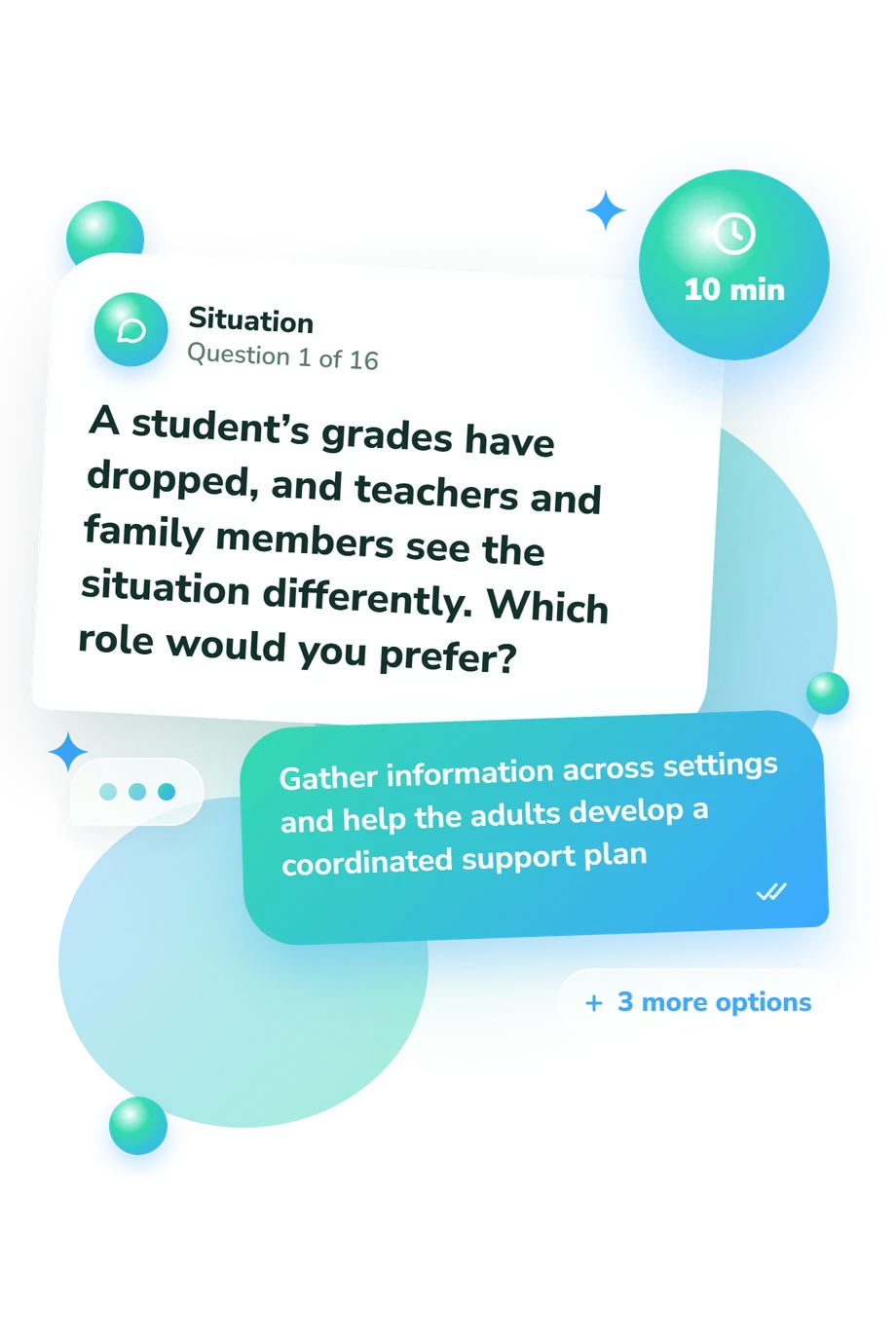
- Gather information across settings and help the adults develop a coordinated support plan
- Offer the student occasional encouragement while another professional coordinates the plan
- Contribute ideas in a meeting but avoid an ongoing school-based role
- Explore the issue through research without becoming involved in the individual case
- Work directly with the school to monitor students’ needs and refine the support plan
- Help interpret the program data without taking part in student support
- Assist with evaluation while also consulting with school staff about implementation
- Choose a project centered on adults or workplaces instead
- I would be most interested in turning the case into a broader research question
- I would enjoy forming a careful, revisable understanding of the person’s needs
- I would prefer focusing on systems or workplace factors rather than an individual case
- I would find the case interesting but prefer a supporting role in planning care
Psychology Career Quiz - Description and methodology of the test
Designed for people exploring study or work directions in psychology, the psychology career quiz links everyday preferences to four broad professional pathways. As a quiz about which psychology field is right for me, it can help you compare responsibilities and kinds of impact before giving closer attention to a setting or course of study. The result is a starting map for reflection, not a prediction of a fixed career outcome.
What the Test Measures
The questionnaire measures current affinity rather than competence, eligibility, or a settled occupational identity. Its scenarios contrast sustained helping, school collaboration, workplace systems, and evidence-focused inquiry, so it suits people exploring careers in psychology through this quiz and comparing settings. The four result scales are:
- Clinical & Counseling Psychology (0-12) reflects interest in assessment, therapeutic relationships, and sustained clinical training.
- Industrial-Organizational Psychology (0-12) reflects interest in workplaces, employee experience, selection, leadership, and organizational systems.
- Research & Academic Psychology (0-12) reflects interest in psychological questions, evidence analysis, and communicating findings.
- School Psychology (0-12) reflects interest in student assessment, consultation, learning support, and collaboration with families and educators.
Across the four scales, the displayed bands are Other priorities (0-4), Meaningful interest (5-8), and Strong affinity (9-12). The highest scale shows the strongest current affinity; scores within one point form a blended result.
Methodology and Evidence Base
Items combine scenarios and preference prompts spanning school, clinical, workplace, and research-related activities, with four responses each. Choices range from direct support and consultation to study design, data analysis, and organizational improvement. This forced-choice format creates a comparative profile rather than a pass-fail result.
The result gives one score for each of the four scales and assigns it to a displayed band. The highest scale represents strongest current affinity, while scores within one point form a blended profile. The quiz can address what psychology career is right for me alongside the 2015 psychology-interest questionnaire, specialty-choice findings from a 2010 study by Wicherts and Vorst, and Holland’s person-environment fit framework, but these sources do not establish that this online profile operationalizes or validates Holland’s classifications.
This profile helps compare possible psychology careers while keeping the result tied to present interests. Its self-report format can be influenced by current goals, self-knowledge, and response bias; it does not establish clinical suitability, job readiness, academic performance, or professional eligibility. The quiz can clarify whether you should major in psychology.
- Bogluț, A., Rizeanu, S., & Burtăverde, V. (2015). Vocational Guidance for Undergraduate Psychology Students. Psychometric Properties of the Questionnaire of Vocational Interests in Psychology. Procedia - Social and Behavioral Sciences, 187, 713-718. 10.1016/j.sbspro.2015.03.133
- Wicherts, J. M., & Vorst, H. C. M. (2010). The relation between specialty choice of psychology students and their interests, personality, and cognitive abilities. Learning and Individual Differences, 20(5), 494-500. 10.1016/j.lindif.2010.01.004
- Holland, J. L. (1997). Making Vocational Choices: A Theory of Vocational Personalities and Work Environments (3rd ed.). Psychological Assessment Resources.
Updated: