
Am I Mexican Quiz
How the Scales are Structured
Who Usually Takes This Test?
See How You Compare
Below is a preview of how scores are typically distributed across each scale.
Example Questions From the Test
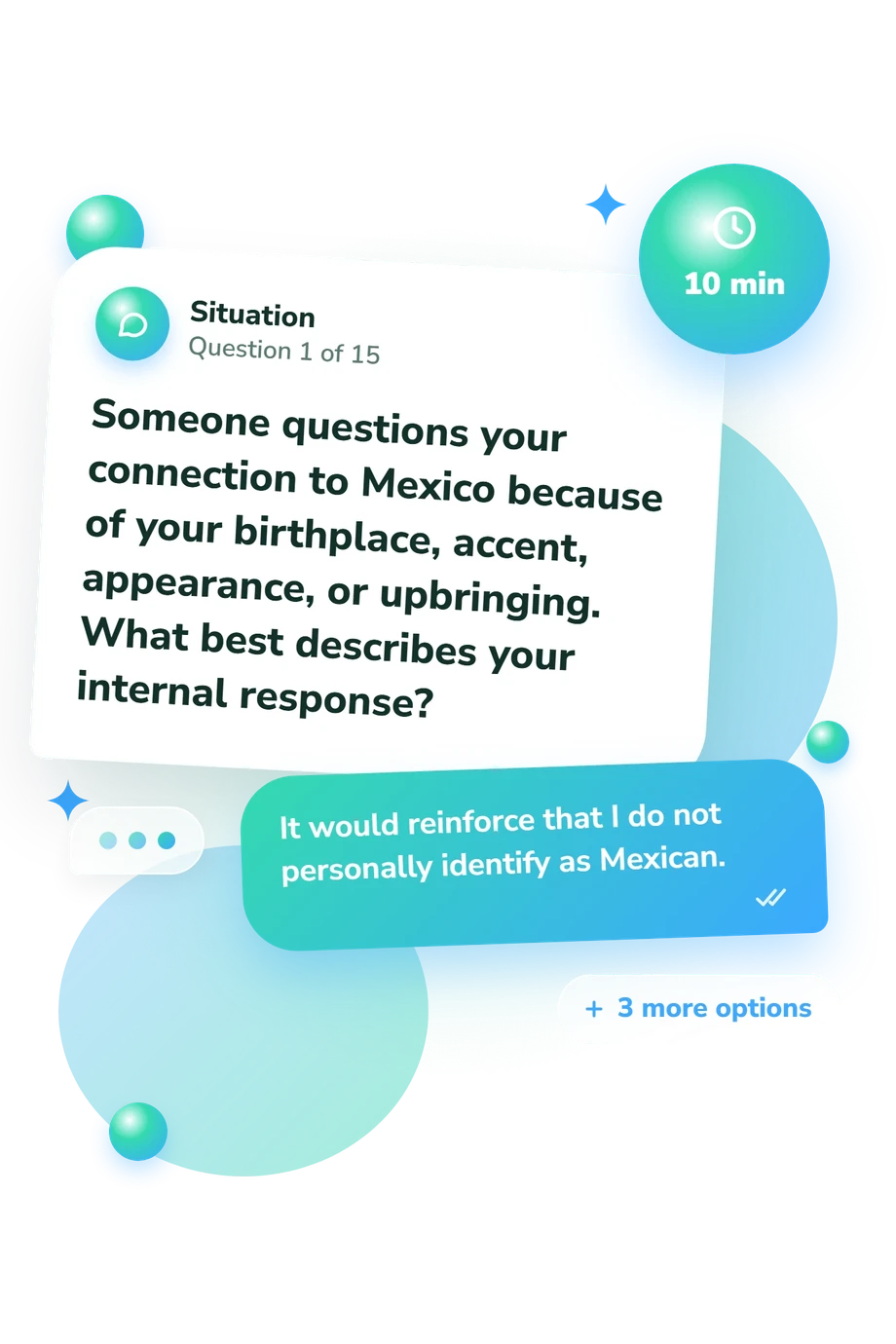
- It would reinforce that I do not personally identify as Mexican.
- I might reconsider how I describe the connection because it is still developing for me.
- I would still regard my Mexican identity as mine, even if the challenge felt uncomfortable.
- I would keep the identity but might explain its particular context or limits.
- I may enjoy it, but it does not carry a particular family or heritage meaning for me.
- I recognize its family history and help keep the recipe or ritual going.
- This situation is unfamiliar because Mexican food traditions are not part of my family context.
- It reminds me of certain relatives, occasions, or family memories.
- A few fragments or possibilities, while being clear about what I do not know.
- Several specific stories, traditions, places, or migration experiences passed through the family.
- Little or nothing, because that connection has not been part of our family narrative.
- A basic account of our roots and at least one meaningful family story.
Am I Mexican Quiz - Description and methodology of the test
People reflecting on how culture, family history, and self-description intersect may use the Am I Mexican Quiz to organize questions that are difficult to answer with one label. It is intended for anyone exploring Mexican identity, including mixed, diasporic, regional, adopted, or evolving backgrounds. Its central question-how Mexican am I?-is explored through the patterns of this how mexican am i quiz rather than an identity verdict.
What This Assessment Explores
This assessment treats Mexican identity as multidimensional, not pass-or-fail. Items cover family stories, customs, language, media, history, community, belonging, and self-description. Results show three perspectives within this are you mexican quiz:
- Cultural Engagement (0-15) reflects participation and familiarity: Occasional engagement (0-5) is limited, Active exploration (6-10) is developing, and Deep engagement (11-15) is recurring and meaningful.
- Family and Heritage Connection (0-15) reflects roots, traditions, and family stories: Limited inherited connection (0-5), Developing heritage connection (6-10), or Strong heritage connection (11-15).
- Personal Belonging and Identification (0-15) reflects self-identification and belonging: Distant identification (0-5), Layered or emerging identification (6-10), or Strong personal identification (11-15).
These bands describe connection, not ancestry, citizenship, authenticity, or a label's legitimacy. Spanish fluency is not required for Mexican identity; language participation can shape engagement, while mixed, adopted, migrant, or incomplete family histories can shape the profile.
Methodology and Scientific Basis
Each item in this how mexican are you quiz presents a situation with four response choices. Options describe different kinds of participation, family connection, or identification, so respondents choose the closest fit rather than a factual answer. Displayed scoring produces three profiles with descriptive bands; scores are not population norms or clinical cutoffs.
Conceptually, the questionnaire is consistent with the Ethnic Identity Scale, which treats ethnic identity as developing and socially situated. It is not an adaptation of that instrument. Cuéllar's cultural-orientation work provides related context, while Knight's research on Mexican American cultural values and White's work on language-related measurement show why these areas require care. These sources support thematic comparison, not validation of this online item set, which is not presented as a standardized or normed instrument.
Read the result as a response to how Mexican you are, not a ranking of authenticity. Family connection may be strong while participation is limited, and belonging may be layered with other identities. Memory and current circumstances can influence self-report, so the result describes perspective rather than establishing ancestry or citizenship.
- White, Rebecca M. B., Adriana J. Umaña-Taylor, George P. Knight, and Katharine H. Zeiders. (2011). Language Measurement Equivalence of the Ethnic Identity Scale With Mexican American Early Adolescents. The Journal of Early Adolescence, 31(6), 817-852. 10.1177/0272431610376246
- Umaña-Taylor, Adriana J., Ani Yazedjian, and Mayra Bámaca-Gómez. (2004). Developing the Ethnic Identity Scale Using Eriksonian and Social Identity Perspectives. Identity: An International Journal of Theory and Research, 4(1), 9-38. 10.1207/S1532706XID0401_2
- Cuéllar, Israel, Bill Arnold, and Roberto Maldonado. (1995). Acculturation Rating Scale for Mexican Americans-II: A Revision of the Original ARSMA Scale. Hispanic Journal of Behavioral Sciences, 17(3), 275-304. 10.1177/07399863950173001
- Knight, George P., Nancy A. Gonzales, Delia S. Saenz, Darya D. Bonds, Miguelina Germán, Julianna Deardorff, Mark W. Roosa, and Kimberly A. Updegraff. (2010). The Mexican American Cultural Values Scales for Adolescents and Adults. The Journal of Early Adolescence, 30(3), 444-481. 10.1177/0272431609338178
Updated: