
Kids Geography Quiz
How the Scales are Structured
Who Usually Takes This Test?
See How You Compare
Below is a preview of how scores are typically distributed across each scale.
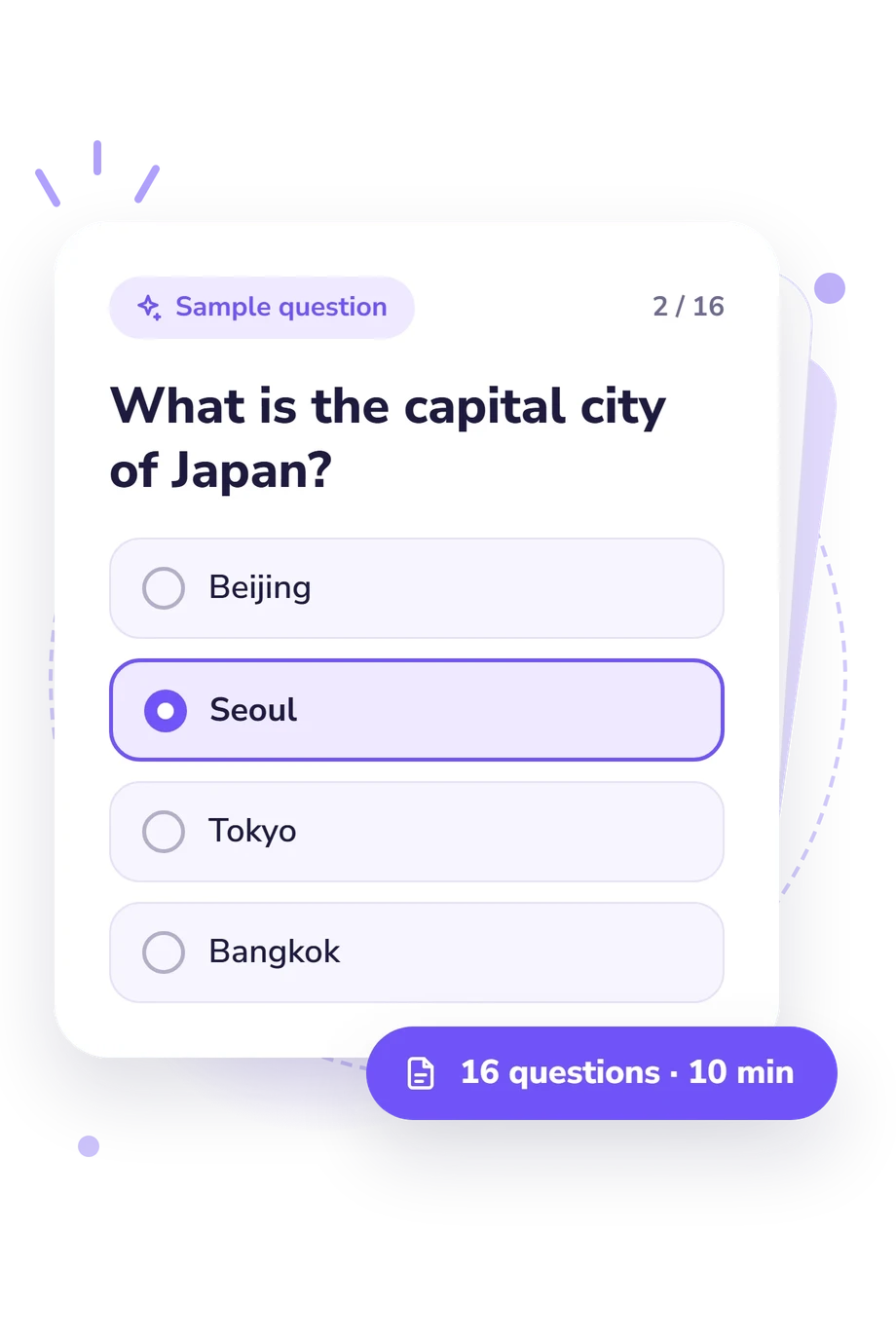
Example Questions From the Test
- Brazil
- Colombia
- Argentina
- Peru
- Beijing
- Seoul
- Tokyo
- Bangkok
- Mexico
- Cuba
- Brazil
- Canada
Kids Geography Quiz - Description and methodology of the test
Children, families, and teachers can use this kids geography quiz to start a conversation about how maps connect places, routes, and regions. It gives learners who enjoy easy geography quiz questions a shared starting point for later group discussion about which topics are stronger and which may benefit from review.
What This Assessment Measures
The questionnaire checks world knowledge used in maps and geography. It covers countries, capitals, continents, oceans, rivers, borders, seas, straits, seasons, and directions. Map situations ask learners to apply a location clue rather than recall a fact.
The result appears on one scale, Kids Geography Knowledge (0-16), with bands that summarize this quiz:
- Explorer Start (0-6) shows recognition of some key places and a foundation for reviewing continents, oceans, countries, and directions.
- Developing Geographer (7-12) shows a useful base with practice helpful for capitals, borders, and written location clues.
- Geography Star (13-16) shows strong knowledge across sampled locations and spatial reasoning.
This geography quiz for children offers a practical snapshot. A missed answer can guide review. Its straightforward format can also work as a geography quiz for 5th graders during classroom practice. The result does not represent every area of geography.
Methodology and Evidence Base
The approach is a structured knowledge assessment: each item uses a four-choice multiple-choice format. The prompts combine direct knowledge questions with brief situations involving travel routes, map directions, seasons, and country-capital matches. The scoring produces one overall total, summarizing performance across the sampled content rather than separate scores for capitals, physical geography, and spatial reasoning.
Its content is conceptually consistent with Demirbaş and Aydınözü (2022), whose work examined geography literacy in primary-school learners, and with Waddington and Shimeda (2019), who studied children’s geographical knowledge and understanding. The National Geography Standards framework from Heffron and Downs (2012) supports the emphasis on locations, spatial relationships, and geographic reasoning. This quiz is not an adaptation of those publications; they provide context for the topics selected.
The result from this world quiz for kids is most useful as an instructional prompt: review missed topics and track recall and application. The questionnaire has no stated reliability estimate or diagnostic cutoff, and its bands are descriptive for this quiz rather than population norms. Performance may reflect schooling, language familiarity, attention, and comfort with multiple-choice wording, so the result is a focused learning snapshot.
- Demirbaş, İbrahim, and Duran Aydınözü. 2022. “Determination of Geography Literacy Levels of Primary School Students.” Afyon Kocatepe University Journal of Social Sciences 24(1): 100-121. 10.32709/akusosbil.949191.
- Waddington, Shelagh, and Takashi Shimeda. 2019. “Worldview-An Investigation of Japanese and Irish Children’s Geographical Knowledge and Understanding.” Review of International Geographical Education Online 9(3): 493-522. 10.33403/rigeo.629090.
- Heffron, Susan Gallagher, and Roger M. Downs, eds. 2012. Geography for Life: National Geography Standards, Second Edition. Washington, DC: National Council for Geographic Education.
Updated: