
Syllabus Quiz
How the Scales are Structured
Who Usually Takes This Test?
See How You Compare
Below is a preview of how scores are typically distributed across each scale.
Example Questions From the Test
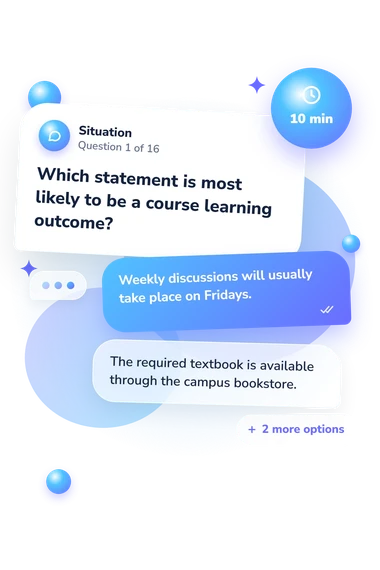
- Weekly discussions will usually take place on Fridays.
- The required textbook is available through the campus bookstore.
- Late work receives a deduction unless an exception applies.
- By the end of the course, students will be able to evaluate evidence from multiple sources.
- Listed dates can be ignored until the final week.
- Only assignment titles can change, not deadlines or readings.
- Students should monitor official course announcements for authorized updates.
- Students may choose their own due dates if the schedule changes.
- The late-work and extension policy
- The instructor's academic background
- The description of recommended readings
- The list of course learning outcomes
Syllabus Quiz - Description and methodology of the test
Students who want to read course requirements more confidently can use this syllabus quiz to check whether they can turn written guidance into sound academic decisions. It suits learners preparing for a new course, reviewing expectations after enrollment, or identifying which parts of a syllabus deserve closer attention. In practical terms, what is a syllabus-based quiz? It is a short exercise in interpreting course information.
What This Assessment Explores
These items test whether a respondent can separate learning outcomes from logistics, interpret schedule changes, and apply policies to ordinary student situations. Across the syllabus-based quiz questions, the task is to locate a rule, judge its scope, and choose the action that follows it. The intended reader is any student managing course information.
The result is Syllabus Knowledge (0-16), describing interpretation and application of common syllabus information. Its three result bands are:
- Foundation to build (0-6) means some elements are recognized, but important policies or instructions may be missed.
- Developing knowledge (7-12) means most common sections are understood, while complex details deserve a second look.
- Strong knowledge (13-16) means typical syllabus information is accurately interpreted and applied; official updates still matter when rules change.
Methodology and Evidence Base
As an online applied-reading assessment, each item presents a short course-related scenario with four answer choices. The respondent selects the option that best fits the stated syllabus principle, so the format examines interpretation rather than personal preference. Responses are scored against keyed answers and summarized as a descriptive total; the questionnaire does not present norms or a standardized diagnostic classification.
Lopez et al. (2024) is the closest subject-specific reference because it examines students’ use of alternate learning-management locations for assignment deadlines. This questionnaire is conceptually consistent with that work, not an adaptation of it. Garavalia et al. (1999) and Parkes and Harris (2002) support its focus on course structure, expectations, policies, deadlines, and communication guidance.
After completion, the selected syllabus-based quiz answers should be read as performance on the covered situations. Attention, prior academic experience, and familiarity with course conventions can influence results, while course-specific exceptions may require checking official announcements and current materials. The assessment offers a focused snapshot of syllabus interpretation, not a norm-referenced estimate of every academic skill.
- Lopez, S., Pham, A., Hsu, J. L., & Halpin, P. A. (2024). Students bypass the syllabus to utilize alternate LMS locations for assignment deadlines. Advances in Physiology Education, 48(3), 588-592. 10.1152/advan.00004.2024
- Garavalia, L. S., Hummel, J. H., Wiley, L. P., & Huitt, W. G. (1999). Constructing the course syllabus: Faculty and student perceptions of important syllabus components. Journal on Excellence in College Teaching, 10(1), 5-21.
- Parkes, J., & Harris, M. B. (2002). The purposes of a syllabus. College Teaching, 50(2), 55-61. 10.1080/87567550209595875