
Literary Devices Quiz
How the Scales are Structured
Who Usually Takes This Test?
See How You Compare
Below is a preview of how scores are typically distributed across each scale.
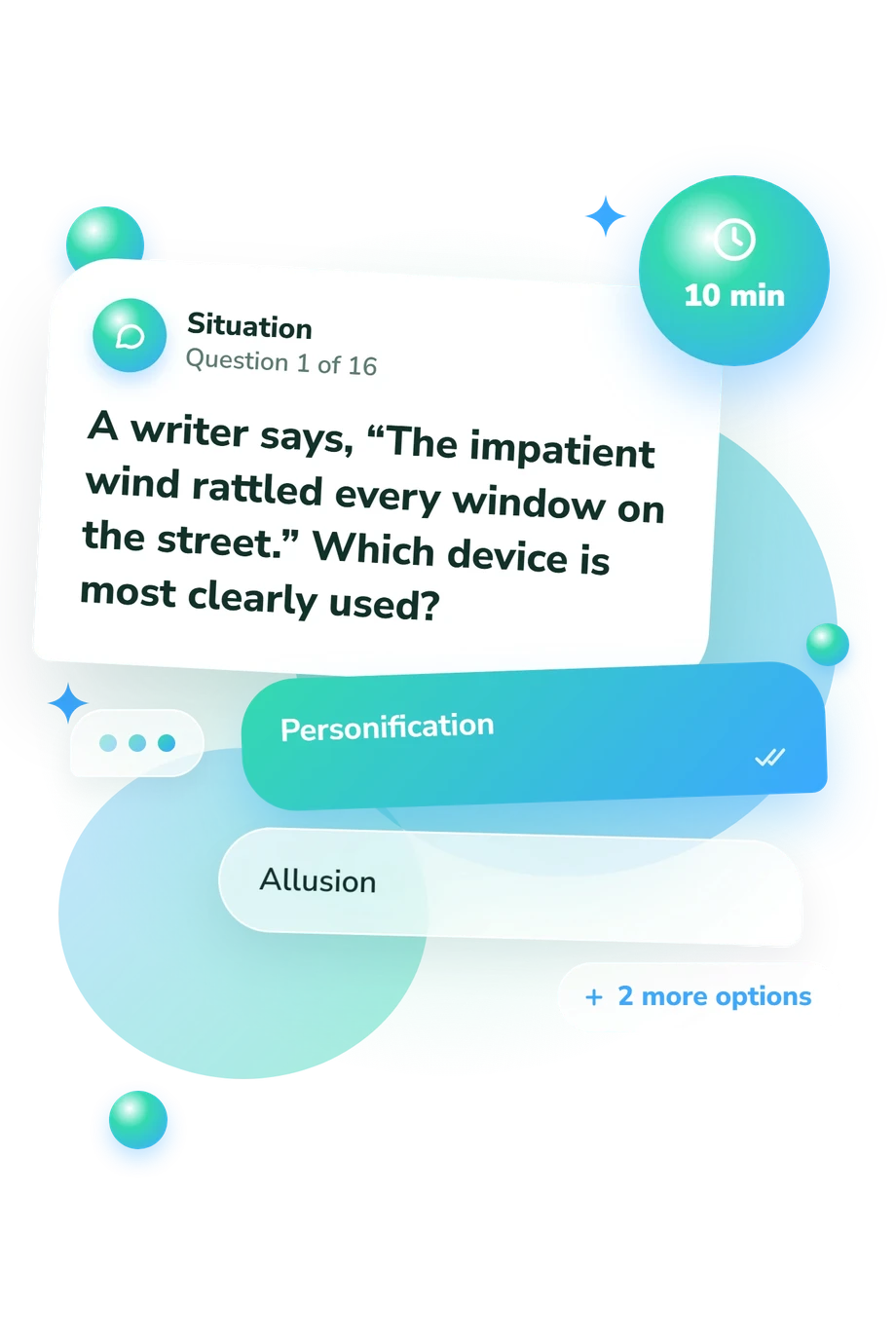
Example Questions From the Test
- Personification
- Allusion
- Onomatopoeia
- Understatement
- Paradox
- Pun
- Metonymy
- Symbolism
- Oxymoron
- Euphemism
- Antithesis
- Allusion
Literary Devices Quiz - Description and methodology of the test
For students, teachers, and curious readers who want to understand how literary language works in context, this literary devices quiz offers a way to examine recognition and interpretation. Quotations, narrative situations, and short descriptions make up this literary devices examples quiz, so you identify techniques rather than recall labels in isolation. The result gives a snapshot of topics that may deserve closer review.
What This Assessment Explores
This literary devices test asks you to distinguish related literary terms and connect each device with its effect. It suits anyone revising literary vocabulary or checking recognition before reading, writing, or classroom analysis. Applied recognition requires distinguishing related terms and interpreting them in context.
The main thematic groups are:
- Figurative language shows how comparison, exaggeration, personification, and contradiction shape meaning.
- Irony and narrative technique reveal how expectation, audience knowledge, hints, and narrator reliability guide interpretation.
- Sound and poetic form show how repeated sounds, direct address, and line movement create emphasis.
- Symbolic and structural devices show how recurring images and substitutions connect details with broader ideas.
The result therefore reflects performance on these recognition tasks, not the quality of a reader’s personal response or creative style.
Methodology and Evidence Base
Each item presents a quotation, situation, or definition with four choices. Selecting the best match requires distinguishing alternatives such as metaphor from simile, alliteration from assonance, and dramatic from situational irony. As a literary devices practice quiz, it uses contextual comparison rather than label recall.
The questionnaire is conceptually consistent with Wilson and Meiklejohn-Whiu (2025) on metalinguistic knowledge and close reading, but it is a separate educational assessment, not an adaptation or measure validated by that study. Abrams and Harpham supply terminology for these distinctions. Pollio and Pollio treat metaphor items as interpretive rather than simple vocabulary.
The questionnaire reports one knowledge result without publishing an item-level weighting rule. Results appear on the Literary Devices Knowledge scale, 0-16, with Building Foundations (0-6), Developing Knowledge (7-12), and Strong Knowledge (13-16). These bands describe performance on this quiz, not universal ability thresholds, and are not presented with population norms or a documented validation basis; scores may vary with instruction, familiarity, attention, and interpretation of ambiguous wording. Use the result to choose what to review next, rather than to generalize about literary ability.
- Wilson, Aaron, and Selena Meiklejohn-Whiu. “A T-Shaped Literacy Approach to Improve Intermediate Aged Students’ Metalinguistic Knowledge, Close Reading and Creative Writing.” New Zealand Journal of Educational Studies, vol. 60, 2025, pp. 339-356. 10.1007/s40841-025-00404-3
- Abrams, Meyer Howard, and Geoffrey Galt Harpham. A Glossary of Literary Terms. 10th ed., Cengage Learning, 2011.
- Pollio, Marilyn R., and Howard R. Pollio. “A Test of Metaphoric Comprehension and Some Preliminary Developmental Data.” Journal of Child Language, vol. 6, no. 1, 1979, pp. 111-120. 10.1017/S0305000900007650
Updated: