
Shakespeare Quiz
How the Scales are Structured
Who Usually Takes This Test?
See How You Compare
Below is a preview of how scores are typically distributed across each scale.
Example Questions From the Test
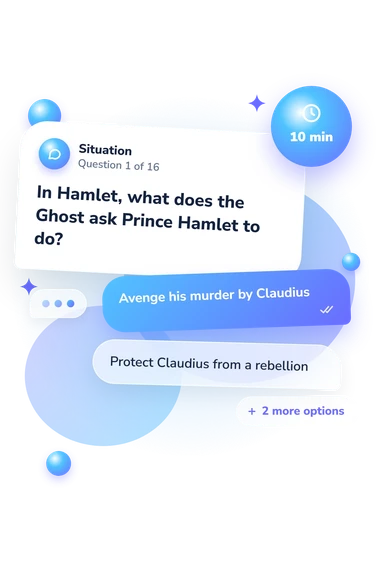
- Avenge his murder by Claudius
- Protect Claudius from a rebellion
- Help Fortinbras recover Danish territory
- Persuade Gertrude to leave Denmark
- A staged accusation is exposed as a deception
- Hero confesses that she deliberately tested Claudio
- A duel proves that Claudio never attended the wedding
- Don Pedro discovers that Hero is already married
- Whether Gertrude intends to marry again
- Whether Claudius reacts in a way that suggests guilt
- Whether Ophelia understands the Ghost’s message
- Whether the actors support Fortinbras
Shakespeare Quiz - Description and methodology of the test
Readers who want to revisit Shakespeare’s drama can use this assessment to test recall, interpretation, and recognition of theatrical craft. This Shakespeare quiz can help a curious reader identify which works, characters, themes, or devices deserve another look. The Shakespeare plays quiz also suits independent learners, theatre-goers, students, and anyone preparing for richer conversation about the plays.
What This Assessment Explores
Questions span tragedy, comedy, history, romance, and poetry, testing characters, plots, themes, and dramatic techniques. They connect motives with consequences, recognize turning points, interpret imagery, and identify soliloquy, irony, disguise, and symbolism. Readers seeking a structured check of literary familiarity may find this quiz about William Shakespeare useful, rather than treating it as a measure of writing or performance skill.
Four content areas within that single score are:
- Character understanding shows how well you identify motives, loyalties, conflicts, and reversals.
- Plot understanding shows whether you recognize actions and turning points.
- Theme understanding shows how images, tensions, and ideas shape meaning.
- Technique understanding shows whether you recognize devices guiding audience knowledge.
Shakespeare Knowledge runs from 0 to 16: Opening Act (0-6) indicates some recognized elements; Developing Player (7-12) indicates a solid foundation with room for detail; Commanding the Stage (13-16) indicates wide-ranging understanding.
Methodology and Evidence Base
Each item presents four answer choices and asks for the best response, combining recall with interpretation. Questions move among tragedy, comedy, history, romance, and poetry, so one total reflects breadth across literary contexts. No separate subscores or additional weighting formula are stated.
The questionnaire is an online knowledge quiz rather than a reported adaptation of a published assessment. Shakespeare’s plays and poems, represented by the edition associated with Jonathan Bate and Eric Rasmussen (2007), provide the literary reference for the characters, plots, themes, and techniques addressed here.
For readers using this Shakespeare trivia quiz to guide further study, the bands are descriptive signposts rather than universal norms. There are no stated population norms or reliability information for this online questionnaire, so the score is an online knowledge snapshot. Prior coursework, familiarity with performances, current memory, and guessing can influence performance.
Test-taking attention, prior exposure, memory, and guessing can affect performance: a missed item may reflect an isolated lapse, while recognizing a passage does not guarantee deeper interpretation. Use the result to choose plays, characters, or techniques to reread and discuss.
- Ott, John Funchess, Jr., and Tammi Kolski. "Shakespeare and Social Presence: The Power of Virtual Reality in Remote Education." The Journal of Applied Instructional Design, vol. 13, no. 2, 2024, pp. 205-208. 10.59668/1269.15660
- Shakespeare, William. The RSC Shakespeare: Complete Works. Edited by Jonathan Bate and Eric Rasmussen, Macmillan, 2007.
Updated: