
Molecular Geometry Quiz
How the Scales are Structured
Who Usually Takes This Test?
See How You Compare
Below is a preview of how scores are typically distributed across each scale.
Example Questions From the Test
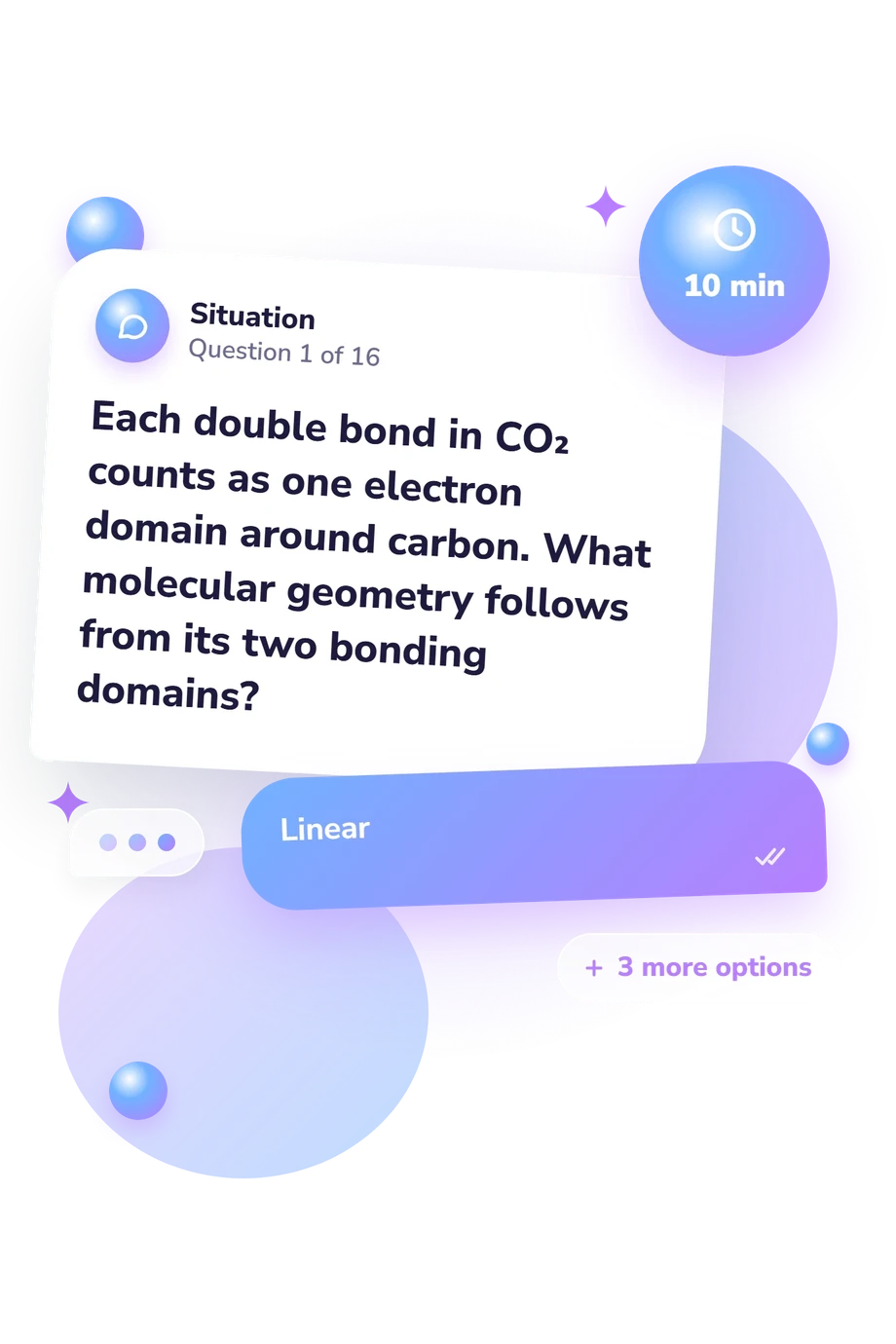
- Linear
- Trigonal planar
- Tetrahedral
- Bent
- CH₄
- BF₃
- CO₂
- SF₆
- Linear
- Bent
- Trigonal planar
- Trigonal pyramidal
Molecular Geometry Quiz - Description and methodology of the test
Students deciding whether their VSEPR review is ready for more complex structure problems can use this molecular geometry quiz to identify which ideas need another pass. It suits learners reviewing introductory chemistry who want a focused check before moving on to unfamiliar molecules. As a molecular geometry practice quiz, it supports a practical choice between progressing and revisiting fundamentals.
What This Assessment Measures
The questions move from electron-domain counts to cases involving lone pairs, bond angles, axial and equatorial positions, and dipole cancellation. Familiar molecules supply concrete contexts for applying the same structural idea.
The result brings together three related areas:
- Shape assignment shows whether you can connect bonding domains and lone pairs with a named molecular geometry.
- VSEPR reasoning shows whether you can compare repulsions, preferred positions, and approximate bond angles.
- Symmetry analysis shows whether you can distinguish molecular shape from electron-domain geometry and judge dipole cancellation.
Together, these items form a quiz on chemistry and the shapes of molecules, helping learners review Lewis-structure consequences without extended calculations. One displayed scale, Molecular Geometry Knowledge, runs from 0-16. Foundation (0-6) covers partial recognition and review needs; Developing (7-12) indicates core VSEPR understanding with room to strengthen lone-pair and expanded-octet applications; Strong (13-16) indicates consistent application across common geometries, bond angles, lone-pair arrangements, and symmetry comparisons.
Methodology and Scientific Basis
Each item offers four answer choices: identify a geometry, compare an angle, place a lone pair, distinguish electron-domain from molecular geometry, or judge symmetry. This makes it an electron-and-molecular-geometry quiz emphasizing VSEPR relationships rather than extended calculations.
Conceptually, the questionnaire is consistent with the VSEPR model described by Gillespie and Robinson in 1996: electron domains minimize repulsion, while lone pairs alter shape and often compress bond angles. Its reasoning also aligns with Gillespie and Nyholm in 1957 and Gillespie in 1970, but this consistency does not establish that the online questionnaire is their adaptation, validated version, or normed instrument.
Scoring produces one aggregate result, but per-answer weighting is unspecified, so no additional points rule should be inferred. Learners can use the result to target missed geometries, angle comparisons, lone-pair arrangements, or symmetry questions, but recognizing an option does not prove transfer to an unfamiliar molecule.
The questionnaire has no stated norms, reliability estimates, or standardized administration. Its bands are descriptive proficiency labels within this test, not norm-referenced classifications; performance may vary with preparation, notation familiarity, attention, and example difficulty.
- Gillespie, R. J., and Robinson, E. A. (1996). Electron Domains and the VSEPR Model of Molecular Geometry. Angewandte Chemie International Edition in English, 35(5), 495-514. 10.1002/anie.199604951
- Gillespie, R. J., and Nyholm, R. S. (1957). Inorganic Stereochemistry. Quarterly Reviews, Chemical Society, 11, 339-380. 10.1039/QR9571100339
- Gillespie, R. J. (1970). The Electron-Pair Repulsion Model for Molecular Geometry. Journal of Chemical Education, 47(1), 18-23. 10.1021/ed047p18
Updated: