
LOL Quiz
How the Scales are Structured
Who Usually Takes This Test?
See How You Compare
Below is a preview of how scores are typically distributed across each scale.
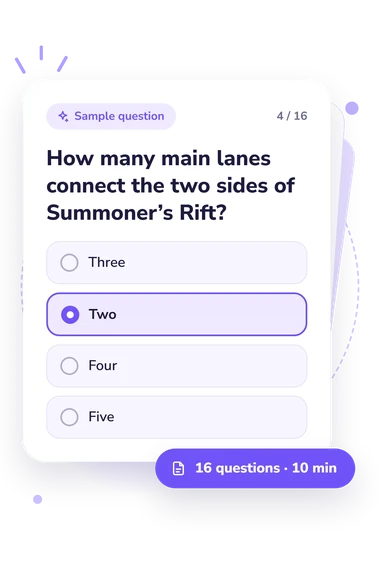
Example Questions From the Test
- Areas hidden because your team lacks vision there
- The visual effect that appears after a turret falls
- A period when both teams lose access to the minimap
- A temporary slowing effect created in the jungle
- Attack speed
- Ability haste
- Critical strike chance
- Magic resistance
- Defeat the most enemy champions
- Destroy the enemy Nexus
- Capture every neutral objective
- Reach the team gold limit first
LOL Quiz - Description and methodology of the test
Designed for players deciding whether to examine their understanding rather than their live performance, the LOL Quiz turns familiar match situations into a focused knowledge check. As a League quiz focused on League of Legends fundamentals, its result separates conceptual knowledge from rank, reflexes, and mechanical skill, helping you decide whether to review the basics before treating a difficult match as a skill problem.
What This Assessment Explores
Viewed as a League of Legends knowledge test, this assessment checks whether players connect terms with decisions. Its four themes contribute to one overall result: they sample map information, strategic objectives, combat functions, and farming systems without producing separate subscores.
The item themes are:
- Map awareness and vision show how you interpret fog of war, wards, and a missing opponent.
- Objectives and structures measure recognition of the Nexus, lanes, inhibitors, turrets, and neutral-objective preparation.
- Combat and roles indicate whether you match damage types, crowd control, summoner spells, and champion classes to their functions.
- Economy and farming reflect item purchasing, CS, minion gold, and last-hitting.
The displayed scale is League of Legends Knowledge (0-16): Foundations to build 0-6 signals core concepts to review; Developing Rift knowledge 7-12 shows many essentials with some gaps; Strong Rift knowledge 13-16 reflects a well-rounded grasp of the tested fundamentals.
Methodology and Evidence Base
Each item uses four answer choices. Prompts ask for a definition, the usual function of a mechanic, or the best response to a match situation. The result is reported on the displayed scale, reflecting recognition of the concepts tested rather than overall game ability.
As a four-choice knowledge check, the questionnaire asks respondents to recognize fundamentals and select the best response to familiar match situations. League expertise research by Furlough and Gillan offers the closest conceptual context, while Donaldson's work provides broader discussion of game mechanics and metagame expertise; Kleinman, Gayle, and Seif El-Nasr examine learning in League of Legends. These studies do not establish this questionnaire's reliability, validity, or norms, and the questionnaire is not an adaptation of them.
When taking this LoL fundamentals quiz, the result offers a general prompt to review the tested knowledge rather than identifying a particular weak area. Interpret the displayed bands as descriptive; no norm-referenced interpretation is provided, and they do not establish competitive rank or practical skill. Patch changes, unfamiliar terms, guessing, and the gap between knowing a rule and applying it under pressure can affect performance.
- Furlough, Caleb S., and Douglas J. Gillan. 2018. "Mental Models: Structural Differences and the Role of Experience." Journal of Cognitive Engineering and Decision Making 12(4): 269-287. 10.1177/1555343418773236
- Kleinman, Erica, Christian Gayle, and Magy Seif El-Nasr. 2021. "Because I'm Bad at the Game!" A Microanalytic Study of Self-Regulated Learning in League of Legends. Frontiers in Psychology 12: 780234. 10.3389/fpsyg.2021.780234
- Donaldson, Scott. 2017. "Mechanics and Metagame: Exploring Binary Expertise in League of Legends." Games and Culture 12(5): 426-444. 10.1177/1555412015590063