
Pedigree Quiz
How the Scales are Structured
Who Usually Takes This Test?
See How You Compare
Below is a preview of how scores are typically distributed across each scale.
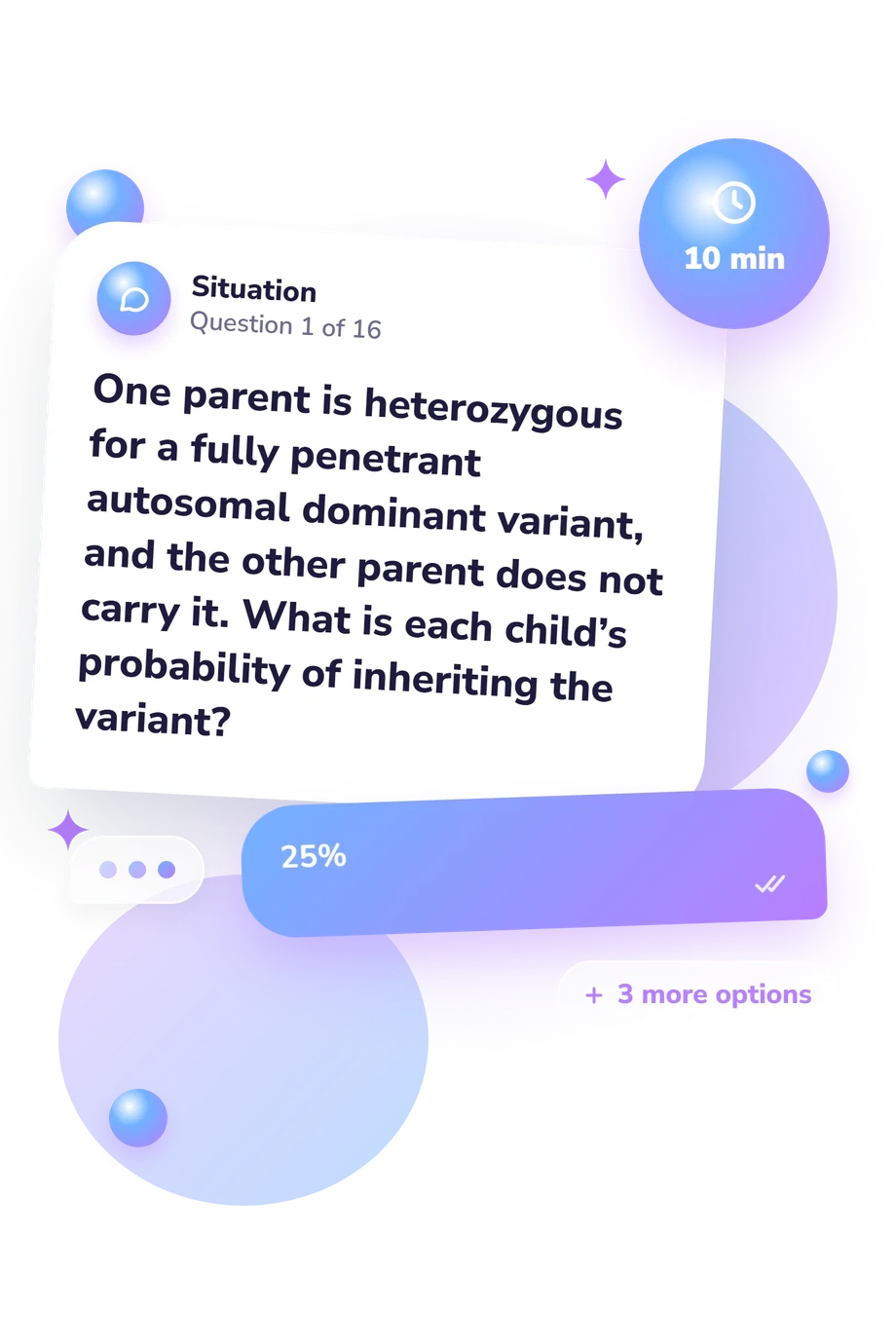
Example Questions From the Test
- Only sons will be affected
- Each child has a 50% chance of being affected
- No children will be affected, but all will be carriers
- All children will be affected
- A diamond
- A circle
- A square
- A triangle
- X-linked recessive
- Y-linked
- Mitochondrial
- Autosomal recessive
Pedigree Quiz - Description and methodology of the test
Students, educators, and curious readers who want to interpret family inheritance diagrams can use this pedigree quiz to check practical understanding of notation, transmission patterns, and simple genetic probability. It suits learners of basic human genetics and people reviewing family-history diagrams independently. A pedigree practice quiz format keeps the exercise focused, while the result points to concepts that feel secure and those that merit further study.
What This Assessment Explores
These items test whether you can read family diagrams and connect relationships with plausible inheritance models. They suit learners of basic human genetics and people reviewing family-history diagrams independently. A pedigree chart quiz approach emphasizes symbols, connecting lines, transmission routes, and assumptions in each scenario.
The result brings together three areas:
- Symbol reading shows whether you identify sex, partners, siblings, twins, and the proband.
- Inheritance reasoning shows whether you distinguish autosomal, X-linked, Y-linked, and mitochondrial transmission.
- Probability application shows how you assess carrier status, affected parents, penetrance, and sex-specific outcomes.
Pedigree Knowledge runs from 0-16. Foundations to Build (0-6) signals review of core symbols and transmission logic. Developing Knowledge (7-12) indicates workable interpretation with harder patterns or caveats remaining. Strong Knowledge (13-16) reflects solid command of notation and inheritance-pattern reasoning. This educational score cannot establish a diagnosis or an individual’s genetic risk.
Methodology and Scientific Basis
Each item presents a family-history situation or pedigree-convention problem with four answer choices. You select the option that fits the stated model, symbol, or probability calculation. Rarity, penetrance, affected status, and the transmitting parent’s sex make careful reading important. The pedigree questions in the quiz test applied interpretation.
Kievit and Bonifati (2018) offer the closest comparison because they treat pedigree reading and inheritance-pattern recognition as practical clinical-genetics tasks. Symbol and relationship conventions align with nomenclature developed and assessed by Bennett and colleagues in 1995 and 2008. Viewed as a pedigree analysis quiz, the exercise turns those conventions into short educational scenarios. It is conceptually consistent with those sources, not an adaptation of their instruments.
The answer choices are judged against the model stated in each item, and the overall result summarizes performance across the question set. The result is interpreted through displayed bands rather than clinical cutoffs. The questionnaire is not norm-referenced; no reliability estimate, population norms, or clinical validation are stated. Performance can vary with instruction, attention, self-awareness, and item assumptions.
- Kievit, Anneke, and Vincenzo Bonifati. 'How Do I Assess a Family Tree for Inheritance Patterns?' Movement Disorders Clinical Practice, vol. 5, no. 4, 2018, p. 453. DOI 10.1002/mdc3.12661
- Bennett, Robin L., Kathryn Steinhaus French, Robert G. Resta, and Debra Lochner Doyle. 'Standardized Human Pedigree Nomenclature: Update and Assessment of the Recommendations of the National Society of Genetic Counselors.' Journal of Genetic Counseling, vol. 17, no. 5, 2008, pp. 424-433. DOI 10.1007/s10897-008-9169-9
- Bennett, Robin L., Kathryn A. Steinhaus, Stefanie B. Uhrich, Corrine K. O'Sullivan, Robert G. Resta, Debra Lochner-Doyle, Dorene S. Markel, Victoria Vincent, and Jan Hamanishi. 'Recommendations for Standardized Human Pedigree Nomenclature.' American Journal of Human Genetics, vol. 56, no. 3, 1995, pp. 745-752.
Updated: