
Beowulf Quiz
How the Scales are Structured
Who Usually Takes This Test?
See How You Compare
Below is a preview of how scores are typically distributed across each scale.
Example Questions From the Test
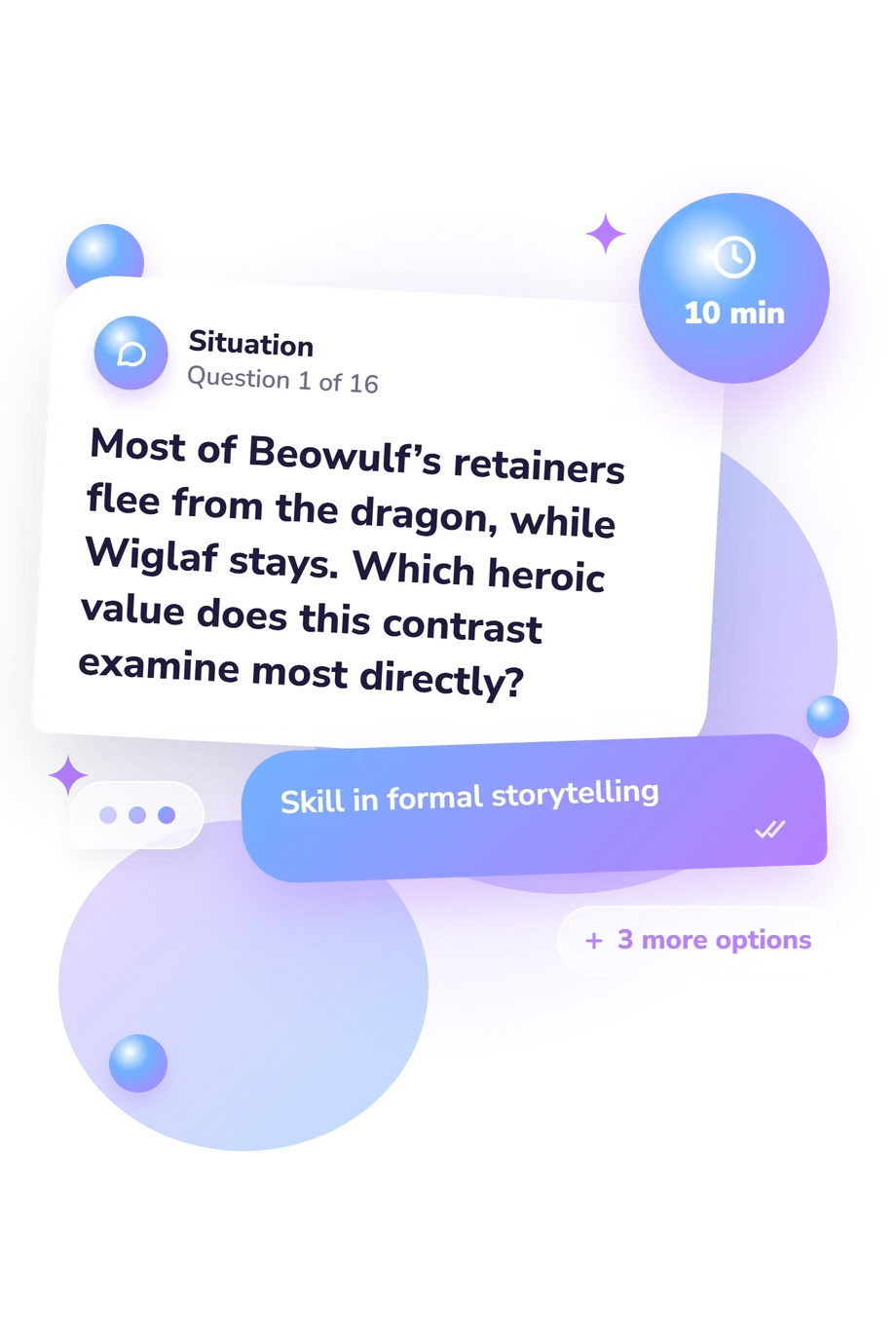
- Skill in formal storytelling
- Loyalty between a lord and his warrior
- Knowledge of distant kingdoms
- Success in negotiating marriage alliances
- Royal messenger
- Keeper of the dragon’s barrow
- Priest of a Danish shrine
- King
- They preserve his body beneath Heorot.
- They send his armor to the Danish court.
- They build a prominent burial mound by the sea.
- They place the dragon’s body on the Geatish throne.
Beowulf Quiz - Description and methodology of the test
Readers returning to the poem, preparing for class discussion, or testing their recall can use the Beowulf Quiz to organize knowledge of its story and culture. It suits learners who want a focused reading check, whether they are revisiting the epic independently or comparing their understanding with an online quiz about Beowulf. The result identifies secure knowledge and areas for review.
What This Assessment Explores
The assessment measures knowledge of Beowulf as a narrative and cultural text. Items connect episodes with characters, places, objects, authorship, heroic conduct, social obligations, and the poem’s Christian framing of an older heroic world. It suits readers checking comprehension or preparing for discussion, rather than measuring general intelligence or literary talent.
The result reflects four related dimensions:
- Plot and character recall shows how securely events, figures, and settings connect.
- Heroic values indicate recognition of loyalty, courage, reputation, and duty.
- Social order reflects lord-retainer bonds, treasure exchange, and fellowship.
- Religious perspective captures how the poem frames its pre-Christian heroic culture.
For revision, a reader can use answers to the quiz on Beowulf to locate a forgotten episode or interpretive distinction. Beowulf Knowledge runs from 0-16: Foundations to revisit (0-6), Developing command (7-12), and Strong command (13-16).
Methodology and Evidence Base
Each item presents a question with four answer choices. Some test recall of characters, settings, objects, events, or authorship; others ask the reader to identify a value, social arrangement, or interpretive relationship. This combination makes the questionnaire a focused reading and memory check. Reviewing questions and answers about Beowulf can connect a missed response with the relevant episode or idea.
The displayed score condenses response performance into a total on the knowledge scale, but the questionnaire does not state item weighting, percentile norms, reliability estimates, or clinical cutoffs. Its bands therefore describe performance on this set of questions, not a standardized comparison with a reference population.
The evidence is the poem and scholarship used to clarify it. The content is conceptually consistent with Klaeber's Beowulf (Fulk, Bjork, and Niles, 2008), which supports names, episodes, and sequence; it is not an adaptation of that edition. Liuzza (2018) supports monster encounters and narrative turns, while Irving (1984) supports reading Christian references alongside older heroic culture.
Results depend on memory, translation, prior study, and guessing; a score guides review but cannot establish complete literary understanding.
- Fulk, R. D., Robert E. Bjork, and John D. Niles, eds. Klaeber's Beowulf and The Fight at Finnsburg, 4th ed. University of Toronto Press, 2008. ISBN 9780802095671
- Liuzza, Roy. "Beowulf: Introduction, Fight with Grendel, the Attack by Grendel's Mother, Fight with Grendel's Mother, and Fight with the Dragon." In Primary Sources on Monsters, edited by Asa Simon Mittman and Marcus Hensel, vol. 2, pp. 73-86. Arc Humanities Press, 2018. 10.1017/9781942401223.013
- Irving, Edward B., Jr. "The Nature of Christianity in Beowulf." Anglo-Saxon England, vol. 13, 1984, pp. 7-21. 10.1017/S0263675100003483
Updated: