
Welding Quiz
How the Scales are Structured
Who Usually Takes This Test?
See How You Compare
Below is a preview of how scores are typically distributed across each scale.
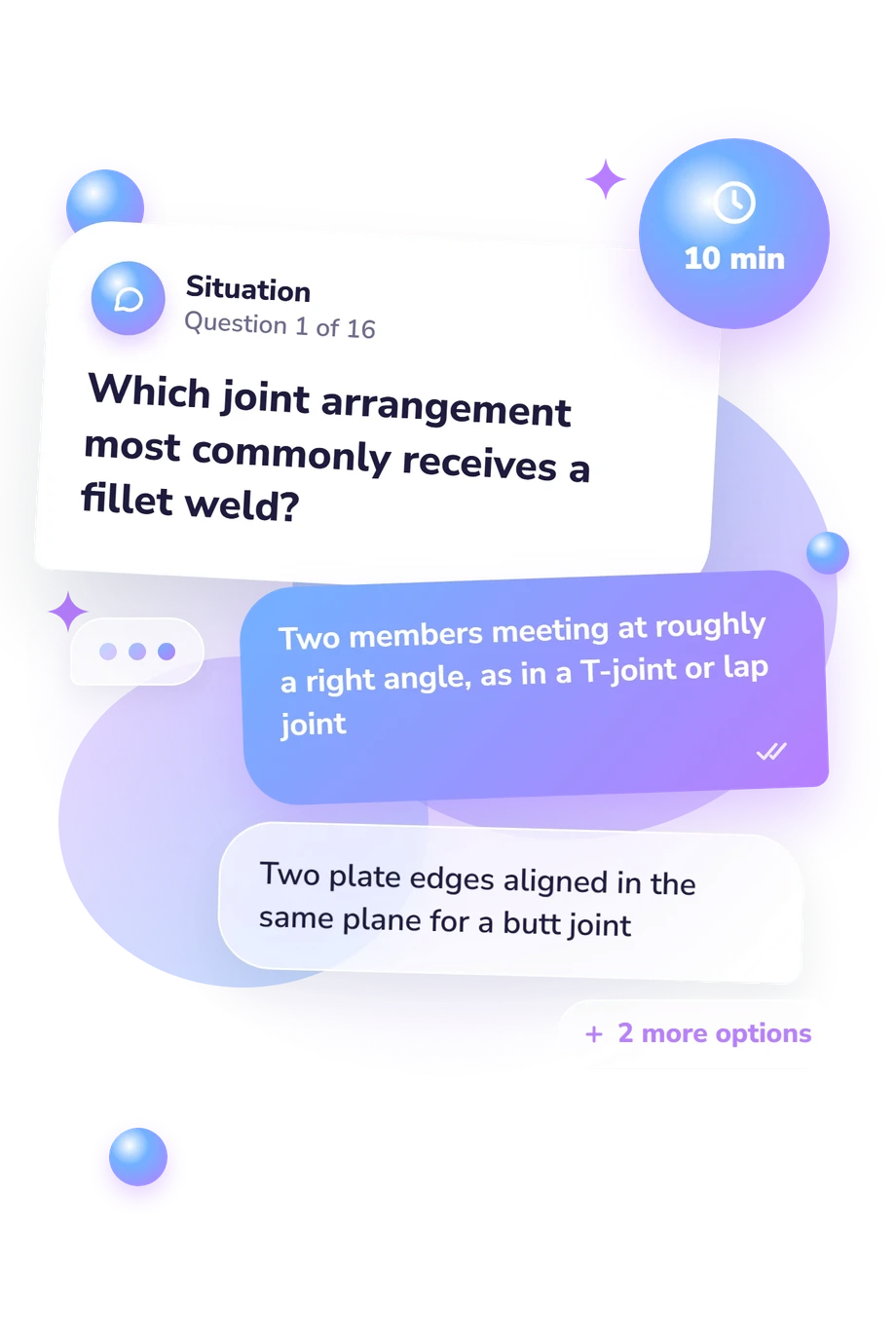
Example Questions From the Test
- It is made only from the same metal as the workpiece
- It provides a solid flux coating around the arc
- It is a nonconsumable tungsten electrode under normal operation
- It melts continuously to provide all filler metal
- Visual inspection
- Guided bend testing
- Ultrasonic testing
- Dye-penetrant testing
- Shielded metal arc welding, or SMAW
- Gas metal arc welding, or GMAW
- Gas tungsten arc welding, or GTAW
- Oxyfuel welding
Welding Quiz - Description and methodology of the test
People learning welding or refreshing workshop knowledge can use this welding quiz to check whether essential concepts are clear before further study or supervised practice. It emphasizes recognition and judgment rather than hand skills. A multiple-choice welding assessment can help a learner identify gaps in process knowledge, equipment handling, inspection, and safe workshop decisions, then choose what to review next.
What This Assessment Explores
Its purpose is to check whether foundational welding knowledge applies to common workshop choices. The intended reader is a learner or refresher who wants to recognize correct principles, rather than demonstrate torch control, fit-up accuracy, or production skill.
Across the welding questions and answers, the scenarios cover three connected areas:
- Process and joint knowledge shows whether you can distinguish welding methods, electrodes, joint arrangements, tack welds, heat input, and flame characteristics.
- Inspection and defect recognition shows whether you can identify discontinuities and understand basic checks of weld soundness.
- Safety and equipment handling shows whether you recognize controls for fumes, electricity, cylinders, combustible materials, shielding, and arc radiation.
The result is reported as Welding Knowledge: 0-16. Foundations to strengthen covers 0-6, Developing knowledge covers 7-12, and Strong foundation covers 13-16. These bands describe performance on tested fundamentals, not practical competence.
Methodology and Scientific Basis
Each item presents four alternatives and asks for the best response to a technical or safety situation. The format combines factual recognition with applied judgment. Because no separate weights, penalties, or norm-referenced comparisons are stated, the result is an educational snapshot of this question set.
The content is conceptually consistent with Welding Fundamentals (Bowditch et al., 2020), covering processes, joints, equipment, defects, inspection, and workshop practice. The American Welding Society’s Welding Handbook supports the science and terminology; ANSI Z49.1:2021 provides the safety framework for ventilation, electrical condition, hot work, cylinders, and protective equipment. Cezar-Vaz et al. (2012) adds evidence about risk communication in apprentice-welder training.
Used as a welding knowledge quiz, the assessment can organize revision, but it has no stated standardization, reliability estimate, or certification status. Guessing, recent instruction, and familiarity with workshop rules may affect performance. A strong score does not show that someone can set up equipment, produce sound welds, or manage every live-work hazard; local procedures and supervised practical training remain necessary for hands-on work.
- Bowditch, William A., Kevin E. Bowditch, and Mark A. Bowditch. Welding Fundamentals. 6th ed. Tinley Park, IL: Goodheart-Willcox, 2020. ISBN 978-1-64564-693-8.
- American Welding Society. Welding Handbook, Tenth Edition, Volume 1: Welding and Cutting Science and Technology. Miami, FL: American Welding Society, 2018. ISBN 978-1-64322-014-7.
- American Welding Society. ANSI Z49.1:2021, Safety in Welding, Cutting, and Allied Processes. Miami, FL: American Welding Society, 2021.
- Cezar-Vaz, Marta Regina, Clarice Alves Bonow, Laurelize Pereira Rocha, Marlise Capa Verde de Almeida, Luana de Oliveira Severo, Anelise Miritz Borges, Joana Cezar Vaz, and Claudia Turik. "Risk Communication as a Tool for Training Apprentice Welders: A Study about Risk Perception and Occupational Accidents." The Scientific World Journal, 2012, Article ID 140564, 10 pages. 10.1100/2012/140564.
Updated: