
90s Music Quiz
How the Scales are Structured
Who Usually Takes This Test?
See How You Compare
Below is a preview of how scores are typically distributed across each scale.
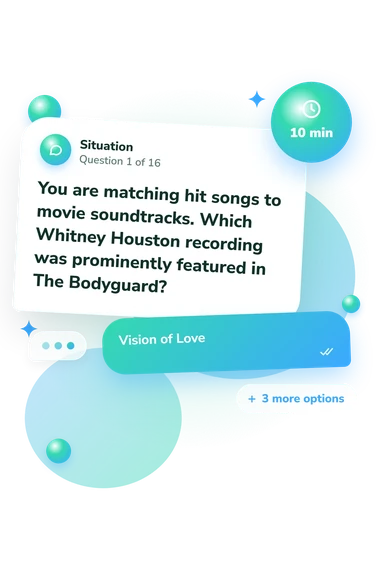
Example Questions From the Test
- Vision of Love
- Because You Loved Me
- Nothing Compares 2 U
- I Will Always Love You
- The Power
- Gonna Make You Sweat (Everybody Dance Now)
- Rhythm Is a Dancer
- Pump Up the Jam
- Vengaboys
- Los del Río
- Aqua
- Bellini
90s Music Quiz - Description and methodology of the test
Listeners who want to reconnect with the decade’s musical landmarks can use this 90s music quiz to see which memories remain accessible. Four choices ask them to identify a song, artist, album, or musical connection; each correct answer builds the knowledge score for this quiz about 90s music. It suits people revisiting 1990s radio, MTV, soundtracks, or playlists from the era. The result supports playlist exploration rather than judging musical ability.
What This Assessment Explores
This questionnaire measures knowledge of 1990s popular music through songs, artists, albums, soundtracks, chronology, and context. It is for listeners testing memory, not singing, instrumental ability, or music theory; items ask them to recognize film recordings, match tracks, identify albums, and order releases.
Coverage spans pop, hip-hop, R&B, dance, film music, and rock. Connections among recordings make it a 90s song quiz focused on recall. Cross-genre links appear. Grunge bands and album clues add a 90s rock quiz dimension without making rock its sole focus.
The single scale is 90s Music Knowledge (0-16), with Opening Act (0-6), Chart Climber (7-12), and Nineties Headliner (13-16), from partial recognition to command. It examines:
- Songs and soundtracks show recognition in settings.
- Artists and groups connect performers with tracks.
- Albums and discographies test title-artist recall.
- Chronology and context place music across years.
Methodology and Evidence Base
The four-option format makes this a quiz on 90s music with answers, while each correct choice earns one point. The total therefore records correct recall within this set, while guessing, prior exposure, and familiarity with particular cultural references can affect performance.
Spanning the full decade, the questionnaire samples 1990s music knowledge rather than familiarity with one year. The questionnaire is a curated online knowledge test. Omar et al. (2010) describe music knowledge as organized associations among musical information and people; this questionnaire is conceptually consistent with that account because its items connect recordings with performers, albums, and contexts. Spivack et al. (2019) connect popular songs with collective cultural memory, while Krumhansl and Zupnick (2013) describe how music from certain periods can remain especially accessible through personal and generational memories.
The displayed result is a raw-score band for this question set, so interpret it as performance on selected items rather than a general measure of musical knowledge; current context, age of first listening, cultural background, and imperfect recall may shift the score. It is most useful for reflecting on remembered music and identifying areas for playlist exploration.
- Omar, R., Hailstone, J. C., Warren, J. E., Crutch, S. J., & Warren, J. D. (2010). The cognitive organization of music knowledge: a clinical analysis. Brain, 133(4), 1200-1213. 10.1093/brain/awp345
- Spivack, S., Philibotte, S. J., Spilka, N. H., Passman, I. J., & Wallisch, P. (2019). Who remembers the Beatles? The collective memory for popular music. PLOS ONE, 14(2), e0210066. 10.1371/journal.pone.0210066
- Krumhansl, C. L., & Zupnick, J. A. (2013). Cascading reminiscence bumps in popular music. Psychological Science, 24(10), 2057-2068. 10.1177/0956797613486486