
Which Premier League Team Should I Support Quiz
How the Scales are Structured
Who Usually Takes This Test?
See How You Compare
Below is a preview of how scores are typically distributed across each scale.
Example Questions From the Test
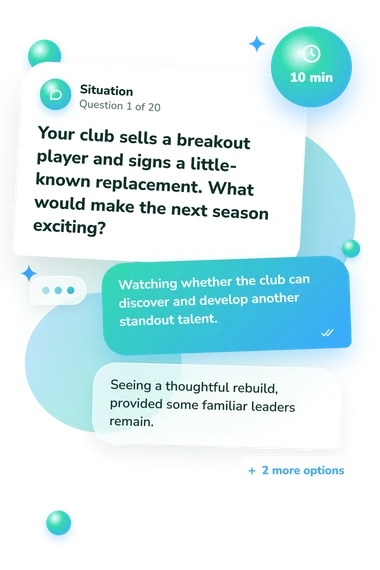
- Watching whether the club can discover and develop another standout talent.
- Seeing a thoughtful rebuild, provided some familiar leaders remain.
- Following the new player, though repeated turnover would test my attachment.
- I would rather support a club usually able to retain its biggest names.
- I could still enjoy it easily because trophies would not define my support.
- I would feel some disappointment, but the overall journey would matter more.
- I would value the season while wondering why the club did not finish the job.
- Falling short of major honors would make the season feel distinctly unfinished.
- A global community is one of my strongest reasons for choosing.
- It is appealing, although club identity matters just as much.
- It is a modest convenience rather than a deciding factor.
- I would prefer a smaller or more locally concentrated following.
Which Premier League Team Should I Support Quiz - Description and methodology of the test
Choosing a first club, exploring a new allegiance, or helping a newcomer decide which EPL team should I support can be easier with this quiz, especially when you compare whether you value ingenuity, inherited loyalty, local belonging, renewed ambition, or global pressure. The Which Premier League Team Should I Support Quiz gives curious football followers a structured way to weigh those priorities before choosing.
What This Assessment Explores
Scenarios test preferences about recruitment, trophies, visibility, atmosphere, history, resilience and pressure. This quiz helps answer what soccer team should I support by showing which club experience fits:
- Clever Disruptors (0-12) measure enjoyment of resourceful clubs challenging wealthier rivals: Established Preference (0-4), Underdog Interest (5-8), Disruptor Match (9-12).
- Defiant Traditionalists (0-12) measure loyalty, regional pride and resilience: Results-Led Match (0-4), Tradition Friendly (5-8), Loyal Traditionalist (9-12).
- Established Ambition (0-12) measures attraction to history and renewed success: Different Journey (0-4), Ambition Curious (5-8), Revival Believer (9-12).
- London Neighborhood Identity (0-12) measures neighborhood character, home atmosphere and community identity: Wider Horizon (0-4), London Curious (5-8), Neighborhood Match (9-12).
- Spotlight and Expectations (0-12) measure attraction to prominent clubs and major expectations: Quieter Stage (0-4), Selective Spotlight (5-8), Big-Stage Pull (9-12).
Methodology and Evidence Base
Each scenario offers four options about recruitment, community, history, matchdays and expectations. This quiz helps clarify what Premier League team should I support by showing which football culture you would enjoy.
Answers become five family totals. The highest is your strongest affinity, while any family within one point can join a blended result. The displayed bands describe preference direction and strength; they do not rank clubs or predict results.
Conceptually, the questionnaire is consistent with broad models such as the Points of Attachment Index, the MSSC and a team-identity model grounded in social identity theory. These instruments address attachment, consumption motives and identity, but not this questionnaire’s five family structure or scoring. This questionnaire has no published norms or validation, so its family scores and displayed bands are questionnaire-specific rather than standardized.
Read the result as structured self-reflection. Mood, recent matches, limited league knowledge and self-presentation can affect answers, so explore suggested families’ history, culture and current football before choosing.
- Trail, Galen T., Matthew J. Robinson, Ronald J. Dick, and Andrew J. Gillentine. "Motives and Points of Attachment: Fans versus Spectators in Intercollegiate Athletics." Sport Marketing Quarterly, 12(4), 217-227, 2003. 10.1177/106169340301200404
- Trail, Galen T., and Jeffrey D. James. "The Motivation Scale for Sport Consumption: Assessment of the Scale's Psychometric Properties." Journal of Sport Behavior, 24(1), 108-127, 2001.
- Heere, Bob, and Jeffrey D. James. "Stepping Outside the Lines: Developing a Multi-dimensional Team Identity Scale Based on Social Identity Theory." Sport Management Review, 10(1), 65-91, 2007. 10.1016/S1441-3523(07)70004-9