
What Business Major Should I Choose Quiz
How the Scales are Structured
Who Usually Takes This Test?
See How You Compare
Below is a preview of how scores are typically distributed across each scale.
Example Questions From the Test
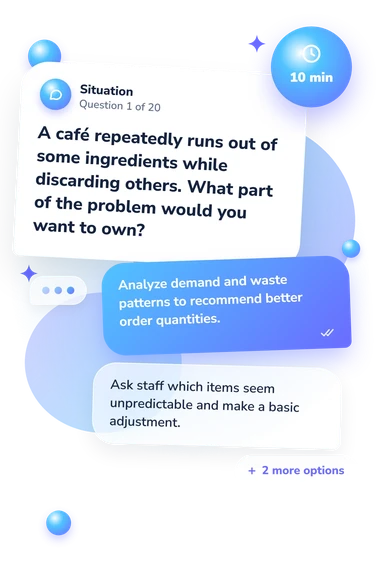
- Analyze demand and waste patterns to recommend better order quantities.
- Ask staff which items seem unpredictable and make a basic adjustment.
- Redesign promotions to steer customers toward available menu items.
- Help managers coordinate ordering responsibilities across shifts.
- Search for patterns and build a model that helps explain or forecast demand.
- Use a few summary figures to support a broader business proposal.
- Turn the strongest product story into a customer campaign.
- Discuss how store managers could use the information with their teams.
- How the change could affect employee motivation and cooperation.
- Whether the policy wording supports the company's public image.
- How each expense should be classified and documented under the new rules.
- A summary of the biggest reporting changes without every procedural detail.
What Business Major Should I Choose Quiz - Description and methodology of the test
Students comparing business pathways can use this business career quiz to notice which kinds of problems, decisions, and responsibilities feel most engaging. The profile is intended for people choosing an initial direction or questioning why one field seems more attractive than another. The What Business Major Should I Choose Quiz offers a structured starting point for reflection, course exploration, and conversations about possible study paths.
What the Questionnaire Measures
Five dimensions capture preferences about records, data, money, teams, and customers. The bands describe interest, not ability:
- Accounting (0-12) reflects attraction to records and reporting: Exploring Elsewhere 0-4; Possible Fit 5-8; Strong Affinity 9-12.
- Business Analytics (0-12) reflects interest in modeling, measurement, and data-led improvement: Exploring Elsewhere 0-4; Possible Analytics Fit 5-8; Strong Analytics Affinity 9-12.
- Finance (0-12) reflects interest in valuation, funding, and risk: Exploring Elsewhere 0-4; Possible Finance Fit 5-8; Strong Finance Affinity 9-12.
- Management (0-12) reflects preference for coordinating people and priorities: Exploring Elsewhere 0-4; Possible Management Fit 5-8; Strong Management Affinity 9-12.
- Marketing (0-12) reflects interest in audiences, positioning, and campaigns: Exploring Elsewhere 0-4; Possible Marketing Fit 5-8; Strong Marketing Affinity 9-12.
The profile helps compare majors and choose subjects. This business major quiz is useful when its pattern prompts next steps, not a single verdict.
Methodology and Scientific Basis
Each scenario presents a business problem with four choices. Options emphasize records, data, financial tradeoffs, people, or customer messages, so an answer signals attraction to work rather than demonstrated competence. Responses are grouped into five totals and read through the displayed bands.
Gilbert, Burnett, and Leartsurawat (2010) provide the comparison: their work connects business students’ preferences with work activity. This questionnaire is conceptually consistent with that perspective, not an adaptation of their instrument. Larson (2018) and Davies, Tikoo, Ding, and Salama (2016) add context about major perceptions and choice motives.
For someone wanting a what business career is right for me quiz, the profile can suggest next steps, such as comparing courses or trying an introductory project. This connects the result to decisions, not a final verdict.
Someone treating the result as a what business degree should i get quiz should check prerequisites and relevant career settings. Self-report responses can shift with current interests, limited exposure, and scenario interpretation. No standardization status, norm sample, or published reliability estimate is stated, so the bands indicate preference rather than ability or eligibility.
- G. Ronald Gilbert, Meredith Burnett, and Watcharaphong Leartsurawat. (2010). The Psychological Work Preferences of Business Students. Journal of Career Assessment, 18(2), 189-206. 10.1177/1069072709354304
- Ronald B. Larson. (2018). Examining Student Perceptions of Business Majors in the US. The International Journal of Management Education, 16(3), 341-348. 10.1016/j.ijme.2018.05.002
- Mark A. P. Davies, Surinder Tikoo, Jiali (Laura) Ding, and Mohamed Salama. (2016). Motives Underlying the Choice of Business Majors: A Multi-Country Comparison. The International Journal of Management Education, 14(1), 50-61. 10.1016/j.ijme.2016.01.001
Updated: