
Platonic or Romantic Feelings Quiz
How the Scales are Structured
Who Usually Takes This Test?
See How You Compare
Below is a preview of how scores are typically distributed across each scale.
Example Questions From the Test
- Very settled; one interpretation has felt consistent over time.
- Mostly settled, with a few moments that make me reconsider.
- Unsettled; the label seems to shift with the situation.
- I cannot yet tell which label reflects what I feel.
- How enjoyable or dependable our friendship is.
- Whether our closeness might have some romantic potential.
- Whether I admire them more than I actually want to date them.
- What it would feel like for us to be a couple.
- It feels distinctly appealing and connected to attraction.
- It feels appealing in some moods or imagined circumstances.
- I can picture it, but curiosity is stronger than actual desire.
- It does not fit the kind of bond I want with them.
Platonic or Romantic Feelings Quiz - Description and methodology of the test
For anyone sorting through a close bond, the platonic or romantic feelings quiz offers a structured way to examine what kind of connection they want. The result can distinguish friendship-centered closeness, romantic interest, and uncertainty without demanding an immediate label. The format works as an is it platonic or romantic quiz when reactions feel mixed or difficult to name. It describes a pattern, not a fixed identity or future prediction.
What This Assessment Explores
Questions cover one-on-one plans, physical closeness, possible dates, reactions to the person dating someone else, imagined futures, and confidence in a label. They examine desire, emotional sufficiency, and uncertainty.
The format works as a platonic or romantic quiz by comparing reactions across contexts.
The displayed outcomes are read together:
- Platonic Connection (0-15) shows friendship-centered satisfaction: Limited Platonic Pull (0-5), Meaningful Friendship Potential (6-10), or Strong Platonic Affinity (11-15).
- Romantic Interest (0-15) shows appeal of dating, affection, or partnership: Little Romantic Pull (0-5), Possible Romantic Interest (6-10), or Strong Romantic Affinity (11-15).
- Still Exploring (0-15) shows remaining ambiguity: Mostly Settled (0-5), Open Question (6-10), or Active Exploration (11-15).
For readers with an are my feelings platonic or romantic quiz question, the result offers concrete reflection rather than a forced yes-or-no label. Outcomes within one point indicate a blended result.
Methodology and Scientific Basis
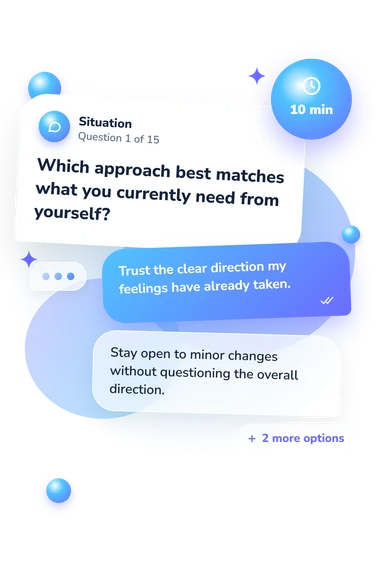
Each item offers four choices spanning friendship-centered comfort, mixed or conditional feelings, romantic pull, and unresolved uncertainty. The respondent selects the option that best fits the present connection, and the answers are read across the displayed scales rather than as isolated verdicts. No single response is treated as decisive.
Conceptually, the structure is consistent with Reeder (2000), which distinguishes attraction from friendship in cross-sex friendship, and with Messman, Canary, and Hause (2000), which considers motives for remaining platonic and strategies for maintaining those friendships. Sternberg (1986) provides a broader model for distinguishing components of love. The questionnaire is conceptually consistent with these works, not a direct adaptation or validation of them.
In this format, the tool functions as a platonic or romantic love quiz, comparing desire, comfort, disappointment, imagined commitment, and clarity across related situations. It is an online self-reflection questionnaire without published norms or clinical validation. Its scores describe the respondent’s current perspective and cannot establish compatibility, mutual interest, or the relationship’s future. Honest answers matter because mood, context, and self-awareness can influence the profile.
- Reeder, H. M. (2000). 'I Like you... as a Friend': The Role of Attraction in Cross-Sex Friendship. Journal of Social and Personal Relationships, 17(3), 329-348. 10.1177/0265407500173002
- Messman, S. J., Canary, D. J., & Hause, K. S. (2000). Motives to Remain Platonic, Equity, and the Use of Maintenance Strategies in Opposite-Sex Friendships. Journal of Social and Personal Relationships, 17(1), 67-94. 10.1177/0265407500171004
- Sternberg, R. J. (1986). A Triangular Theory of Love. Psychological Review, 93(2), 119-135. 10.1037/0033-295X.93.2.119