
What Weapon Are You Quiz
How the Scales are Structured
Who Usually Takes This Test?
See How You Compare
Below is a preview of how scores are typically distributed across each scale.
Example Questions From the Test
- Find a quiet alternative that lets me preserve the principle.
- Follow the rule temporarily while considering other options.
- Ask the person responsible to clarify the rule and its purpose.
- Challenge the rule openly and explain the principle at stake.
- Prioritize one or two comfort items that make the trip enjoyable.
- Bring backups for the problem I would least want to face.
- Coordinate with others so we can divide useful supplies.
- Choose compact, multipurpose essentials and leave extra space.
- Measure, research, and prepare a detailed materials list.
- Practice the unfamiliar technique on spare material first.
- Invite capable friends and organize the work together.
- Start building and solve practical problems as they appear.
What Weapon Are You Quiz - Description and methodology of the test
Readers who want to examine how they respond to pressure, ambiguity, disagreement, and changing conditions can use the What Weapon Are You Quiz as a symbolic self-reflection exercise. The resulting profile from this what weapon am i quiz maps familiar choices to planning, timing, directness, adaptability, and persistence, giving a symbolic answer without assigning a fixed identity. It is intended for people curious about their everyday decision habits, not for assigning a fixed identity.
What This Assessment Explores
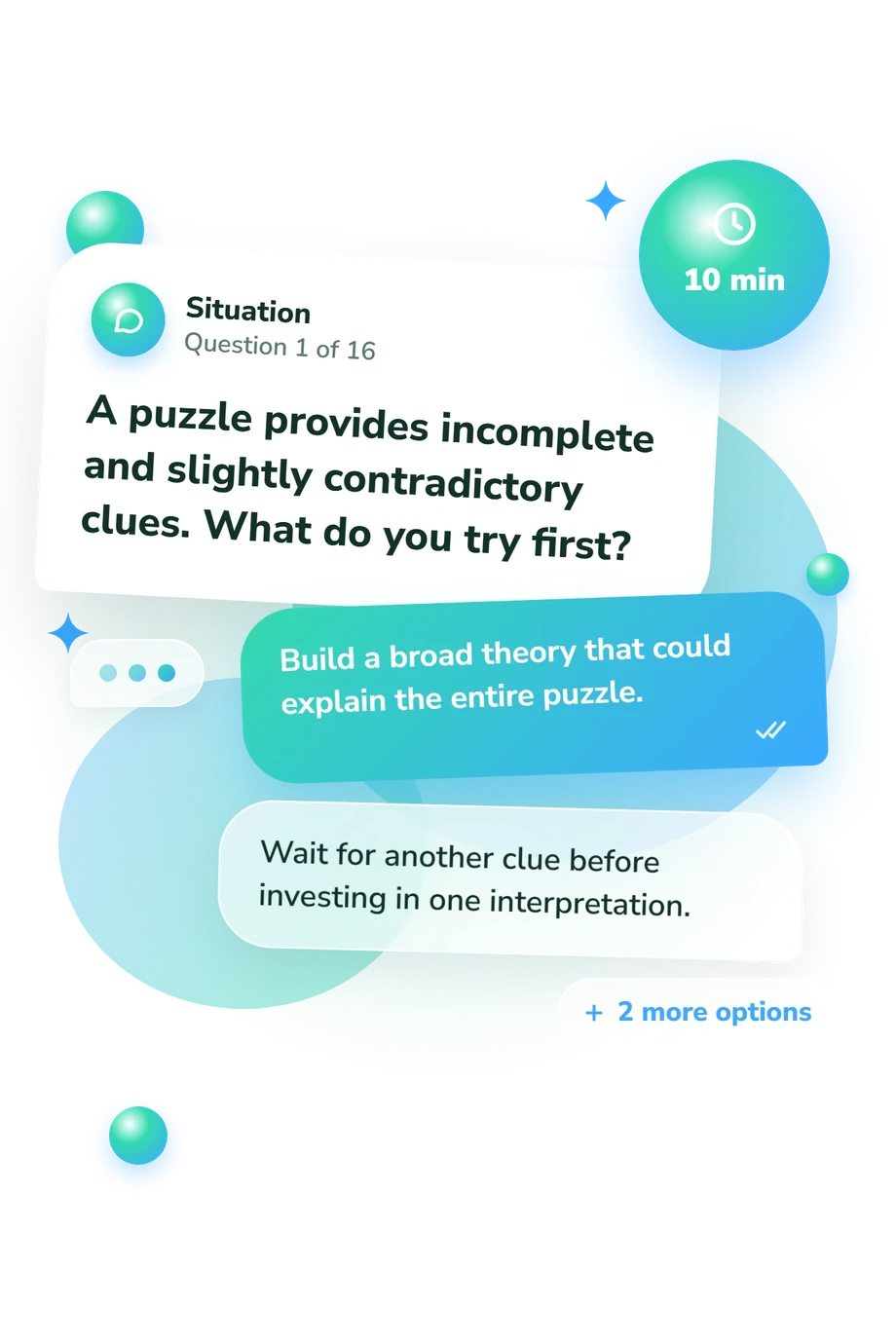
Scenarios cover incomplete clues, principles, social tension, practical limits, long projects, setbacks, and changing plans. Four weapon symbols organize the result dimensions and represent different approaches to obstacles in this weapon quiz.
The four result dimensions are:
- Bow (0-12) reflects patience, perspective, timing, and deliberate precision; its bands are Close-In Approach (0-4), Measured Aim (5-8), and Bow Affinity (9-12).
- Dagger (0-12) reflects agility, discretion, compact solutions, and precise intervention; its bands are Broad Approach (0-4), Agile Edge (5-8), and Dagger Affinity (9-12).
- Hammer (0-12) reflects momentum, persistence, visible impact, and hands-on effort; its bands are Reflective Approach (0-4), Constructive Power (5-8), and Hammer Affinity (9-12).
- Sword (0-12) reflects direct decisions, clear principles, and focused commitment; its bands are Indirect Approach (0-4), Balanced Blade (5-8), and Sword Affinity (9-12).
Methodology and Scientific Basis
Each item presents a situation with four responses. Choosing what feels natural makes the exercise a self-report of preferred approaches; the result summarizes four affinities rather than one type.
Each symbolic dimension receives a 0-12 score. The highest is the strongest affinity, and any result within one point of it contributes to a blended result. The displayed bands and blended-result rule show how this quiz answers what my weapon is and how the profile should be read, rather than implying an unstated point rule.
Its framework is conceptually consistent with the General Decision-Making Style Inventory (Scott & Bruce, 1995), which distinguishes decision approaches; this questionnaire is not an adaptation of that inventory. This four-symbol online questionnaire has no established norms or validation data, so its scores are descriptive reflections of response tendencies rather than standardized measurements.
This weapon personality quiz highlights how readers prepare, adapt, persist, or commit. Self-report answers can shift with current circumstances, mood, and self-awareness, so the profile is a prompt for reflection rather than a complete account of behavior.
- Scott, S. G., & Bruce, R. A. (1995). Decision-making style: The development and assessment of a new measure. Educational and Psychological Measurement, 55(5), 818-831. 10.1177/0013164495055005017
- Loo, R. (2000). A psychometric evaluation of the General Decision-Making Style Inventory. Personality and Individual Differences, 29(5), 895-905. 10.1016/S0191-8869(99)00241-X
- Thunholm, P. (2004). Decision-making style: Habit, style or both? Personality and Individual Differences, 36(4), 931-944. 10.1016/S0191-8869(03)00162-4
Updated: