
Buddhism Quiz
How the Scales are Structured
Who Usually Takes This Test?
See How You Compare
Below is a preview of how scores are typically distributed across each scale.
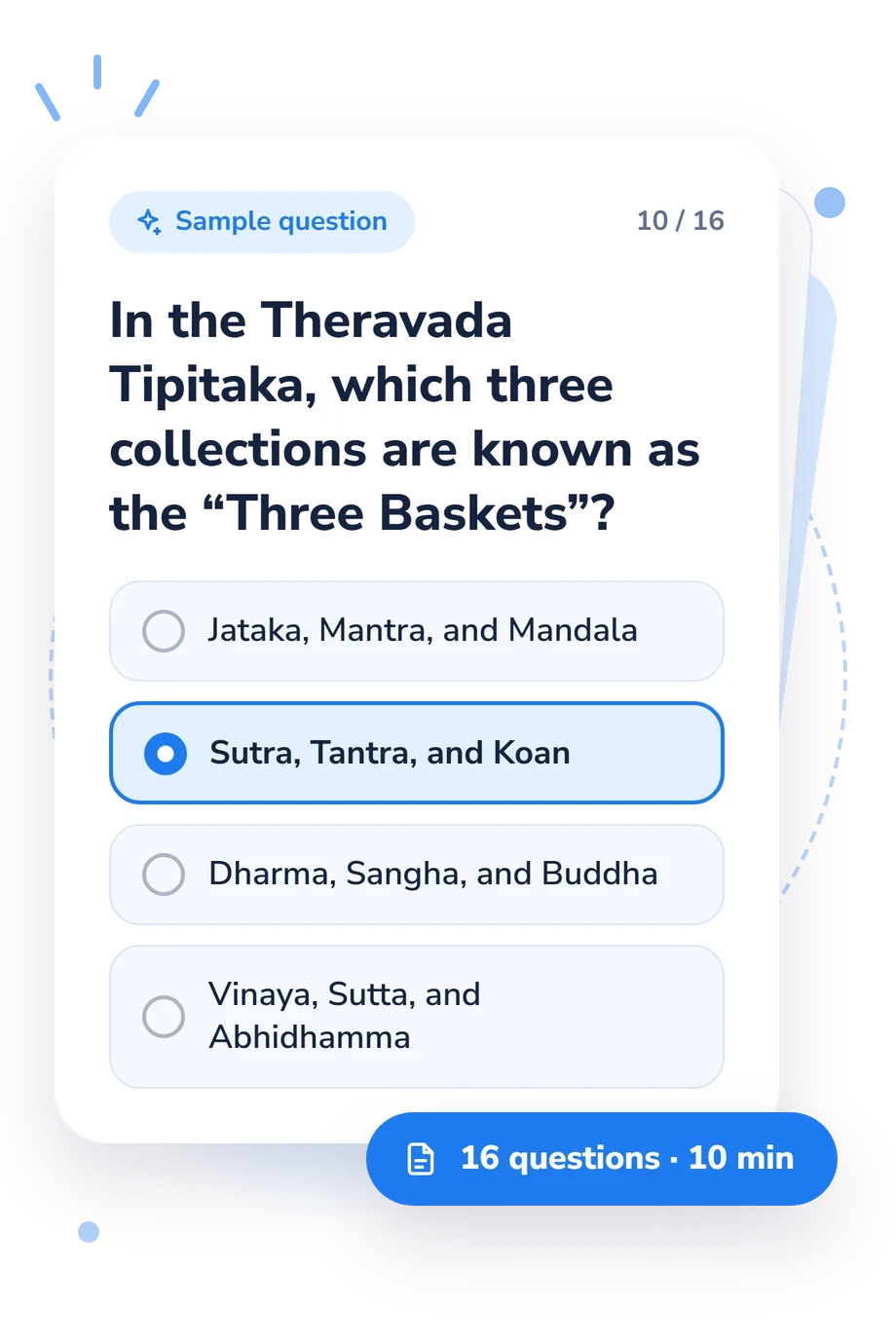
Example Questions From the Test
- Wisdom, concentration, and morality
- The Buddha, the Dharma, and the Sangha
- The Buddha, karma, and rebirth
- Compassion, mindfulness, and generosity
- The existence of a permanent, independent self
- The possibility of ethical action
- The value of meditation
- The reality of ordinary experiences
- Karma, the effects of intentional action
- Anicca, the impermanence of conditioned things
- Metta, the cultivation of goodwill
- Sangha, the community of practitioners
Buddhism Quiz - Description and methodology of the test
People revisiting Buddhist studies, preparing for discussion, or checking remembered material can use the Buddhism Quiz for a structured learning review. This Buddhist knowledge check tests whether key ideas can be recognized in context rather than asking for a report of spiritual identity or personal practice. Its single result places overall knowledge within a level, indicating whether introductory review may be useful.
What This Assessment Explores
The questions assess Buddhist knowledge rather than identity, spirituality, or wellbeing. They ask readers to connect teachings with examples, practices, terms, texts, and traditions. This Buddhist knowledge test is suited to learners who want to distinguish related concepts and see whether foundational ideas can be recognized in context.
The main themes are:
- Core teachings connect dukkha, craving, the Four Noble Truths, and the Eightfold Path.
- Ethics shows how intention, karma, speech, livelihood, and precepts relate to conduct.
- Meditation covers mindful awareness and metta as practices of attention and goodwill.
- Traditions distinguish Mahayana and Theravada ideas, the Three Jewels, anatta, and the Pali canon.
The result uses one scale: Buddhism Knowledge, 0-16. Foundation to build covers 0-6; Developing understanding covers 7-12; Strong understanding covers 13-16. The scale measures knowledge and practical meaning, not spiritual attainment, Buddhist identity, or mental wellbeing.
Methodology and Evidence Base
Each item presents a short question with four answer choices. Some test direct recall; others use scenarios involving an argument, donation, meditation, or a sand mandala to ask whether a teaching can be applied. The format therefore combines factual recognition with basic conceptual interpretation.
Questions about Buddhist teachings and practices frame this learning check about Buddhism. The questionnaire is conceptually consistent with Gethin (1998), whose work gives context for the Four Noble Truths, the path, karma, impermanence, and doctrine in practice. Williams, Tribe, and Wynne (2012) contextualize Indian Buddhist traditions; Bodhi (2005) gives canonical context, and Analayo (2021) addresses mindful awareness. These sources clarify subject matter; they do not validate the questionnaire or show that it reproduces a published instrument.
The result is a descriptive knowledge score interpreted through the displayed bands: it places overall performance in one of three levels rather than producing separate scores for doctrine, ethics, meditation, or traditions. Performance may also reflect prior education, wording interpretation, and current attention. An incorrect answer can indicate a recall gap without revealing spiritual attainment or a settled view about Buddhism.
- Rupert Gethin. The Foundations of Buddhism. Oxford University Press, 1998.
- Bhikkhu Analayo. The Buddha’s Awakening. Mindfulness, 12, 2141-2148, 2021. 10.1007/s12671-021-01649-x
- Paul Williams, Anthony Tribe, and Alexander Wynne. Buddhist Thought: A Complete Introduction to the Indian Tradition. 2nd ed. Routledge, 2012.
- Bhikkhu Bodhi, ed. In the Buddha’s Words: An Anthology of Discourses from the Pali Canon. Wisdom Publications, 2005.
Updated: