
Career Cluster Quiz
How the Scales are Structured
Who Usually Takes This Test?
See How You Compare
Below is a preview of how scores are typically distributed across each scale.
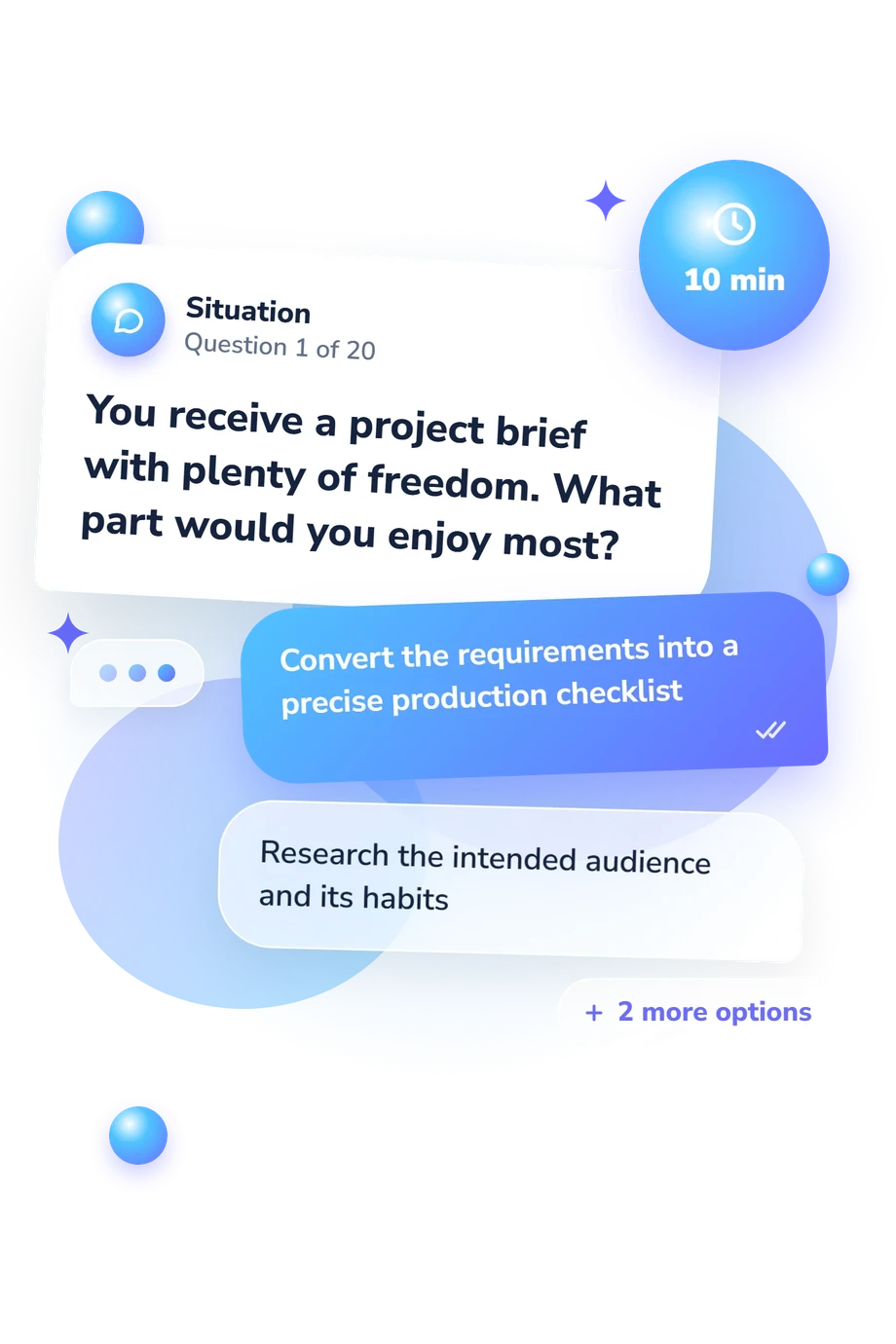
Example Questions From the Test
- Convert the requirements into a precise production checklist
- Research the intended audience and its habits
- Generate several original concepts and creative directions
- Refine the language, tone, and flow of the strongest concept
- Install and test the equipment the program will use
- Manage registration costs and supply purchases
- Interview residents to understand what support they want
- Lead a workshop that helps participants build a useful skill
- Mechanical systems, materials, and production methods
- Public programs, access to services, and community planning
- Human development, health, and wellbeing
- Teaching methods, communication, and learning differences
Career Cluster Quiz - Description and methodology of the test
For people choosing subjects, considering a career change, or feeling unsure about suitable work, this career cluster quiz offers a structured starting point. As a career interest assessment, it focuses on preferred activities and work settings rather than talent, credentials, or status. The profile helps readers compare broad directions and select occupations, courses, or experiences for closer investigation.
What This Assessment Explores
Items present situations and ask which task feels engaging. It is a career exploration quiz for comparing directions by interest, not ability or credentials.
These scales cover:
- Arts, Media & Communication (0-12) captures creative expression and audience communication; Limited pull 0-4, Possible fit 5-8, Strong affinity 9-12.
- Business, Law & Public Leadership (0-12) reflects interest in strategy, rules, negotiation, resource allocation, stakeholder influence, not leadership ability or authority; Limited pull 0-4, Possible fit 5-8, Strong affinity 9-12.
- Health, Education & Human Services (0-12) captures teaching, care, support, and wellbeing; Limited pull 0-4, Possible fit 5-8, Strong affinity 9-12.
- Science, Technology & Engineering (0-12) captures design, testing, coding, and modeling; Limited pull 0-4, Possible fit 5-8, Strong affinity 9-12.
- Skilled Trades, Agriculture & Operations (0-12) captures tools, equipment, land, logistics, and production; Limited pull 0-4, Possible fit 5-8, Strong affinity 9-12.
Methodology and Evidence Base
Each question presents a scenario with four contrasting options. You select the activity that feels most appealing, so the format captures relative preference among tasks rather than agreement with a personality statement. Options sample designing, helping, analyzing, coordinating, explaining, negotiating, and building. The result is shown as five displayed interest scales with the stated bands, allowing comparison among broad families.
Conceptually, the grouping aligns with the Career Clusters Interest Survey, a published survey linked to the 16-cluster framework. This questionnaire is consistent with that work, not an adaptation of its items. The five-family career cluster profile provides a broader overview than the 16-cluster framework, so it does not identify one specific cluster. General vocational-interest models such as Holland’s offer background, not the scoring basis or source model here.
The displayed bands support comparison among your own interest areas. The published survey reports reliability support but also notes restricted coverage and weak agreement with another interest measure. Interpret results with self-knowledge, experience, skills, values, and practical constraints; current context and self-perception can shift self-report choices.
- Prime, Dominic R., and Terence J. G. Tracey. (2010). Psychometric Properties of the Career Clusters Interest Survey. Journal of Career Assessment, 18(2), 177-188. 10.1177/1069072709354202
- National Association of State Directors of Career Technical Education Consortium. (2007). Career Clusters and Programs of Study: State of the States. Washington, DC: Author.
- Holland, John L. (1997). Making Vocational Choices: A Theory of Vocational Personalities and Work Environments (3rd ed.). Odessa, FL: Psychological Assessment Resources.
Updated: