
Should I Be a Manager Quiz
How the Scales are Structured
Who Usually Takes This Test?
See How You Compare
Below is a preview of how scores are typically distributed across each scale.
Example Questions From the Test
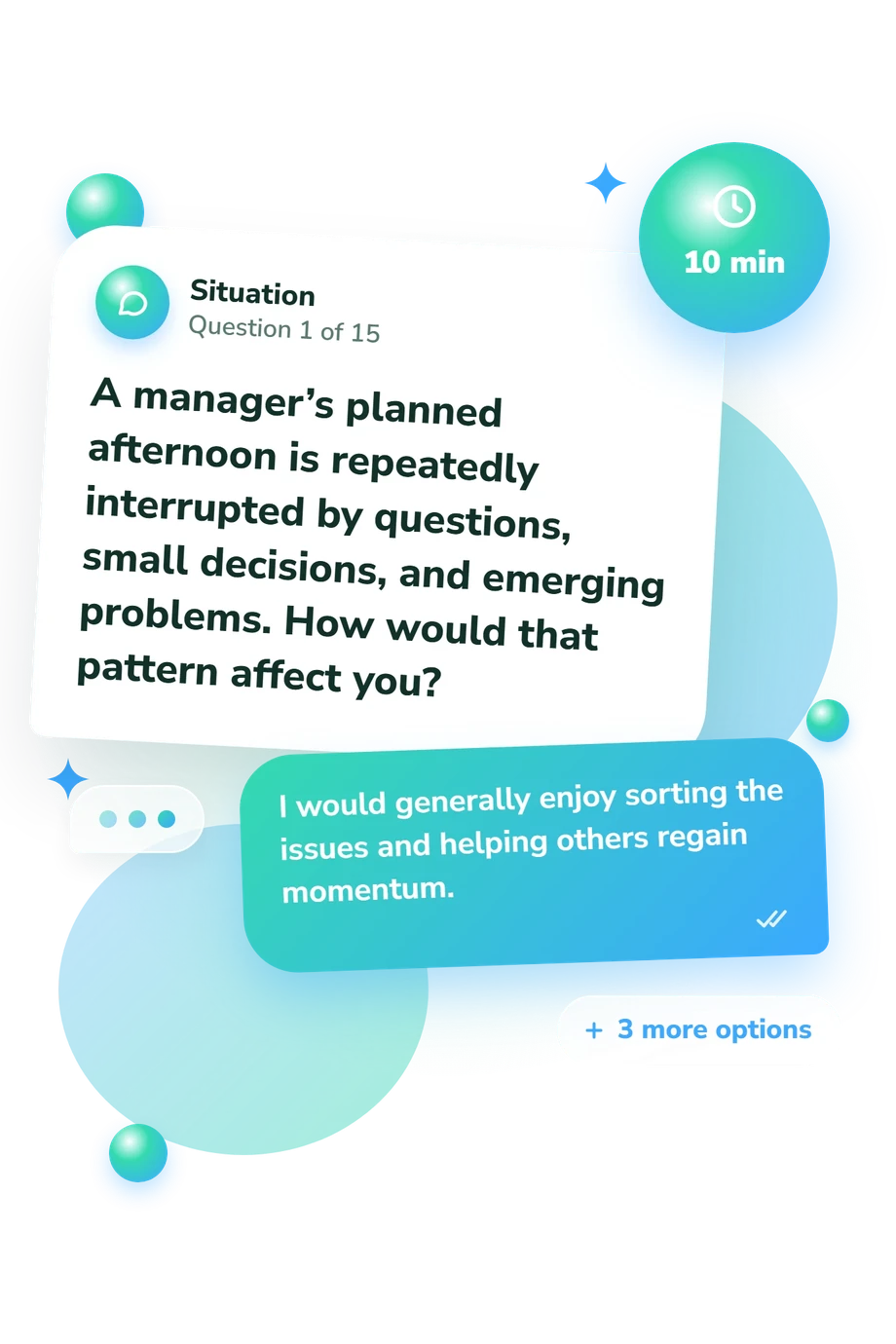
- I would generally enjoy sorting the issues and helping others regain momentum.
- I could handle it if I also had protected periods for focused work.
- I would enjoy the coaching questions but find the constant coordination draining.
- I would strongly prefer work where sustained concentration is the normal pattern.
- A combination of outcomes, quality indicators, workload signals, and relevant team context.
- Clear output measures such as completed work, deadlines, and service levels.
- Regular conversations about whether people feel the current workflow is sustainable.
- My overall impression from recent projects and stakeholder comments.
- I would rather advise the person responsible for the decision than communicate it myself.
- I could do it if a senior sponsor joined the conversation and shared responsibility.
- I am willing to own the message, explain the reasoning, and listen to their reactions.
- It reinforces my preference for a career path where I remain accountable mainly for my own work.
Should I Be a Manager Quiz - Description and methodology of the test
People considering a first management role, a return to leadership, or a specialist path can use the Should I Be a Manager Quiz to examine how their preferred way of working matches formal responsibility. The would i be a good manager quiz question is addressed through role interest alongside the operational and people-leadership approaches the role involves. It is designed for practical self-reflection before choosing a next step.
What This Assessment Explores
The questionnaire looks at fit with formal management through interruptions, accountability, prioritization, decisions, delegation, feedback, conflict, and support for colleagues. It describes current preferences rather than issuing one leadership verdict.
These are the displayed scales:
- Management Role Motivation (0-15) measures appeal of management responsibilities: Lower fit right now (0-5), Conditional interest (6-10), Strong motivation (11-15).
- Operational Management (0-15) measures prioritization, decisions, process improvement, and outcome tracking: Specialist-work preference (0-5), Developing manager toolkit (6-10), Strong operational alignment (11-15).
- People Leadership (0-15) measures coaching, delegation, tension, and adaptable support: Individual-contributor orientation (0-5), Emerging people leader (6-10), Strong people-leadership alignment (11-15).
For anyone asking whether they are ready to be a manager, this quiz places the three profiles alongside the role and work setting you are evaluating.
Methodology and Scientific Basis
Each item presents a workplace situation with four response options, so you choose your likely reaction. The scenarios sample motivation, operational judgment, and people-leadership behavior rather than abstract personality agreement. Results appear across the three scales, but the questionnaire does not publish each option’s contribution, a norming sample, or a standardized conversion rule; read scores as indicators within this questionnaire.
Its content is conceptually consistent with Weidmann et al. (2026) on delegation, coaching, coordination, and execution. It also aligns with Mael et al. (2001) on management aspiration, Chan and Drasgow (2001) on motivation to lead, and Mintzberg’s (1973) account of managerial work as varied, interruption-prone, relational, and decision-oriented. It is not an adaptation of those studies or instruments, which do not validate its scoring or interpretation.
Those asking whether they are ready to be a manager can compare this quiz's profile with the role. It can inform a management career fit by showing whether motivation, operational preferences, and people-leadership tendencies align. Self-report may reflect workload, confidence, experience, and self-image, so treat the result as a starting point.
- Weidmann, B., Vecci, J., Said, F., Bhalotra, S., Adhvaryu, A., Nyshadham, A., Tamayo, J., & Deming, D. (2026). How Do You Identify a Good Manager? The Quarterly Journal of Economics, 141(2), 1581-1633. 10.1093/qje/qjag004
- Mael, F. A., Waldman, D. A., & Mulqueen, C. (2001). From Scientific Work to Organizational Leadership: Predictors of Management Aspiration among Technical Personnel. Journal of Vocational Behavior, 59(1), 132-148. 10.1006/jvbe.2000.1783
- Chan, K. Y., & Drasgow, F. (2001). Toward a theory of individual differences and leadership: Understanding the motivation to lead. Journal of Applied Psychology, 86(3), 481-498. 10.1037/0021-9010.86.3.481
- Mintzberg, H. (1973). The Nature of Managerial Work. New York: Harper & Row.
Updated: