
20of 24
Your strength
Logical reasoning
Spotting the rule in number series, analogies and arguments — the skill behind planning and sound decisions.
IQ test · 70 tasks · free to start
Know your IQ. Know yourself better.
Solve 70 tasks on patterns, numbers, logic and memory to get your IQ score and a full cognitive profile.
No sign-up to startNo time limit
Rated 4.8 / 5 by 243,000+ Freudly users
Freudly has been featured on




How it works
Take the test, get your result and understand your strengths.
Answer 70 progressively challenging tasks inspired by Raven’s Progressive Matrices. No time limit — most people finish in 35–45 minutes.
See your IQ on the Cattell scale, your level and exactly how many people you outperform.
Explore your profile in logic, visual-spatial reasoning, memory and the hardest tasks — then ask Freudly AI what it means for you.
Your report
Find out where you stand, how you compare and what your score says about you.
Your cognitive report
IQ follows a normal distribution: mean 100, standard deviation 24 (Cattell scale).
Cognitive profile
See how each ability shows up in everyday life.
Spotting the rule in number series, analogies and arguments — the skill behind planning and sound decisions.
Rotating, folding and completing shapes in your mind — useful for maps, design, engineering and sport.
Holding digits, shapes and positions for a few seconds while you work with them.
How many of the 23 hardest tasks you cracked — your reserve for new, unfamiliar challenges.
Your ranking
88 of 100
In a room of 100 people, you would score higher than 88 of them.
Based on Freudly test takers, not the general population.
Benchmarking
See how you rank among everyone who took the same test — in plain, memorable numbers.
Also in your report
See which geniuses, inventors and leaders your IQ puts you next to.







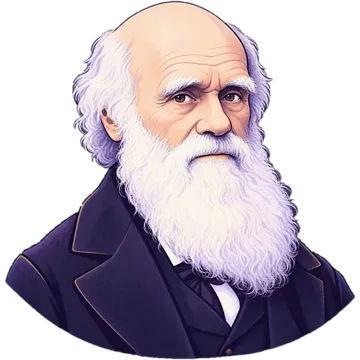


Estimated historical IQs, converted to the Cattell scale.
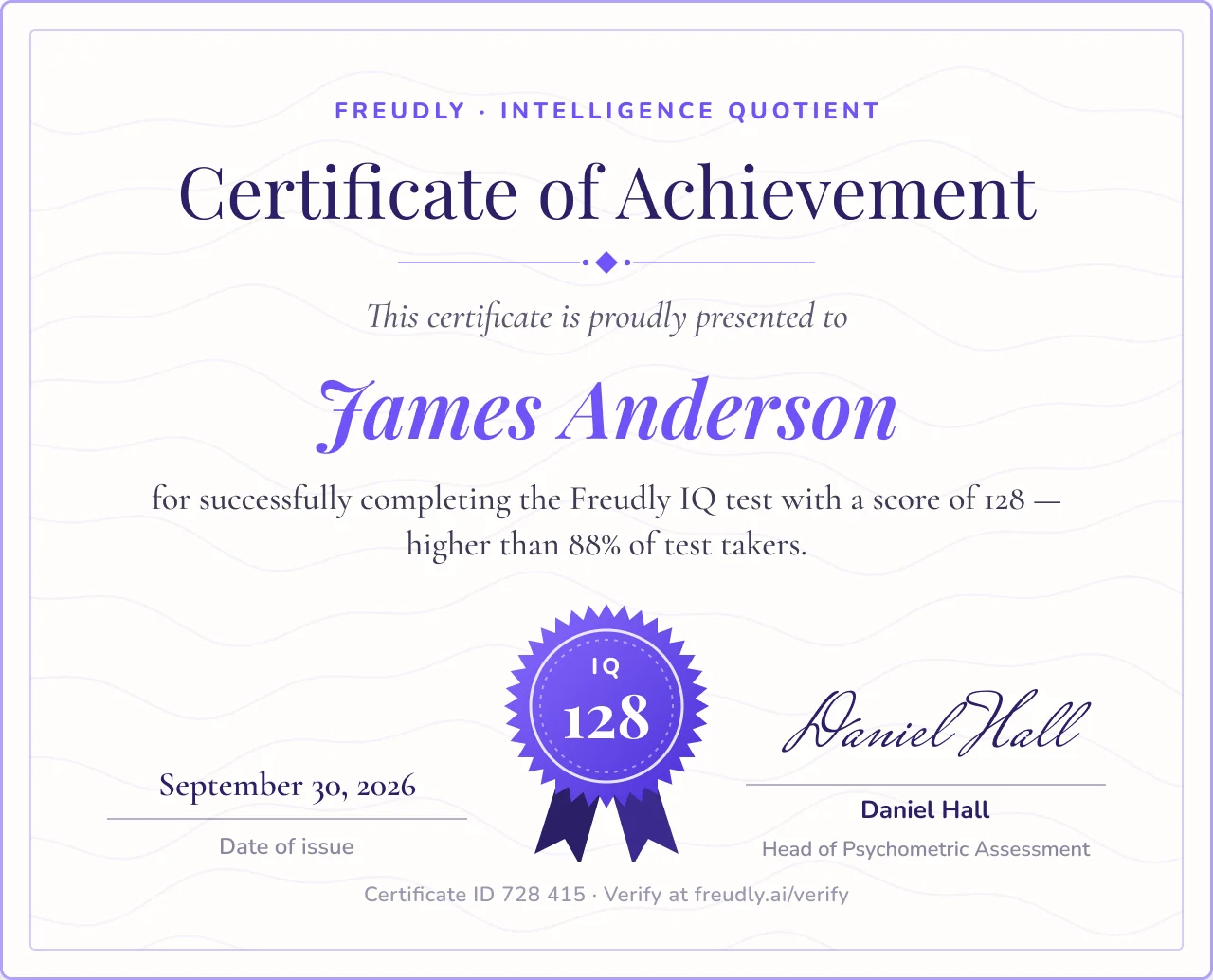
Verifiable credential
Download it, verify it and share your achievement any time.
 Freudly AIKnows your IQ-70 result
Okay, 128. What can you tell me about myself beyond the number?
Your mistakes caught my attention. You solved several hard patterns, yet missed simpler tasks built on the same principle.
And the answers you picked in those mistakes weren’t random: each one fits part of the rule. Almost everything checks out — except one detail.
So what does that mean?
Here’s a hypothesis: when a solution looks obvious, you stop checking it. A hard task makes you look closer — and you catch what you missed in the easy one.
Which leads to a curious thing: you may slip exactly where you feel most confident.
I’d show you the two tasks side by side. On their own, these answers are unremarkable. Together, there’s something to talk about.
Beyond the score
Ask anything about your score and get a plan built on your own profile. Everything is included in your membership.
Sample questions
Logic, two visual puzzles and a hard problem — the kind of tasks you’ll meet across all 70.
Tap an option to see the answer
Tap an option to see the answer
Tap an option to see the answer
Tap an option to see the answer
These are 4 of the 70 real tasks. No sign-up needed to start.
Reviews
The last third of the tasks really made me think. The profile showed exactly where I’m strong.
Mark T. · United States
Quick to start, no sign-up, and the memory tasks were a nice surprise.
Laura M. · Canada
I liked that the result explains each ability instead of giving me just a score.
Daniel R. · United Kingdom
Matrices, cube nets, number series — the variety kept me focused to the very end.
Sofia P. · Spain
No time limit made it far less stressful. I took my time and still finished in about 40 minutes.
Chris W. · Australia
Asking Freudly AI why my memory score was lower gave me a real plan, not a generic tip.
Nina K. · Germany
Pricing
Take the test for free. Unlock your full report with a 3-day free trial. Cancel anytime.
Freudly membership
The test is free. Your trial starts only if you choose it after your result and lasts 3 days. Unless you cancel before it ends, it renews at $18.99 every month. Cancel anytime in your account or at hello@freudly.ai.
Secure payment by Stripe
FAQ
Everything you need to understand your mind — in one place. Your full IQ report with a cognitive profile across four abilities, Freudly AI interpretation, unlimited AI sessions, a personal growth plan, 3,700+ psychological tests and a mood journal with daily AI insights. One membership, zero limits.
In two clicks, any time — right in your account settings or with one email to hello@freudly.ai. No calls, no hoops. You keep full access until the end of the period you’ve paid for.
The average is 100. Hit 116+ and you’re above average, 132+ puts you in the high range, and 148+ lands you in the top 2% — genius territory shared with the names in our historical gallery. Where do you land? There’s only one way to find out.
Precisely. Every correct answer earns 1, 2 or 3 points depending on difficulty, and item response theory converts your total into IQ on the Cattell scale — the same logic professional psychometricians rely on. The result: an accurate IQ test score you can trust and compare.
Yes. It is a legit test of fluid reasoning built on the Horn and Cattell model and reviewed by a psychologist: every task has one correct answer, and your score is reported on the Cattell scale. There is no official IQ test online, though — the WAIS, WISC and Stanford–Binet are given one-to-one by a licensed psychologist, and only they count for school, medical or legal purposes.
Right here, online and free to start. For the most reliable score, do it in one sitting, somewhere quiet. If you need an official result, contact a licensed psychologist or a university psychology clinic.
Not quite. Most IQ quizzes are a handful of puzzles for fun, with no scoring model behind them. An IQ test uses tasks of graded difficulty and converts your answers to a standard IQ scale.
Look for four things: enough tasks to be reliable, more than one ability measured, a published scoring method and a named IQ scale. Very short quizzes give only a rough guess. This test meets all four, and you can check its methodology on this page.
100%. Your results are yours alone — nobody sees them unless you decide to share. Rankings are fully anonymous, and your data can be deleted at any moment on request.
Yes — and that’s the exciting part. Mental training, learning, quality sleep and the right habits sharpen memory, focus and pattern recognition. Freudly AI builds a personal plan around your weakest ability, so you can see real progress the next time you test your IQ.
Your potential doesn’t expire. Processing speed may slow over the years, but vocabulary, knowledge and strategic thinking keep growing well into later life. Test yourself today and track how your mind evolves.
Genes deal the cards, but you play the hand. Heredity sets a starting range, while education, environment and daily habits decide how far you go. Your profile shows exactly where your untapped potential lies.
About 35–45 minutes for 70 tasks — shorter than a movie and far more revealing. There’s no time limit, so you can think at your own pace and get the most accurate result. A quick IQ test of 10–15 questions takes less time, but it is too short to measure several abilities reliably.
Yes — this is a free IQ test with instant results: your answers are scored the moment you finish, and no sign-up is needed to start. To unlock your full report, certificate and AI insights, start a 3-day free trial. After that it’s $18.99 per month unless you cancel.
What the test measures
This IQ test measures how you reason on material you have never seen before. It has 70 IQ test questions with one correct answer each and takes about 35–45 minutes. There is no time limit: the score depends on what you solve, not on how fast.
A correct answer earns 1, 2 or 3 points for an easy, medium or hard task; a wrong answer earns nothing. The total, from 0 to 157, is converted to IQ on the Cattell scale (mean 100, standard deviation 24) with a three-parameter item response model that accounts for task difficulty and the 25% chance of guessing.
The core of the test is fluid reasoning — solving new problems without relying on learned knowledge — as described by Horn and Cattell (1967). The matrix tasks follow the format made familiar by Raven’s Progressive Matrices; the items themselves are original.
Take the test in one sitting, somewhere quiet. Memory material is shown only once. If you are unsure, go with your best guess. Your first attempt is the most accurate.
70 tasks. 35–45 minutes. Your full profile at the end.
Free to start · No sign-up needed · No time limit
An IQ test is a set of reasoning tasks scored on a common scale: your IQ shows how your result compares with other people’s, not how much you know. Below is how to read the result of this test, how it relates to the scales other tests use, and what an online test can and cannot tell you. How the test is built and scored is covered in the methodology section above.
The results of this free IQ test are reported on five scales: the overall IQ and four abilities.
| Scale and range | Levels |
|---|---|
| IQ (overall)0–196 | Below average 0–83Average 84–115Above average 116–196 |
| Logical reasoning0–24 | Low 0–10Average 11–17High 18–24 |
| Visual-spatial reasoning0–36 | Low 0–12Average 13–25High 26–36 |
| Memory0–10 | Low 0–3Average 4–6High 7–10 |
| Hard problems0–23 | Low 0–6Average 7–10High 11–23 |
The ability scales count correct answers, and their Average band corresponds to an IQ of roughly 84–116 under the same model. A High score on one ability next to an Average IQ is therefore not a contradiction: it shows where your reasoning is strongest.
All IQ scales put the mean at 100, but they differ in spread. This test uses the Cattell scale, with a standard deviation of 24; the Wechsler scale behind most clinical tests uses 15. The same result therefore looks higher on the Cattell scale: 124 on Cattell and 115 on Wechsler describe the same position. Compare percentiles, not the numbers themselves.
| Cattell (SD 24) | Wechsler (SD 15) | Higher than about |
|---|---|---|
| 76 | 85 | 16% of people |
| 100 | 100 | 50% of people |
| 116 | 110 | 75% of people |
| 124 | 115 | 84% of people |
| 132 | 120 | 91% of people |
| 148 | 130 | 98% of people |
These percentiles come from the theoretical normal distribution. The ranking in your report is calculated among people who took the test on Freudly.
Even the most accurate IQ test gives a slightly different score from day to day. These factors matter most:
Clinical intelligence tests, such as the Wechsler scales (WAIS, WISC) or the Stanford–Binet, are given one-to-one by a trained psychologist. They cover more abilities, including verbal comprehension and processing speed, are normed on large representative samples and are used for diagnosis, school placement and legal decisions. There is no official online version of these tests.
This is a real IQ test of fluid reasoning, but it is a self-assessment. It gives a well-grounded estimate of your IQ and a profile of your abilities, but it is not a medical or psychological diagnosis and does not replace an assessment by a specialist. If you need a result for official purposes, see a licensed psychologist.