
Trypophobia Test
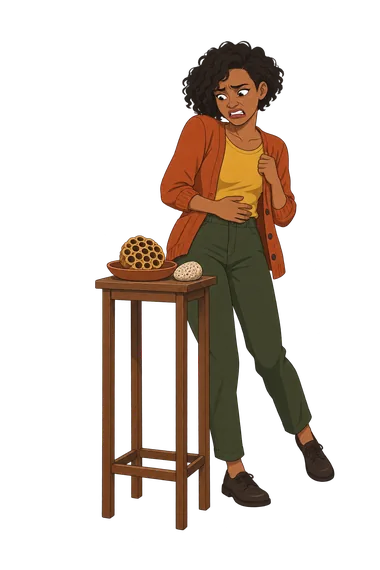
How the Scales are Structured
Who Usually Takes This Test?
See How You Compare
Below is a preview of how scores are typically distributed across each scale.
Example Questions From the Test
- Strongly disagree
- Disagree
- Not sure
- Agree
- Strongly agree
- Strongly disagree
- Disagree
- Not sure
- Agree
- Strongly agree
- Strongly disagree
- Disagree
- Not sure
- Agree
- Strongly agree
Trypophobia Test - Description and methodology of the test
Some people scroll past a lotus seed pod without a second thought, while others feel their skin crawl at the first glance. This trypophobia test measures how strongly clusters of small holes get to you and turns the answer into one clear number. Think of it as a trypophobia quiz for anyone who has ever winced at honeycomb, coral or the bubbles rising in pancake batter.
What your trypophobia score measures
Your result opens with an overall trypophobia score from 0 to 100. It is built from three parts, each scored on its own. Disgust is the first gut reaction: the instant «ew» at a lotus pod, the queasy moment at holes in old wood and the feeling that a tight cluster looks wrong. Body reaction covers what your skin does, from goosebumps and a sudden shudder to tingling palms and the urge to scratch. Looking away is what happens next, whether you scroll past a picture, cover the screen with your hand or leave a holey sponge on the shelf. If you have ever asked yourself do I have trypophobia, these three parts give a sharper answer than a simple yes or no, because most people react strongly in one area and stay calm in another.
How it works and how to read your result
There are twenty-seven short statements, and most people finish in about seven minutes. Each one names a familiar trigger, such as strawberry seeds, sea sponges, a cluster of holes in rock or skin-like textures, and you choose how much you agree. Nine statements describe a calm reaction to the same things and are scored in reverse. The test shows no pictures, so you answer from memory. Your result includes:
- your trypophobia score from 0 to 100 with a plain label;
- separate scores for disgust, body reaction and looking away;
- your strongest reaction and your calmest side;
- a comparison with other people who answered the same statements.
The reaction is often called a fear of holes, yet for most people it feels more like disgust than fear. Your three parts show which word fits you better. Friends often take the test on the same evening and compare numbers, and the gaps between them can be surprisingly wide.
- Le, A. T. D., Cole, G. G., & Wilkins, A. J. (2015). Assessment of trypophobia and an analysis of its visual precipitation. Quarterly Journal of Experimental Psychology, 68(11), 2304-2322.
- Imaizumi, S., & Tanno, Y. (2018). Rasch analysis of the Trypophobia Questionnaire. BMC Research Notes, 11, 128.
- Kupfer, T. R., & Le, A. T. D. (2018). Disgusting clusters: trypophobia as an overgeneralised disease avoidance response. Cognition and Emotion, 32(4), 729-741.
- Le, A. T. D., Cole, G. G., & Wilkins, A. J. (2020). Trypophobia: Heart rate, heart rate variability and cortical haemodynamic response. Journal of Affective Disorders, 274, 1147-1151.
Updated: