








ADHD Test

In just 2 minutes, see how strongly adult ADHD symptoms may be affecting your daily functioning. This ADHD Test — based on the WHO-developed ASRS-5 scale — uses six DSM-5 aligned items to flag concerns and guide your next steps toward evaluation or support.
Start Online Test
Questions62 minutes
Hi! My name is Freudly, i am an AI therapist, I will give you an interpretation of the test after you complete it.
08:30
October 2, 2025
October 2, 2025
Material has been updated
21,863 views
2,540 completions
1,754 likes
Verified by Daniel Hall
Psychologist with 25 years of experience
Share
Scale Explorer

How the Scales are Structured

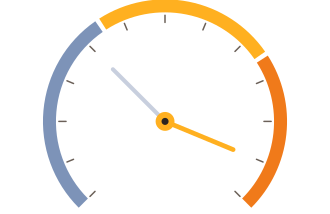
example score
16/24
ADHD Diagnostic Scale (ADS)
Measures the frequency and impact of adult ADHD-related inattention and hyperactivity/impulsivity symptoms over a brief self-report screen.
Lower symptom level
Moderate symptom level
Higher symptom level
07Lower symptom level815Moderate symptom level1624Higher symptom level
A score of 16 falls in the Higher symptom level range, indicating more frequent self-reported ADHD-related symptoms on this screening scale.
Start Online Test
just completed the test
DATA-BASED USER COHORTS

Who Usually Takes This Test?

Adults noticing ADHD signs
46%OF USERS
People who struggle with focus, forgetfulness, impulsive decisions, or inner restlessness use it to check whether their symptoms match common ADHD patterns.
Patients awaiting evaluation
32%OF USERS
Adults who are considering or scheduled for a clinician visit take it to organize their symptoms and support a more informed conversation.
Clinicians and researchers
22%OF USERS
Health professionals and study teams use it as a quick screening measure to estimate symptom severity and track change over time.
BASED ON AGGREGATED, ANONYMIZED DATA FROM TENS OF THOUSANDS OF FREUDLY USERS.
Benchmarking

See How You Compare

Once you complete the test, your results are compared with real-world data from people in your country.
Below is a preview of how scores are typically distributed across each scale.
ADHD Diagnostic Scale (ADS)
Average
12.1
Normal range
8.615.7
min.
0
max.
24
Majority
This curve shows how scores are typically distributed.
Once you complete the test, your result will appear on the scale so you can see how you compare.
Featured On
CLEAR ANSWERS TO COMMON QUESTIONS

Frequently Asked Questions

What does this ADHD Test measure?
It screens for current symptoms of inattention and hyperactivity-impulsivity in adults based on DSM-5 criteria. It provides a brief, structured indication of symptom frequency and overall severity to support decisions about whether further clinical evaluation is warranted.
Who can complete it?
It is intended for adults wondering "do I have ADHD?" as well as clinicians and researchers using it as a rapid ADHD screening measure. It is not designed for children or adolescents.
How long does it take and how many items are included?
The questionnaire contains 6 questions and typically takes about 2 minutes to complete. All items should be answered to allow accurate scoring. No specialist knowledge is required.
How should responses be selected?
Each item should be rated based on how often the symptom occurred over the recent period indicated in the instructions. Responses should reflect your typical functioning rather than an isolated or unusual day.
What is the difference between ADHD and ADD?
ADD is an older term previously used to describe the inattentive presentation of ADHD without prominent hyperactivity. Under current DSM-5 criteria, this is classified as ADHD, predominantly inattentive type. This ADHD quiz covers both inattentive and hyperactive-impulsive symptom domains.
Does a positive result on this ADHD Test confirm a diagnosis?
No. A positive screen indicates that reported symptoms are consistent with attention-deficit/hyperactivity disorder and that a comprehensive clinical evaluation is recommended. Formal diagnosis requires a clinician assessment considering developmental history, functional impairment, and alternative explanations.
What should I do if my ADHD Test results suggest elevated symptoms?
We recommend discussing your results with a psychiatrist or psychologist experienced in adult ADHD assessment. Your ASRS-5 score provides a useful starting point for a more targeted clinical conversation and can help guide next steps toward formal evaluation or support.
WHAT THE TEST MEASURES
About This Assessment
Adult ADHD Diagnostic Scale, ASRS-5 Test

The Adult ADHD Self-Report Scale (ASRS-5) is a brief, clinically validated self-report screener used to identify the likelihood of clinically significant attention-deficit/hyperactivity disorder symptoms in adults. Developed in collaboration with the World Health Organization, it is intended to support initial case finding and guide whether a more comprehensive clinical evaluation may be warranted. The ASRS-5 is one of the most widely used online ADHD tests in both clinical practice and research settings worldwide.

Why Take an ADHD Test Like the ASRS-5

Attention-deficit/hyperactivity disorder is frequently underrecognized in adults. Many individuals who struggle daily with inattention, impulsivity, and difficulty regulating focus have never received a formal evaluation — either because their symptoms were attributed to stress, anxiety, or personality traits, or because ADHD in adults presents differently than the hyperactive stereotype associated with childhood diagnoses.

Adults with unidentified ADD or ADHD commonly report chronic difficulties with executive function — including task initiation, time management, working memory, and sustained concentration — that significantly impact professional performance, relationships, and self-esteem. A structured ADHD quiz like the ASRS-5 provides a fast, evidence-based way to assess whether these difficulties align with recognized DSM-5 symptom patterns and whether a clinical consultation may be warranted.

What the Assessment Measures

The ASRS-5 consists of 6 items and typically takes about 2 minutes to complete. Items ask respondents to rate the frequency of core symptoms over a defined recent timeframe — the two primary domains recognized in DSM-5 criteria:

  • Inattention — difficulty sustaining focus, making careless errors, losing track of tasks, forgetting obligations, and being easily distracted by external stimuli
  • Hyperactivity and impulsivity — restlessness, difficulty remaining seated, talking excessively, interrupting others, and acting before thinking

Results indicate whether symptom frequency falls within ranges consistent with lower, moderate, or higher ADHD symptom burden. Scores should always be interpreted in the context of developmental history, functional impairment across settings, and differential diagnosis.

Who Should Take This ADHD Test

This screening is appropriate for any adult who suspects that attention, concentration, or impulse control difficulties may be affecting their daily life — whether at work, in relationships, or in personal organization. It is particularly relevant for individuals who have long managed these challenges without a clear explanation, or who are preparing for a first clinical conversation about possible ADD or ADHD symptoms.

It is also widely used by clinicians and researchers as a rapid first-step measure to estimate symptom severity and track change over time.

Clinical Validity and Use in Practice

The ASRS-5 has been validated in large international studies and is endorsed by the World Health Organization for adult ADHD screening. A positive screen indicates that symptoms are consistent with attention-deficit/hyperactivity disorder and that further clinical evaluation is recommended — it does not confirm a diagnosis. Formal diagnosis requires a comprehensive clinician assessment incorporating developmental history, functional impairment, and consideration of alternative explanations. If your results suggest elevated symptoms, discussing them with a psychiatrist or psychologist is the appropriate next step.

Author: psytests.org (2024)
Literature: Kessler, R. C., Adler, L., Ames, M., et al. The World Health Organization adult ADHD self-report scale (ASRS). Psychological Medicine. 2005.; Ustun, B., Adler, L. A., Rudin, C., Faraone, S. V., Spencer, T. J., Berglund, P., Gruber, M. J., & Kessler, R. C. The World Health Organization adult attention-deficit/hyperactivity disorder self-report screening scale for DSM-5. JAMA Psychiatry. 2017.
Test Question Form
You Might Also Like
Wender Utah Rating Scale (WURS)
When adults present with suspected ADHD, a retrospective appraisal of child…
Start Test
Adult ADHD Self-Report Scale (ASRS)
This measure is a brief self-report screener for symptoms commonly associat…
Start Test
Adult Attachment Scale (AAS)
This self-report measure evaluates adult attachment-related attitudes in cl…
Start Test
Popular tests
Narcissistic Personality Inventory (NPI)
This self-report measure is used to assess narcissism as a personality trai…
Start Test
Yale-Brown Obsessive Compulsive Scale (Y-BOCS)
This measure is used to rapidly quantify the current severity of obsessive…
Start Test
CRAFFT Screening Test (CRAFFT 2.1)
This brief screening measure is designed to identify potential alcohol and…
Start Test
Patient Health Questionnaire-9 (PHQ-9)
This measure is commonly used to quickly screen for the presence and severi…
Start Test
Maslach Burnout Inventory (MBI)
This self-report measure is used to assess occupational burnout symptoms in…
Start Test
Adolescent Anxiety Questionnaire
This measure is designed to support a brief appraisal of anxiety symptoms a…
Start Test
Emotional Creativity Inventory (ECI)
This self-report measure assesses individual differences in the originality…
Start Test
Horne–Ostberg Morningness–Eveningness Questionnaire (MEQ)
Circadian preferences influence typical patterns of alertness and sleep tim…
Start Test
Ambivalent Sexism Inventory (ASI)
This measure is designed to assess attitudes toward women, including both o…
Start Test
Internalized Misogyny Scale (IMS)
This measure is designed to assess internalized negative beliefs and stereo…
Start Test
Perceived Stress Scale (PSS-10)
This self-report measure assesses the degree to which individuals appraise…
Start Test
Impulsive Behavior Scale (SUPPS-P)
Impulsivity is a multidimensional construct that is often assessed with bri…
Start Test
Clinical Institute Withdrawal Assessment for Alcohol, Revised (CIWA-Ar)
This rating scale is used to rapidly assess the severity of alcohol withdra…
Start Test
Positive and Negative Affect Schedule (PANAS)
This measure provides a brief self-report assessment of current or typical…
Start Test
Light Triad Scale (LTS)
This self-report measure assesses prosocial personality tendencies and orie…
Start Test
Suicidal Ideation Scale
In clinical settings, the Suicidal Ideation Scale is used to structure an i…
Start Test
Body Dysmorphic Disorder Scale (BDD-D)
This brief self-report measure is designed to screen for and quantify distr…
Start Test
Beck Anxiety Inventory (BAI)
This measure is a brief self-report inventory used to screen for anxiety sy…
Start Test
Differential Test of Perfectionism
This instrument is used to screen for perfectionism-related attitudes and t…
Start Test
Locus of Control Scale
This measure assesses generalized expectancies regarding the degree to whic…
Start Test
New Apathy Scale
This brief self-report measure is used to screen for apathy-related symptom…
Start Test
Perth Alexithymia Questionnaire (PAQ)
This measure assesses individual differences in alexithymia, including diff…
Start Test
Social Intelligence Scale
This brief self-report measure is designed to support rapid screening of in…
Start Test
Fear Test
This measure is designed to evaluate individual differences in fear-related…
Start Test
Neuroticism Level Scale
The measure is intended for brief screening of an individual’s propensity t…
Start Test
Aggressiveness Indicators Screening Questionnaire
This screening tool is designed to quickly identify behavioral indicators a…
Start Test
Comments
Leave a Comment