













Freudly+971 508685814hello@freudly.ai
Freudly
archetypes
Free Archetype Test: Find Your Jungian Archetype - FreudlyFree archetype test: 60 statements reveal which of the 12 Jungian archetypes leads your personality, your secondary archetype and your shadow side.en

12 archetypes · free test

Archetype Test

Which archetype am I⁠—and what does it explain about the choices I keep making?

Discover the motive behind the choices you repeat: what pulls you toward challenge, freedom, closeness or control⁠—and which side of yourself you tend to push away.

Free to take · no sign-up
Your answers stay private

Rated 4.8 / 5 by 243,000+ Freudly users

480+ people have taken this test on Freudly

The Explorer

Very high

The Creator

High

Shadow · The Ruler

Very low

Example result

Your archetype constellation

Leading

Very high

Secondary

High

Shadow

Very low

Leading family

Freedom & meaning

High

Freudly has been featured on

FOX

USA TODAY

CNN

Forbes

FOX

USA TODAY

CNN

Forbes

FOX

USA TODAY

CNN

Forbes

480+ people took this test on Freudly⁠—to see what guides their choices.

12

Distinct motives you may recognise

4

Motivation families

60

Everyday statements about real choices

1

Personal reading

Sound familiar?

The choice changes. The motive often doesn’t.

The same need can show up at work, in love and in the way you rest. See which of these moments feels familiar.

The Hero

One more, then I’ll stop

Everyone has gone home, and you’re still crossing things off. “One more. Okay — one more.” Rest feels like losing.

The Explorer

Fine here, still restless

Good job, nice flat, kind people. “Everything here is fine. So why do I want to leave?”

The Caregiver

Always the one who comes

Someone calls, and you’re already packing food for them while your own plate goes cold. “No, I’m fine, really.”

The Jester

The joke that saves the evening

The table goes quiet, you say something funny, everyone laughs. “If they’re laughing, nobody has to say it.”

The Sage

Understanding comes first

Fourteen tabs open to choose a kettle. “I just need to understand how it works first.”

The Rebel

“Who decided this?”

Someone says “that’s how it’s always been done,” and something in you sits up. “Then let’s do it differently.”

Recognised yourself in opposite scenes?

The test shows which motive leads most often, which one supports it and where an inner conflict keeps asking you to choose.

Try three statements

What does one answer already say about you?

Choose what fits your usual life, not who you think you should be.

Choose an answer to see what it says about you

Real statement

From the test

The Rebel · Leaving a mark

Hearing “that’s how it has always been done” makes me want to do it differently.

A pointless rule wakes your urge to challenge it

“That’s how it’s done” makes you test whether a rule still deserves respect. Other answers show whether this is a steady drive or appears only when a rule gets in the way of something important.

A pointless rule wakes your urge to challenge it

A familiar way of doing things suits you: if it works, there is no reason to change it. Other answers will show what matters more to you — reliability, caring for people or order.

A pointless rule wakes your urge to challenge it

You don't challenge rules for the sake of it, but you will suggest your own way when the old one clearly gets in the way. Other answers will show where you look for the new and where you keep to what works.

Real statement

From the test

The Caregiver · Structure

I find it easier to look after others than to let anyone look after me.

Caring comes easier than being cared for

You may notice other people’s needs before your own and feel awkward receiving help. Other answers show whether care is a free choice for you⁠—or a duty that quietly drains you.

Caring comes easier than being cared for

Accepting care comes easily: you let people help you. Other answers will show which role you tend to take with others.

Caring comes easier than being cared for

You look after others and let them look after you, depending on the moment. Other answers will show when caring gives you energy and when it drains it.

Real statement

From the test

The Jester · Connection

Even in serious situations, I cannot help noticing the absurd side.

Humour helps you make tension bearable

You notice the absurd even when things are serious, which can free everyone to breathe. Other answers show when humour helps you connect⁠—and when it lets you step around a feeling.

Humour helps you make tension bearable

In serious moments you stay focused on the matter at hand. Other answers will show what you lean on when things get hard.

Humour helps you make tension bearable

You almost always see the funny side, even when others aren't laughing. Other answers will show when humour brings you closer to people and when it helps you avoid what is hard.

Three real statements. See how your answers fit together.

How it works

From a familiar reaction to a motive you can use.

There are no right answers. The useful result is the one that sounds like your real life.

One honest answer

Being needed gives me a deep sense of purpose.

1

2

3

4

5

Not like me at all

Exactly like me

01

Answer honestly

Think about real days and different situations. Your first honest reaction is more useful than the answer that sounds admirable.

Your pattern takes shape

Mark

Freedom

Connection

Structure

Your answers are read together

02

See your pattern

Learn which motive leads, which one colours it and which energy you rarely let yourself use.

Drive

The Explorer

Support

The Creator

Avoided

The Ruler

Drive · Support · Shadow

03

Use it in real life

Connect the pattern to work, relationships and a choice in front of you, then talk one real situation through with Freudly AI.

Questions in your profile

Why control makes me so angry

Why I keep rescuing people

Which voice feels natural at work

Your motives

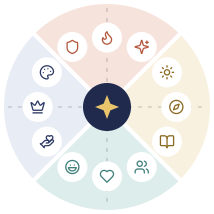
Four motives can pull at once. Your pattern shows which wins.

You may want freedom and closeness, impact and safety, all at once. The twelve archetypes show how you pursue those needs⁠—and where they start pulling against each other.

Leaving a mark

Connection

Structure

Freedom &
meaning

Opposite motives can both be strong

Two strong motives explain why one part wants to leave while another keeps taking responsibility for everyone.

Leaving a mark

Changing the world through courage, defiance or transformation.

The Hero

Courage, mastery and testing yourself against challenge.

The Rebel

Independence, defiance and the urge to change the rules.

The Magician

Vision, intuition and the power to transform.

What it seeks

Freedom & meaning

Searching for a life that is true, free and good.

The Innocent

Trust, hope and the wish for a simple, good life.

The Explorer

Freedom, discovery and a path of your own.

The Sage

Truth, understanding and independent thinking.

What it seeks

Connection

Belonging, closeness and joy shared with others.

The Everyman

Belonging, equality and down-to-earth realism.

The Lover

Intimacy, passion and sensitivity to beauty.

The Jester

Humour, play and living in the moment.

What it seeks

Structure

Building, protecting and giving the world a lasting shape.

The Caregiver

Compassion, protection and service to others.

The Ruler

Order, responsibility and leadership.

The Creator

Imagination, self-expression and making ideas real.

What it seeks

Your reading

See the motive behind your habits.

Your profile shows why you can crave freedom yet still take responsibility for everyone.

When responsibility is care⁠—not control

Why freedom can become another escape

When humour helps⁠—and what it avoids

A personal-brand voice you can sustain

Your archetype pattern

Example · all 12

01

The Explorer

Leading

Very high

02

The Creator

Secondary

High

03

The Sage

High

04

The Magician

High

05

The Lover

Moderate

06

The Rebel

Moderate

07

The Jester

Moderate

08

The Hero

Moderate

09

The Innocent

Low

10

The Caregiver

Low

11

The Everyman

Low

12

The Ruler

Shadow

Very low

What it reveals

Freedom leads and creation follows: new ground matters most when you can leave something of your own on it. With the Ruler last, other people’s control gets under your skin⁠—but your best ideas may stall when nobody turns them into a plan.

Example profile. Your reading is built from your own answers.

Inside your profile

How you act under pressure

What really drives your decisions

How you love — and whom you choose

How you work and lead

Your inner tug-of-war: archetypes pulling you apart

Where your energy leaks

How other people see you

Your archetype as a personal brand

Three steps for the coming weeks

Meet your shadow

What you reject in others may be missing in your own life.

Jung called the shadow the part of ourselves we hide and often judge in others. Your profile shows which energy you use least⁠—and what it could add to your life.

Your archetypes, from familiar to avoided

Explorer

Creator

Sage

Magician

Lover

Rebel

Jester

Hero

Innocent

Caregiver

Everyman

Ruler

Shadow · The Ruler

The energy you reach for least

What you avoid

Taking charge, setting the rules, being the one everyone answers to. Control feels heavy, so you leave it to others.

What irritates you in others

People who need to steer everything, love status or expect everyone to meet their standards. They hit a nerve for a reason.

What it could give you

Stability people can rely on. A little of the Ruler would turn your ideas into plans other people can follow.

Example shadow. Your profile shows how yours appears in recurring conflicts.

Go beyond the label

Ask about the life behind your archetypes.

Freudly AI connects answers that look unrelated and helps you test what their combination means in a real conflict, decision or working week.

Freudly AI

Reading your answer pattern

Everyone calls me responsible. Why isn’t the Ruler my leading archetype?

Your answers pair two things: in chaos you take charge, and you cannot relax while someone close is struggling. Yet “Status and a solid reputation matter to me” sits near the bottom.

From outside: “They need control.” Inside: “If I don’t fix this, who will? Fine⁠—me again.” The same action can come from wanting order or from refusing to leave someone alone with a problem.

When you take over, what feels worse: not knowing how it will turn out⁠—or watching someone struggle while you could help?

Maybe responsibility is not your drive but the price you pay to protect people. This week, before taking over, ask: “Am I creating order⁠—or rescuing someone?” If it’s rescue, pause and see who steps in.

That sounds right. I step in before anyone asks. How do I tell care from control?

01

Ask about a real choice

Compare what you want with what your answers repeat

02

Find combinations

See what a single archetype label would miss

03

Try one step

Test an insight in your week instead of just reading it

04

Mood journal

See when each motive comes forward

Who takes it

For people who want to know why they choose what they choose.

Three reasons people come to the archetype test on Freudly.

People at a crossroads

Changing jobs, cities or relationships and wanting to see which motive is steering the choice right now.

The question they bring

“Which part of me is making this choice?”

Fans of Jung and self-discovery

People who love myths and personality models and want a clear map of their profile — and its shadow.

The question they bring

“What does my shadow actually look like?”

Creative and leading roles

Writers, coaches, designers and managers who use archetypes to find their voice and see how others read them.

The question they bring

“Which voice can I keep up without pretending?”

Reviews

What people understood⁠—and changed.

Rated 4.8 / 5 · trusted by 243,000+ users worldwide

HR

Hannah R. · United Kingdom

Took the test

I stopped fighting over control

The shadow section showed why my sister’s need to organise everyone hits such a nerve. Now I ask whether I disagree with the decision or simply hate being managed. Half our arguments end there.

Where it helped

Relationships

MT

Marcus T. · United States

Took the test

I changed how I help

I thought every big project exhausted me because I worked too hard. The report caught something else: I was quietly taking responsibility for everyone. Now I agree on roles before I start rescuing the team.

Where it helped

Work

DK

Daniel K. · Canada

Took the test

It wasn’t a brand quiz

I expected marketing advice and got a precise explanation of why resistance gives me energy. Now, before fighting a rule, I ask what I am trying to protect. Sometimes the answer is “nothing.”

Where it helped

Decisions

PS

Priya S. · Canada

Took the test

My blog finally sounds like me

I kept copying the loud coaching style because it seemed to sell. My profile made the obvious clear: my best work explains difficult things calmly. I rewrote the main page in that voice, and it finally feels honest.

Where it helped

Personal brand

LM

Laura M. · Ireland

Took the test

I started saying what I need

I recognise everyone else’s needs before my own and then resent them for not guessing mine. Seeing that pattern in the Caregiver changed one small thing: I now ask directly instead of waiting to be noticed.

Where it helped

Boundaries

RB

Ryan B. · Australia

Took the test

I found a reason to stay

I assumed changing jobs was the only way to feel free. The AI asked what I wanted to move toward, not what I wanted to escape. I negotiated one day for my own projects first. That was enough.

Where it helped

Career

Use it

Turn recognition into a useful change.

Take the test free. Then use your profile to understand recurring conflicts, protect your energy and try one useful change.

What you can do

Understand why certain conflicts keep repeating

Choose a work rhythm that sustains your energy

Use your shadow instead of fighting it

Freudly AI for a real choice this week

Explore another question when it starts to matter

Mood journal for daily patterns

Freudly tools

Today

Free

No sign-up

Your answers stay private

FAQ

About the test

From archetype to action

An archetype is useful when it explains a real choice⁠—and helps you act.

1 · Notice

Notice a choice, conflict or role that keeps repeating.

You are here

2 · Name it

See the motives that lead, support and stay in the shadow.

3 · Understand

Connect the pattern to work, love, boundaries and decisions.

4 · Use it

Try one change and discuss what happened with Freudly AI.

01

What is the test based on?

It follows Carl Jung’s idea of archetypes and the twelve-archetype model developed by Carol Pearson and Margaret Mark. The model describes recurring motives behind how people seek freedom, connection, impact and structure. Sixty everyday statements create a personal pattern across all twelve.

02

What will I learn about myself?

You will see which archetype leads your choices, which one changes how it appears and which energy you tend to reject. The personal reading connects that combination to recurring conflicts, work style, closeness, boundaries and the voice that feels natural in a personal brand.

03

What is a shadow archetype?

It is the energy you use least and may judge most quickly in other people. In Jung’s terms, the shadow is the part of ourselves we keep out of view. Recognising it can explain why certain traits provoke you⁠—and show a quality that may be useful to develop.

04

Can I be more than one archetype?

Yes. Everyone carries all twelve in different amounts. The useful part is not forcing yourself into one label but seeing the combination: one motive may lead at work, another may shape relationships, and two strong motives can pull in opposite directions.

05

Can this help with my personal brand?

Yes. Because the test starts with your real motives rather than a marketing style, it can reveal the voice you can sustain without pretending. A Sage may earn trust by explaining, a Rebel by challenging stale assumptions, and a Caregiver by making people feel supported.

06

Why show all twelve instead of one label?

The same leading archetype can look very different depending on what supports it. An Explorer with a Creator turns freedom into projects; with a Caregiver, freedom may compete with duty. The full pattern shows these combinations and the motive you rarely use.

07

What if context changes?

Think about what happens most often and what takes the least effort. If work and home bring out different sides, use the middle answer only when both genuinely fit. The pattern comes from several statements, so one unusual week will not decide the whole result.

08

Can my archetype pattern change?

Core motives are often fairly stable, but their order can shift after a new role, relationship or major decision. That does not make either result false. It shows which part of you is doing more work in this period of life.

09

How does Freudly AI help after the test?

It works with your own combination of answers, not a generic archetype description. Ask why you keep taking responsibility for everyone, why control provokes you or what voice fits your work. Freudly AI can suggest one small experiment and help you review what happened.

How the test works

Archetype Test: description and methodology

The test follows Carl Jung’s idea of archetypes and the twelve-archetype model developed by Carol Pearson and Margaret Mark. It maps recurring motives behind how people seek freedom, connection, impact and structure.

60

Statements

60 everyday statements, five per archetype, rated from 1 to 5.

12

Archetypes

Twelve, from the Innocent to the Creator, each scored from 5 to 25.

4

Families

Four motivation families of three archetypes, each scored from 15 to 75.

How your profile is calculated

Every answer adds 1⁠–5 points to one archetype and its family. Five statements produce each archetype score from 5 to 25; three archetypes produce each family score from 15 to 75. The top two lead the profile, and the lowest identifies the shadow.

Rate 60 statements

1⁠–5 points each

12 archetype scores, 5⁠–25

4 family scores, 15⁠–75

Leading, secondary and shadow

Where the twelve come from

1949

Campbell, The Hero with a Thousand Faces

1959

Jung, The Archetypes and the Collective Unconscious

1986

Pearson, The Hero Within

1991

Pearson, Awakening the Heroes Within

2001

Mark & Pearson, The Hero and the Outlaw

Where the model comes from

Jung described archetypes as universal patterns that shape how people love, work and search for meaning. Joseph Campbell traced them through myths; Carol Pearson turned them into twelve figures people recognise in themselves; Margaret Mark and Pearson grouped them by four basic motives.

How to get a sharp result

Answer for how you usually act, not one unusually good or hard day. Trust your first reaction; use the middle only when both sides genuinely fit.

Literature

Jung, C. G. (1959). The Archetypes and the Collective Unconscious. Collected Works, Vol. 9, Part 1. Princeton University Press.

Pearson, C. S. (1986). The Hero Within: Six Archetypes We Live By. Harper & Row.

Pearson, C. S. (1991). Awakening the Heroes Within: Twelve Archetypes to Help Us Find Ourselves and Transform Our World. HarperSanFrancisco.

Mark, M., & Pearson, C. S. (2001). The Hero and the Outlaw: Building Extraordinary Brands Through the Power of Archetypes. McGraw-Hill.

Campbell, J. (1949). The Hero with a Thousand Faces. Pantheon Books.

Popular tests

Archetype Test - Description and methodology of the test

Carl Jung described archetypes as universal patterns of motivation that shape how people love, work, fight and search for meaning. This Jungian archetype test turns that idea into a practical self-portrait: 60 everyday statements, twelve archetypes and four motivation families, so you can see which energy leads your life, which one supports it and which one you keep in the shadow.

What the archetype test measures

The questionnaire follows the twelve-archetype model popularised by Carol Pearson and Margaret Mark: the Innocent, the Sage, the Explorer, the Rebel, the Magician, the Hero, the Lover, the Jester, the Everyman, the Caregiver, the Ruler and the Creator. Each archetype is measured by five statements about real behaviour, such as how you react to a pointless rule, what you do when someone close is struggling or how you feel after weeks of routine. The archetypes are grouped into four motivation families: leaving a mark (Hero, Rebel, Magician), freedom and meaning (Innocent, Explorer, Sage), connection (Everyman, Lover, Jester) and structure (Caregiver, Ruler, Creator). Your result is therefore not a single label but a ranked profile of all twelve energies and the family that drives you most.

How the test works and how to read the result

You rate each statement on a five-point scale from “Not like me at all” to “Exactly like me”. Statements from different archetypes are mixed, so it is hard to steer the outcome, and each answer adds to one archetype and to its family. Scores are then compared as a share of the possible range. The result highlights four things:

  • your core archetype, the energy with the highest score and the clearest influence on your decisions;
  • your secondary archetype, which colours the way the core one shows up;
  • your shadow archetype, the lowest score, often linked to what irritates you in others;
  • your leading motivation family and how it compares with other people in your country.

Read the profile as a combination rather than a verdict. Two strong archetypes from different families often explain inner conflicts, while a very low shadow points to a quality worth developing. Retaking the test after a major life change shows how your archetypes shift over time.

Comments
Leave a Comment