
Glasses Quiz
How the Scales are Structured
Who Usually Takes This Test?
See How You Compare
Below is a preview of how scores are typically distributed across each scale.
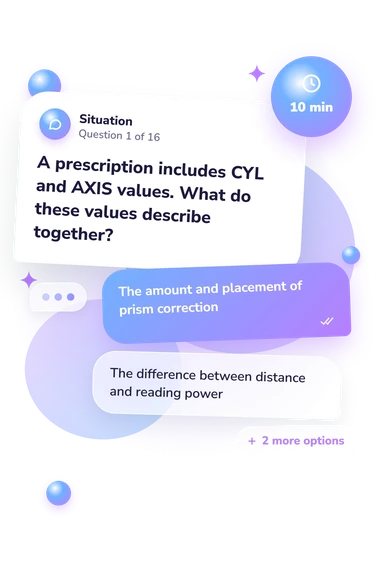
Example Questions From the Test
- The amount and placement of prism correction
- The difference between distance and reading power
- The horizontal and vertical positions of each pupil
- The amount and orientation of astigmatism correction
- UV400 or 99–100% UVA and UVB protection
- Dark smoke tint
- Polarized lenses
- Premium mirrored finish
- Single-vision lenses
- Standard lined bifocals
- Progressive lenses
- Plano polarized lenses
Glasses Quiz - Description and methodology of the test
Readers preparing to interpret a prescription, compare lens options, or care for existing eyewear can use the glasses quiz as a focused learning check. It is intended for prescription-wearers and shoppers who want practical confidence with optical terminology. Readers asking what glasses should I get quiz themselves on the principles behind lens choice, fitting, protection, and maintenance rather than on personal style.
What This Assessment Explores
These questions assess eyewear knowledge, not eyesight or personal style. They cover SPH, CYL, AXIS, ADD, and PD; lens technologies; fitting clues; and safe care. People wondering what colour glasses suit me quiz themselves here, but the result cannot choose a flattering hue.
The content groups into three practical areas:
- Prescription and lens knowledge shows whether optical terms and technologies are matched to their purposes.
- Frame fitting shows whether bridge, width, temple, nose-pad, and optical-centre clues are recognized.
- Care and safety shows whether cleaning, heat, glare, ultraviolet protection, and adjustment choices are handled appropriately.
Glasses Knowledge runs from 0-16: Foundation (0-6), Developing (7-12), and Strong (13-16). The bands summarize performance on the tested information. Readers asking what glasses fit my face quiz themselves on fitting principles, but the score does not judge facial appearance.
Methodology and Scientific Basis
Each item offers four multiple-choice answers, and each correct response adds one point. The total is assigned to the displayed band, so performance reflects accumulated knowledge across prescription interpretation, lens design, fitting, cleaning, and protection rather than a preference profile.
Content follows the practical framework in System for Ophthalmic Dispensing (Brooks & Borish, 2007), covering prescription notation, lens selection, frame fitting, and dispensing care. Mehta and Onyegbule (2024) support the emphasis on pupillary distance and optical-centre alignment, while Kozol, Capone, and Kozol (1998) address positioning for multifocal and progressive lenses.
These works are conceptual reference points, not evidence that the online questionnaire reproduces a published standardized scale; its bands do not establish population norms. Someone asking what shape glasses should I get quiz themselves on fitting concepts here, but the score cannot determine a frame without prescription strength, bridge geometry, comfort, and preference.
Self-report, guessing, unfamiliar terminology, and current attention may affect performance. The result is educational knowledge feedback, not a vision assessment or substitute for an optician or optometrist.
- Brooks, Clifford W., and Irvin M. Borish. System for Ophthalmic Dispensing. 3rd ed. St. Louis, MO: Butterworth-Heinemann, 2007. 10.1016/B978-0-7506-7480-5.X5001-1
- Mehta, Michelle, and Stellamaris Onyegbule. “Prescribing and fitting spectacles: the role of pupillary distance and the optical centre.” Community Eye Health 37, no. 122 (2024): 18-19.
- Kozol, F., R. C. Capone, and N. D. Kozol. “Determining the vertical and horizontal positioning of multifocal and progressive lenses.” Survey of Ophthalmology 43, no. 1 (1998): 71-82. 10.1016/S0039-6257(98)00013-7