
APUSH Quiz
How the Scales are Structured
Who Usually Takes This Test?
See How You Compare
Below is a preview of how scores are typically distributed across each scale.
Example Questions From the Test
- Virginia transferred political control from planters to landless laborers
- Chesapeake elites increasingly relied on racialized enslaved labor rather than indentured servitude
- England abolished the colonial tobacco trade
- The rebellion ended conflict between settlers and Indigenous peoples
- Immediate emancipation pursued through moral persuasion
- Gradual emancipation followed by compulsory western settlement
- Permanent protection of slavery where it already existed
- Expansion of slavery to prevent sectional imbalance
- The Seventeenth Amendment
- The Sixteenth Amendment
- The Eighteenth Amendment
- The Nineteenth Amendment
APUSH Quiz - Description and methodology of the test
Students preparing for Advanced Placement United States history can use the APUSH Quiz to judge their overall preparation from an informal result. This ap us history quiz helps learners decide whether broad review is worthwhile before they commit to more detailed study. Its result offers a quick readiness check rather than a complete picture of performance.
What This Assessment Explores
The assessment samples United States history from the colonial era through the twentieth century. Its prompts ask learners to identify significance, compare developments, apply constitutional principles, and connect policy with social or international change. This assessment serves as a broad APUSH review quiz, indicating overall familiarity without diagnosing specific gaps.
The single result reflects recognition of themes and historical reasoning. The question themes below are content areas that contribute to one aggregate knowledge result:
- Chronology and causation link developments to consequences.
- Constitutional ideas and institutions show how authority fits historical situations.
- Reform, rights, and federal policy show changing demands for citizenship and equality.
- Economic, social, and international change connect domestic events with wider transformations.
APUSH Knowledge 0-16 has Foundations to Build (0-6), Developing Knowledge (7-12), and Strong Knowledge (13-16); these are informal practice bands, not official AP score predictions.
Methodology and Scientific Basis
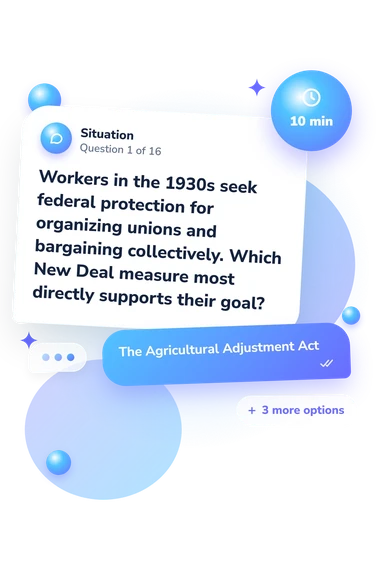
Each item presents a historical situation with four answer choices. Respondents select the option that best explains an event, policy, constitutional principle, or consequence. With four choices per item, the assessment functions as an APUSH practice quiz for applying historical knowledge; its multiple-choice format does not assess sustained writing.
Scoring produces one aggregate knowledge result. One aggregate scale is displayed; no scoring method or official AP conversion is documented, so the result is an informal practice guide. Its AP history quiz format samples selected course themes, so a strong result indicates broad familiarity rather than complete mastery.
The questionnaire is conceptually consistent with the College Board’s AP U.S. History framework, but it is not an adaptation of it. That framework supports reading the prompts as course-aligned historical reasoning, not as evidence of this tool’s validity. Bridgeman, Morgan, and Wang describe reliability research in AP history assessment; their findings do not establish reliability or validity here.
Preparation, attention, and current recall can affect a one-sitting result; because the band is aggregate, it cannot represent every aspect of course performance, but it can help decide whether broad review is worthwhile.
- College Board. AP U.S. History Course and Exam Description, Effective Fall 2026. New York: College Board, 2026.
- College Board. AP United States History Exam Questions and Scoring Information. College Board, accessed September 18, 2026.
- Bridgeman, Brent, Rick Morgan, and Ming-mei Wang. The Reliability of Document-Based Essay Questions on Advanced Placement History Examinations. ETS Research Report Series, 1996, no. 1, i-12. 10.1002/j.2333-8504.1996.tb01683.x
- College Board. AP Exam Development. College Board, accessed September 18, 2026.
Updated: