
Tape Measure Quiz
How the Scales are Structured
Who Usually Takes This Test?
See How You Compare
Below is a preview of how scores are typically distributed across each scale.
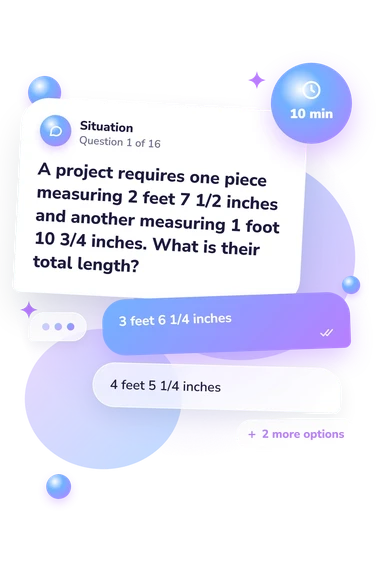
Example Questions From the Test
- 3 feet 6 1/4 inches
- 4 feet 5 1/4 inches
- 4 feet 6 1/4 inches
- 4 feet 8 1/4 inches
- 35
- 32
- 37
- 42
- 625 inch
- 875 inch
- 800 inch
- 750 inch
Tape Measure Quiz - Description and methodology of the test
People checking practical measurement skills can use this tape measure quiz to see how confidently they interpret markings, calculate lengths, and apply workshop reasoning. It suits DIY learners, trade students, and anyone seeking a quiz on reading a tape measure that focuses on usable numeracy rather than abstract calculation. The result identifies skills that may deserve further practice.
What This Assessment Explores
The assessment tests measurement literacy in inch and metric systems. Items cover fractions, conversions, combined lengths, rounding, and details such as hook movement, case length, and blade alignment. The result is a snapshot of measurement reasoning, not a personality profile.
As a quiz on how to read a tape measure, it groups tasks into areas:
- Markings and fractions show whether you read sixteenths, eighths, and metric subdivisions.
- Calculations and unit transfer show how you add, subtract, convert, and find distances.
- Practical conventions show whether you understand case length, hook movement, alignment, rounding, and repeated readings.
Tape Measure Knowledge runs from 0-16. Foundations to Build (0-6) calls for review of markings, fractions, and conversions. Developing Accuracy (7-12) reflects understanding that may need practice with calculations, offsets, or fine divisions. Strong Knowledge (13-16) indicates reliable command of markings and practical measurement reasoning.
Methodology and Evidence Base
Each item uses a selected-response format with four answer choices. One option matches the calculation or measurement principle, while the others represent arithmetic, reading, or conversion errors. One point is awarded for each correct answer, producing the score.
This quiz with answers makes each result concrete: respondents can connect a choice with a skill such as converting metres to centimetres, compensating for the case during an inside measurement, or aligning the blade with the distance.
Webster and Bright (2011) provide the closest trade-education framework for the arithmetic and measurement knowledge represented here. Scott (2023) supports the emphasis on workplace numeracy and applied calculation. McGuire and colleagues (2025) reinforce careful unit handling and repeatable measurement practice. The questionnaire is conceptually consistent with these sources, not an adaptation or validation of any one of them.
As free tape-measure practice, the assessment is best read as a task-based snapshot. No population norms or reliability estimates are supplied; performance may shift with trade experience, attention, calculator habits, or familiarity with notation. Careful responses give the indication of which skills deserve further practice.
- Webster, Alfred P., and Kathryn E. Bright. Mathematics for Carpentry and the Construction Trades. 3rd ed., Pearson, 2011.
- Scott, Karynn A. Trade Skills for Success: Numeracy. Camosun College, 2023.
- McGuire, John, David Sefcik, Loren Minnich, Elizabeth Benham, Isabel Baucom, and Katrice Lippa. NIST Handbook 133: Checking the Net Contents of Packaged Goods (2026 Ed.). National Institute of Standards and Technology, 2025. DOI 10.6028/NIST.HB.133-2026
Updated: