
Animal Farm Quiz
How the Scales are Structured
Who Usually Takes This Test?
See How You Compare
Below is a preview of how scores are typically distributed across each scale.
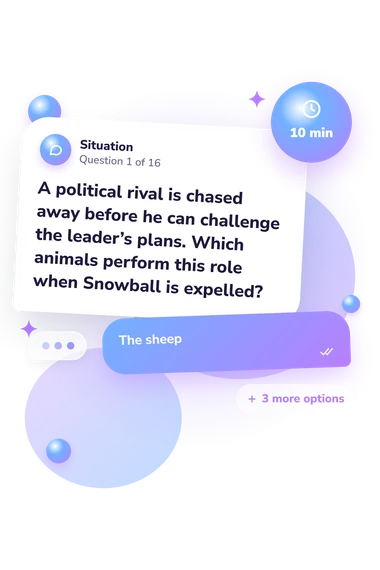
Example Questions From the Test
- Napoleon
- Boxer
- Snowball
- Benjamin
- Joseph Stalin
- Tsar Nicholas II
- Leon Trotsky
- Karl Marx
- Mr. Jones
- Frederick
- Snowball
- Pilkington
Animal Farm Quiz - Description and methodology of the test
Readers revisiting Orwell’s novel, preparing for a class discussion, or checking what they remember can use this animal farm quiz to connect factual recall with interpretation. It suits anyone who wants a clearer picture of the story’s political meaning rather than a simple plot recap. Its questions about Animal Farm move from characters and events to propaganda, symbolism, and historical parallels.
What This Assessment Explores
The questionnaire measures knowledge of Animal Farm and how its fictional events carry political and historical meanings. In this Animal Farm literature quiz, questions cover rebellion, leadership changes, military conflicts, commandments, propaganda, literacy, religion, class privilege, and the final comparison between pigs and humans. The result reflects remembered details alongside comprehension of Orwell’s allegory.
Its catalogue scale is:
- Animal Farm Knowledge: 0-16. The score counts correct answers and places the reader in Foundation (0-6), Developing (7-12), or Strong (13-16). Foundation indicates recognition of major elements; Developing shows understanding of much of the story and allegory; Strong reflects confident grasp of events, propaganda methods, symbols, and historical allegory.
A stronger band indicates broader command of the tested text, while a lower band identifies topics worth revisiting. It describes performance on this question set, not general literary ability.
Methodology and Evidence Base
Each item uses multiple-choice format with four answer options and one intended best answer. Questions combine direct recall-who acted, what was written, or what happened next-with interpretation of political allegory, propaganda, symbolism, and historical parallels. The score is the number of correct responses; no additional weighting is implied.
Animal Farm (Orwell, 1945) supplies the plot, characters, slogans, and images tested here. Morris Dickstein’s discussion of the novel as political fable supports reading the farm’s power struggle as a structured allegory. The 2025 analysis by Zumyati Zumi and colleagues is relevant to the political-allegory dimension, especially the movement from revolutionary ideals to an oppressive ruling elite. The questionnaire is conceptually consistent with these sources, but is not a reproduction or validated adaptation, and no standardization data are stated.
For readers treating it as an Animal Farm book test, the result depends on familiarity with the text, attention to wording, and interpretation of ambiguous themes. No population norms or reliability estimates are reported, so use the bands for self-checking and focused rereading; current memory, prior teaching, and interpretive preference can affect performance.
- Orwell, George. Animal Farm: A Fairy Story. London: Secker & Warburg, 1945.
- Dickstein, Morris. “Animal Farm: History as Fable.” In The Cambridge Companion to George Orwell, edited by John Rodden, 133-145. Cambridge: Cambridge University Press, 2007. 10.1017/CCOL0521858429.011
- Zumyati Zumi, Ulpia Rahim, Novita Sari, Khairunnisa, and Abdul Syahid. “An Analysis of Political Allegory in Animal Farm by George Orwell.” Darussalam English Journal 5, no. 1 (2025): 57-66. 10.30739/dej.v5i1.3967