
195 Countries Quiz
How the Scales are Structured
Who Usually Takes This Test?
See How You Compare
Below is a preview of how scores are typically distributed across each scale.
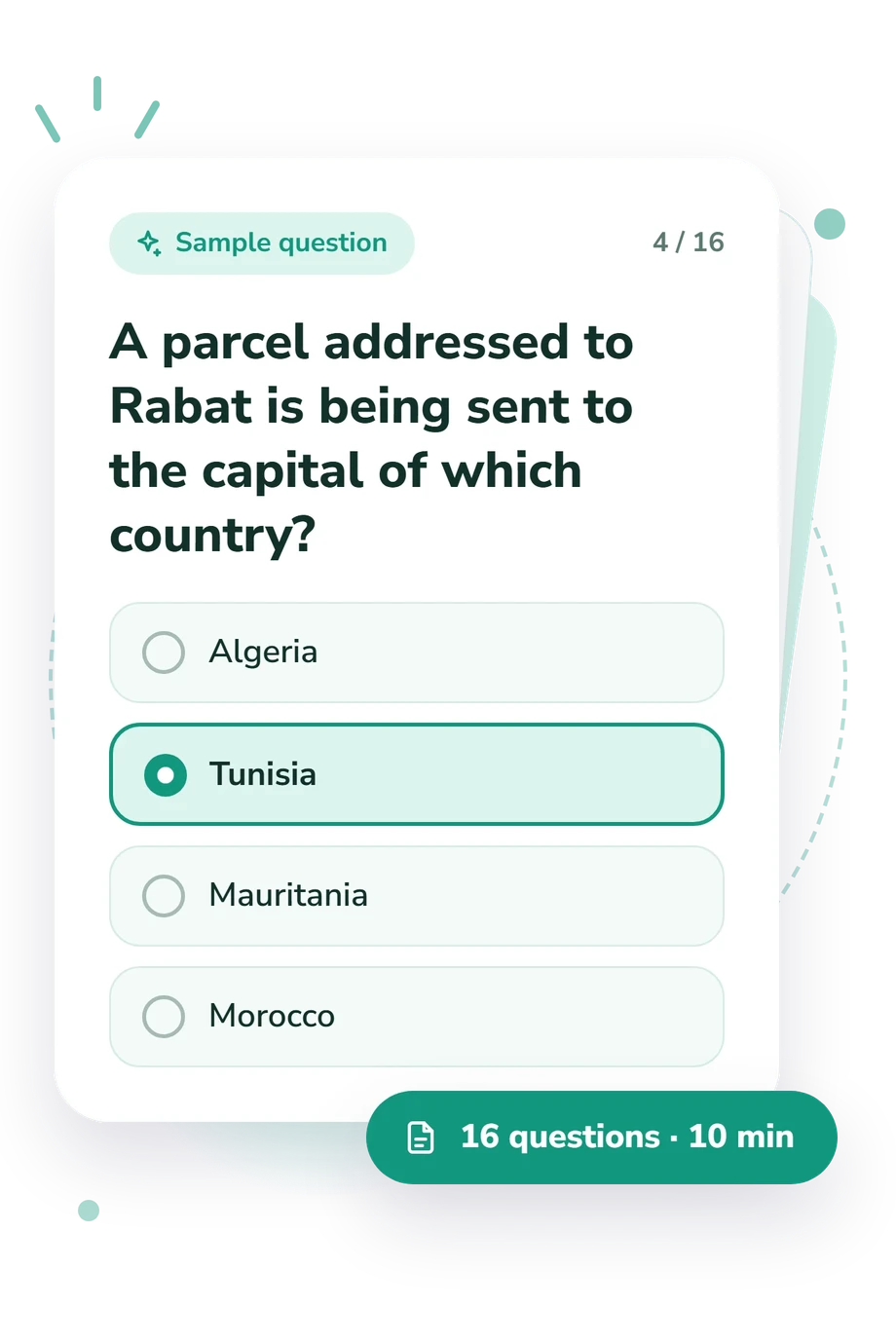
Example Questions From the Test
- Slovenia
- Czechia
- Croatia
- Slovakia
- Malta
- Spain
- Italy
- Portugal
- Christchurch
- Hamilton
- Wellington
- Dunedin
195 Countries Quiz - Description and methodology of the test
For readers who want to check practical geography knowledge, the 195 countries quiz offers a focused way to connect capital cities with their countries. Its overall result summarizes performance on the tested capital-country items and assigns a descriptive level band. It suits learners, travelers, and anyone who wants a clearer picture of current geography before choosing what to review next.
What This Assessment Explores
This questionnaire examines how reliably a person identifies national capitals, matches them with countries, and follows geographic sequences. Scenarios use travel plans, news reports, addresses, and paired locations rather than isolated definitions. That makes the result relevant to world-capital knowledge, especially for learners, travelers, and readers revisiting geography after a long break.
These question formats create three practical demands:
- Direct recall tests whether a capital can be linked to its country.
- Reverse recognition shows whether a capital identifies its country.
- Route and pairing tasks examine whether several relationships stay in regional or sequential order.
The result appears on one scale, 195 Countries Knowledge, ranging from 0-16. Foundation covers 0-6, Developing covers 7-12, and Strong covers 13-16. These bands describe the breadth and accuracy of the answers, so a lower result points to useful review areas rather than a fixed ability.
Methodology and Evidence Base
Each item uses a multiple-choice format with four answer options, and the displayed score awards one point for every correct response; the total is interpreted through the listed descriptive bands.
The questionnaire is conceptually consistent with Eve et al. (1994), the closest contextual source for uneven geographic knowledge, but that study does not validate this questionnaire. De Witte et al. (2024) offers broader context on factual learning alongside cognitive load and spatial abilities; neither study validates this particular questionnaire. Al-Rukban (2006) supports clear stems, plausible alternatives, and one best answer in multiple-choice construction.
As a geography self-assessment, the format works best when answers are given without looking up capitals and mistakes are treated as study clues. Performance can vary with schooling, travel, language familiarity, fatigue, and regional exposure. The score is a snapshot of performance on these 16 capital-country items, not a complete measure of geographic knowledge.
- De Witte, Benjamin, Vincent Reynaert, Jerome Hutain, Danny Kieken, Joseph Jabbour, and Jalal Possik. "Immersive learning of factual knowledge while assessing the influence of cognitive load and spatial abilities." Computers & Education: X Reality, vol. 5, 2024, article 100085. DOI 10.1016/j.cexr.2024.100085
- Eve, Raymond A., Bob Price, and Monika Counts. "Geographic Illiteracy among College Students." Youth & Society, vol. 25, no. 3, 1994, pp. 408-427. DOI 10.1177/0044118X94025003006
- Al-Rukban, Mohammed O. "Guidelines for the Construction of Multiple Choice Questions Tests." Journal of Family and Community Medicine, vol. 13, no. 3, 2006, pp. 125-133. DOI 10.4103/2230-8229.97543
Updated: