
NHL Teams Quiz
How the Scales are Structured
Who Usually Takes This Test?
See How You Compare
Below is a preview of how scores are typically distributed across each scale.
Example Questions From the Test
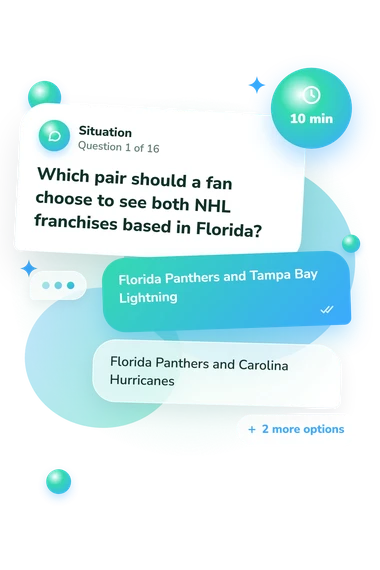
- Florida Panthers and Tampa Bay Lightning
- Florida Panthers and Carolina Hurricanes
- Tampa Bay Lightning and Nashville Predators
- Carolina Hurricanes and Washington Capitals
- Arizona Coyotes
- Minnesota Wild
- Colorado Avalanche
- Dallas Stars
- Carolina Hurricanes
- Winnipeg Jets
- Nashville Predators
- Dallas Stars
NHL Teams Quiz - Description and methodology of the test
Fans, travelers, and learners who want to gauge their grasp of professional hockey franchises can use the NHL Teams Quiz to decide whether a refresher on team facts would be useful. It suits fans, travelers, and learners who want to take a quiz about hockey teams rather than a broad examination of rules, tactics, or player statistics. The result highlights accurate recognition of clubs and points to areas for study.
What This Assessment Explores
This questionnaire measures factual NHL franchise knowledge through geography, official names, relocations, historic membership, and regional grouping, making it an NHL franchise knowledge test. Its items test recognition of franchise locations, identities, and selected historical links across teams and eras.
The displayed result uses one scale: NHL Teams Knowledge (0-16). Its bands are Foundation Building (0-6), Developing Knowledge (7-12), and Strong Knowledge (13-16). They describe emerging, developing, or broad knowledge of team identities, locations, and franchise history.
The item themes fall into three areas:
- Geography and regional identity show whether you match clubs with cities, provinces, states, and regions.
- Team identity and naming show whether you recognize official names, abbreviations, and distinctive labels.
- Franchise history and expansion show whether you connect current teams with relocations and earlier eras.
The profile points to review subjects rather than measuring broader hockey expertise.
Methodology and Evidence Base
In this format, an NHL team history quiz functions as an online knowledge test rather than a personality inventory. Each item presents a factual prompt with four candidate answers, and the result summarizes performance across the questions. The questionnaire does not specify how individual responses are converted into points; the displayed result presents descriptive knowledge bands rather than population norms.
Its factual content can be read alongside Total Hockey, an encyclopedia edited by Dan Diamond, which provides context for team identities and league history; the online questionnaire is not a reproduction of that reference. Historical context also appears in Klein’s account of league expansion and the NHL’s historical overview. A separate case study by Cintron, Levine, and Hambrick adds context about expansion. These references provide factual context for team identities, relocations, and league history; they do not establish psychometric validation, reliability, or validity for this online test.
Results can be affected by guessing, memory, familiarity with franchise changes, or attention at the time. Use the profile to guide review of franchise locations, naming history, and relocations.
- Diamond, Dan, editor; Duplacey, James; Zweig, Eric. Total Hockey: The Official Encyclopedia of the National Hockey League. Total Sports, 1998. ISBN 0836271149.
- Klein, Cutler. From Six Teams to 31: History of NHL Expansion., June 22, 2016.
- National Hockey League. A Brief History of the League., n.d.
- Cintron, Alicia; Levine, Jeffrey F.; Hambrick, Marion E. A Case Study of the National Hockey League: The Question of Expansion. Case Studies in Sport Management, 5(1), 17-23, 2016. 10.1123/cssm.2015-0020.
Updated: