
Kinsey Scale Quiz
How the Scales are Structured
Who Usually Takes This Test?
See How You Compare
Below is a preview of how scores are typically distributed across each scale.
Example Questions From the Test
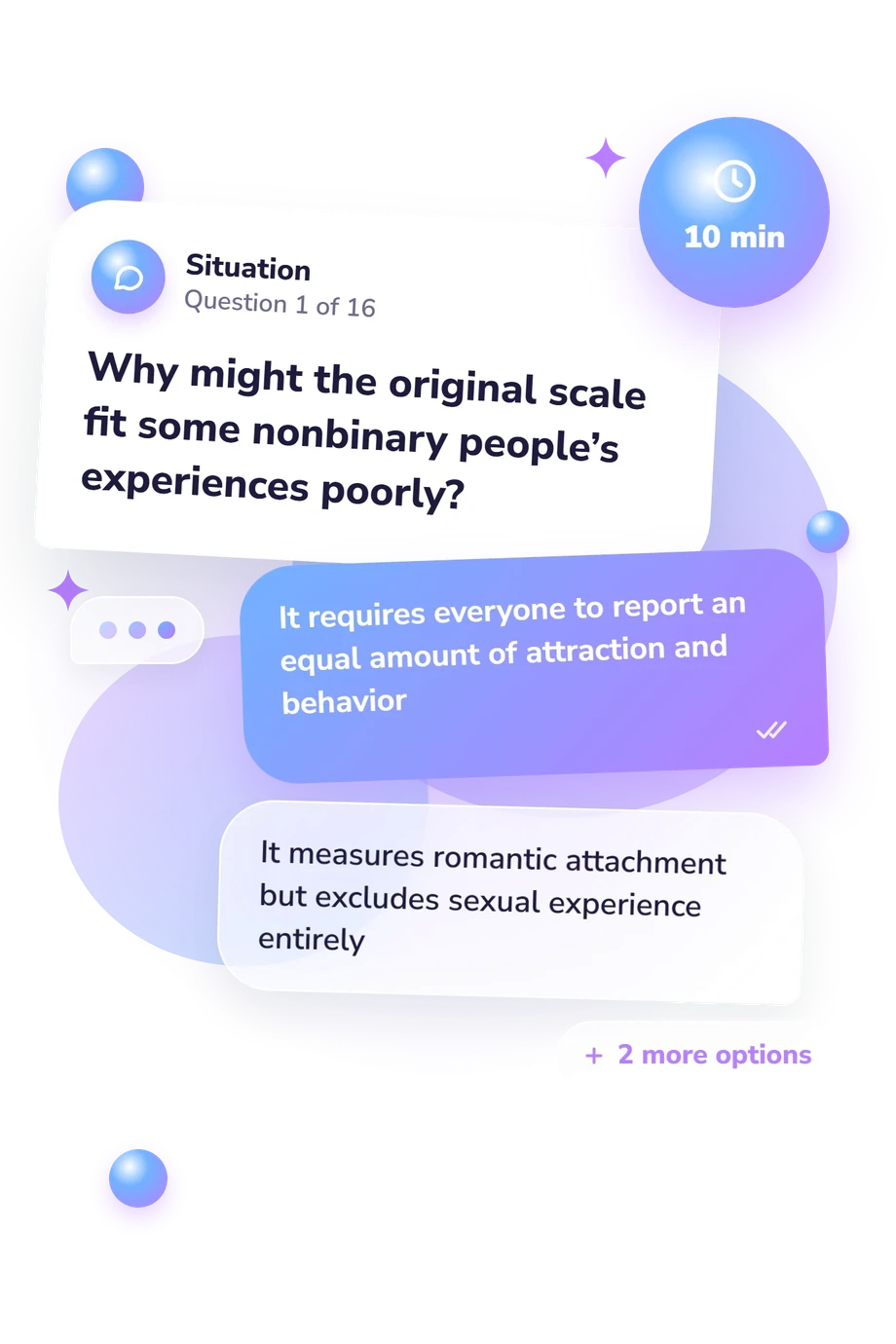
- It requires everyone to report an equal amount of attraction and behavior
- It measures romantic attachment but excludes sexual experience entirely
- Its heterosexual–homosexual continuum relies on binary sex or gender categories that may not map neatly onto their experiences
- It provides separate ratings for every gender but does not combine them
- 3
- 5
- 4
- 6
- No reported socio-sexual contacts or reactions
- A person whose responses changed too often to receive a number
- A person who was exclusively homosexual in attraction but not behavior
- A person whose heterosexual and homosexual patterns were equal
Kinsey Scale Quiz - Description and methodology of the test
People who want to understand what the Kinsey continuum can and cannot express can use the Kinsey Scale Quiz as a focused learning exercise. It suits readers who want to understand the continuum, its ratings, and why a historical classification is not automatically a personal identity. A kinsey quiz result reflects model knowledge rather than assigning a sexuality label.
What This Assessment Measures
The assessment measures knowledge of a historical framework for describing relative heterosexual and homosexual experience or reaction, not orientation. It suits readers who want to understand the continuum, its ratings, and why a historical classification is not automatically a personal identity.
The result shows how well you recognize definitions, examples, context, and limitations. It reports Kinsey Scale Knowledge (0-16): Foundations to build (0-6), Developing knowledge (7-12), and Strong knowledge (13-16). These bands describe model knowledge, not sexuality.
Questions are grouped around four kinds of understanding:
- Historical purpose explains the continuum’s challenge to either-or thinking.
- Numbered ratings describe relative patterns from 0 to 6.
- The X classification identifies no reported socio-sexual contacts or reactions.
- Interpretation shows why one number can miss differences among attraction, behavior, and identity.
Together, these areas make the kinsey sexuality quiz a focused check of model literacy.
Methodology and Evidence Base
The source framework is the Heterosexual-Homosexual Rating Scale described by Kinsey and colleagues in 1948 and 1953. This online questionnaire is conceptually consistent with that model, but it is a knowledge assessment rather than a reproduction of the original research procedure.
Each item presents a question with four answer choices. The total reflects the number of correct responses across historical definitions, rating examples, applications, and limitations; it does not calculate orientation or treat an answer as evidence of a particular identity.
Historical context also shapes interpretation. Drucker’s 2012 analysis helps explain how the 0-6 continuum became recognizable in online culture, while Zietsch and Sidari’s 2020 critique emphasizes that attraction, behavior, and related dimensions should not be collapsed without care. As a gay scale quiz, this assessment teaches the historical model while preserving that distinction.
Because this is an online educational questionnaire, the result is not a standardized personal measure. Performance can reflect prior familiarity, wording, and the respondent’s understanding of historical terms. The model itself may also obscure differences among attraction, behavior, and identity, so one rating cannot represent every aspect of sexuality.
- Kinsey, Alfred C., Wardell B. Pomeroy, and Clyde E. Martin. 1948. Sexual Behavior in the Human Male. Philadelphia: W. B. Saunders.
- Kinsey, Alfred C., Wardell B. Pomeroy, Clyde E. Martin, and Paul H. Gebhard. 1953. Sexual Behavior in the Human Female. Philadelphia: W. B. Saunders.
- Zietsch, Brendan P., and Morgan J. Sidari. 2020. The Kinsey scale is ill-suited to most sexuality research because it does not measure a single construct. Proceedings of the National Academy of Sciences of the United States of America, 117(44), 27080. 10.1073/pnas.2015820117
- Drucker, Donna J. 2012. Marking Sexuality from 0-6: The Kinsey Scale in Online Culture. Sexuality & Culture, 16(3), 241-262. 10.1007/s12119-011-9122-1
Updated: