
3rd Grade Math Quiz
How the Scales are Structured
Who Usually Takes This Test?
See How You Compare
Below is a preview of how scores are typically distributed across each scale.
Example Questions From the Test
- 25 minutes
- 30 minutes
- 35 minutes
- 45 minutes
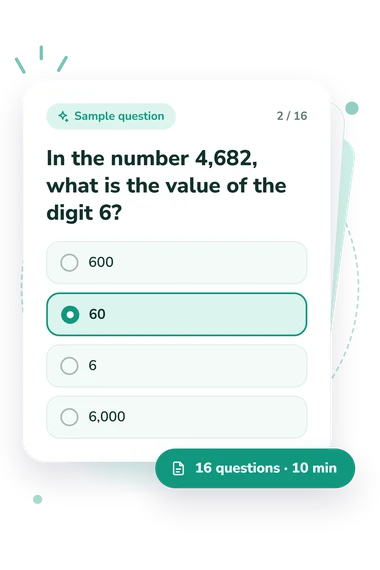
- 600
- 60
- 6
- 6,000
- 2/6
- 2/4
- 3/4
- 4/6
3rd Grade Math Quiz - Description and methodology of the test
Children strengthening their classroom foundations can use this assessment to check how comfortably they handle familiar third-grade ideas. The 3rd grade math quiz turns everyday problems into a focused snapshot of current understanding. It helps a learner, parent, or teacher judge whether broad review or mixed practice is warranted. As a math quiz for 3rd graders, it is suited to review and guided self-reflection rather than ranking students.
What This Assessment Measures
Items cover core arithmetic and application: place value, comparison, rounding, addition, subtraction, multiplication, division, fractions, elapsed time, money, area, perimeter, and shape recognition. Short contexts ask learners to select a calculation and apply it to a familiar situation.
The assessment functions as a third grade math quiz by sampling connected strands instead of one operation. Its main areas are:
- Place value and number sense show understanding of digit value, comparison, and rounding.
- Operations measure use of addition, subtraction, multiplication, and division.
- Fractions check recognition of equal parts and equivalent forms.
- Measurement and money connect time, length, area, perimeter, and everyday quantities.
- Geometry reflects recognition of shape properties and spatial language.
These areas describe the sampled knowledge, not every skill in a classroom curriculum.
Methodology and Evidence Base
Each item offers four answer choices, and a correct response adds one point. That selected-response format asks for recognition or application rather than extended written work. The total appears on 3rd Grade Math Knowledge (0-16), with Foundation to Review (0-6), Developing Knowledge (7-12), and Strong Knowledge (13-16). These bands describe a general review score: they indicate whether to revisit core skills, continue mixed practice, or recognize strong understanding in the sampled topics. The result is not a complete measure of classroom performance.
The Common Core framework (2010), the National Research Council (2001), and NCTM (2000) serve as content references for operations, fractions, measurement, geometry, and place value. They guide topic selection only; the questionnaire's score comes from its own correct-answer count.
For independent practice, it can guide the next review topic. The bands are most useful as prompts for review, not fixed labels of ability. Independent performance on this grade 3 math quiz can still reflect attention, recent instruction, reading fluency, and familiarity with the wording.
- National Governors Association Center for Best Practices, and Council of Chief State School Officers. (2010). Common Core State Standards for Mathematics. Washington, DC: National Governors Association Center for Best Practices, Council of Chief State School Officers.
- National Research Council. (2001). Adding It Up: Helping Children Learn Mathematics. Edited by Jeremy Kilpatrick, Jane Swafford, and Bradford Findell. Washington, DC: National Academy Press. 10.17226/9822.
- National Council of Teachers of Mathematics. (2000). Principles and Standards for School Mathematics. Reston, VA: National Council of Teachers of Mathematics.
Updated: