
Periodic Table Quiz Symbols
How the Scales are Structured
Who Usually Takes This Test?
See How You Compare
Below is a preview of how scores are typically distributed across each scale.
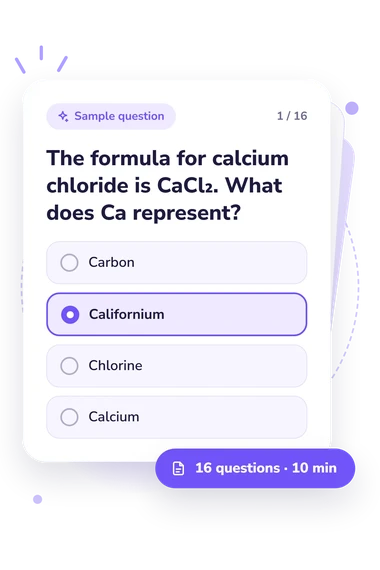
Example Questions From the Test
- Carbon
- Californium
- Chlorine
- Calcium
- Osmium
- Gold
- Oxygen
- Sulfur
- Hydrogen
- Mercury
- Holmium
- Hafnium
Periodic Table Quiz Symbols - Description and methodology of the test
Students, teachers, and curious learners can use Periodic Table Quiz Symbols to check whether they recognize chemical symbols accurately in formulas, labels, and reports. As an element symbol quiz, it highlights recognition of familiar and easily confused chemical symbols, while the result indicates how reliably that knowledge transfers to formulas, labels, materials, and laboratory contexts.
What This Assessment Measures
Recognition is the central ability: can you connect an element’s name with its chemical symbol, then reverse that link when the symbol appears first? Contexts include formulas, labels, reports, materials, and safety information. This suits learners refreshing chemistry vocabulary or targeting pairs that need practice.
The assessment is a periodic table of elements quiz about symbols. Its Periodic Table Symbols Knowledge scale runs from 0-16: Foundation (0-6) signals some familiar symbols with possible confusion over names, abbreviations, or capitalization; Developing (7-12) reflects many correct matches with gaps; Strong (13-16) indicates reliable command, including less intuitive examples.
The item themes are:
- Direct recognition shows whether common symbols are identified accurately.
- Formula reading shows whether symbols are understood inside compounds.
- Applied identification shows whether knowledge transfers to real labels and reports.
- Similar-symbol discrimination shows whether near-neighbours stay distinct.
Methodology and Scientific Basis
Each item presents a chemical context or symbol prompt with four answer choices. The respondent identifies an element from its symbol or selects the symbol for an element, with capitalization carrying meaning: Co, C, and Ca are different entries. Recognition is tested in both directions.
The result is reported on the displayed 0-16 scale for this questionnaire. This periodic table abbreviations quiz reviews missed chemical symbol-name pairs, especially similar symbols or those without an English initial.
Conceptually, the questionnaire is consistent with Chemical Symbol Representation Abilities (CSRA), research on connecting chemical notation with meaning; it is not presented as an administration or adaptation of that instrument. Research on progression in CSRA across grade levels provides developmental context, but does not validate this online version. NIST supplies the reference standard for element names and official symbols.
The cited CSRA studies provide conceptual context, not validation of this questionnaire. The catalogue-defined bands are descriptive levels, and performance can vary with attention, study exposure, and familiarity with the format. This elements and symbols quiz offers a learning snapshot and points to a revision topic.
- Wang, Zuhao, Shaohui Chi, Ma Luo, Yuqin Yang, and Min Huang. "Development of an instrument to evaluate high school students' chemical symbol representation abilities." Chemistry Education Research and Practice 18, no. 4 (2017): 875-892. 10.1039/C7RP00079K
- Chi, Shaohui, Zuhao Wang, Ma Luo, Yuqin Yang, and Min Huang. "Student progression on chemical symbol representation abilities at different grade levels (Grades 10-12) across gender." Chemistry Education Research and Practice 19, no. 4 (2018): 1055-1064. 10.1039/C8RP00010G
- Kramida, Alexander, Karen Olsen, and Yuri Ralchenko. "Periodic Table: Atomic Properties of the Elements." NIST Special Publication 966, June 2024.