
True or False Quiz
How the Scales are Structured
Who Usually Takes This Test?
See How You Compare
Below is a preview of how scores are typically distributed across each scale.
Example Questions From the Test
- True — the ice vanishes as heat and therefore adds no water to the glass.
- False — melting always makes the level rise because solid water contains no liquid volume.
- True — the floating ice already displaces an amount of water equal in weight to the ice.
- False — the level falls sharply because liquid water weighs less than the same ice cube.
- True — bats lack functioning eyes because echolocation replaces vision completely.
- False — bats use vision only as newborns and permanently lose it when they begin flying.
- True — every bat species navigates exclusively by interpreting reflected sound.
- False — bats can see, and species differ in how much they also use echolocation.
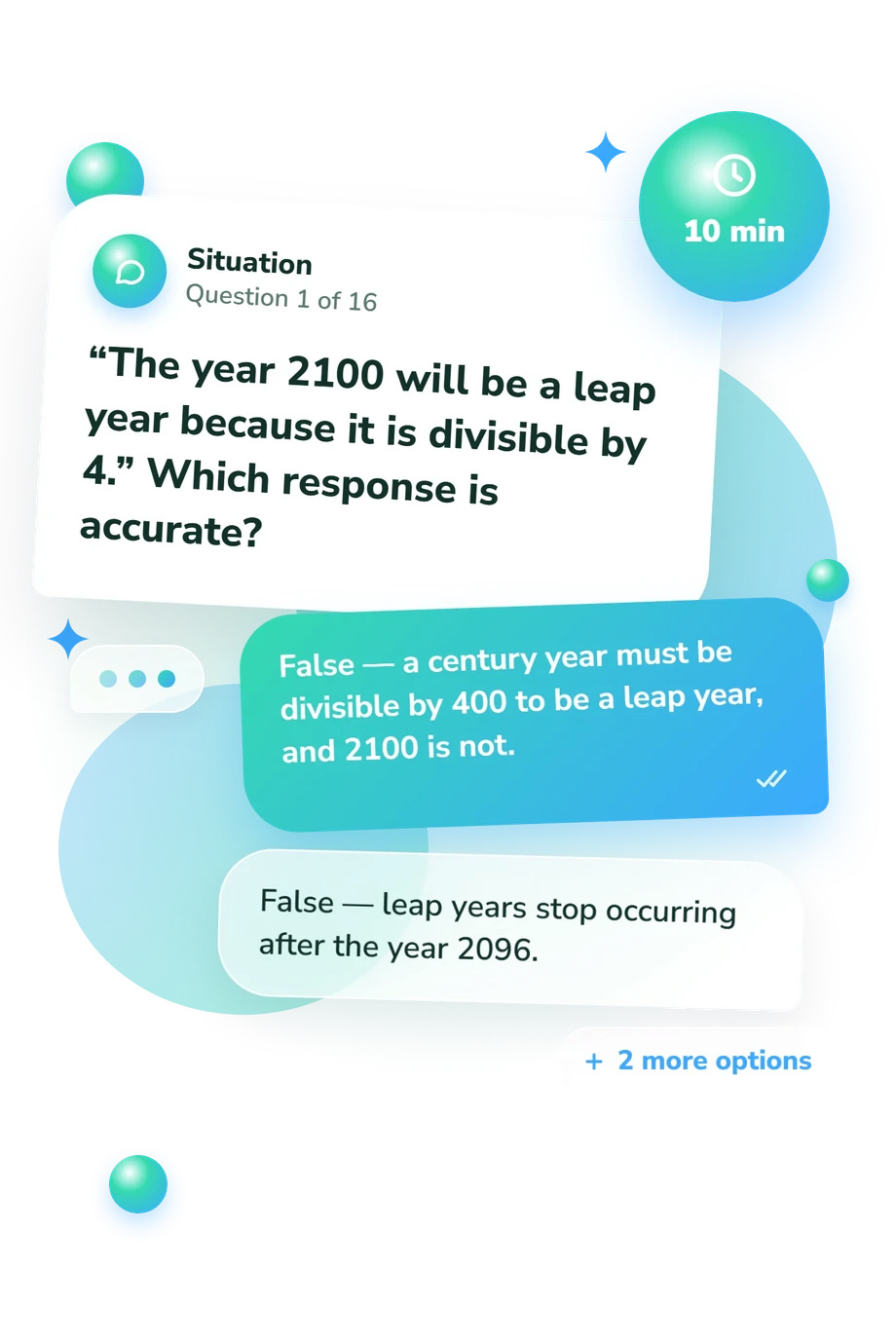
- False — a century year must be divisible by 400 to be a leap year, and 2100 is not.
- False — leap years stop occurring after the year 2096.
- True — divisibility by 4 is the only rule used to determine every leap year.
- True — every year ending in 00 automatically includes February 29.
True or False Quiz - Description and methodology of the test
People who enjoy testing familiar claims can use this assessment to examine general factual knowledge across everyday subjects. The true or false quiz asks you to select a verdict together with its explanation, so the result reflects the accuracy of those selected verdicts and explanations. This true-false quiz can prompt focused review of uncertain facts.
What This Test Measures
Broad factual accuracy is the focus, not one narrow ability. Claims span science, mathematics, health, nature, astronomy, and history; several true-or-false quiz questions require a rule or relationship to be applied. Your result shows how accurately the selected verdict and explanation match each claim, reflecting overall trivia knowledge.
The main content groups are:
- Science and nature show whether claims follow principles about matter, energy, bodies, plants, and animals.
- Mathematics and logic show whether definitions, divisibility, probability, and classification are applied correctly.
- Astronomy, health, and history show whether misconceptions are separated from reliable explanations.
The displayed scale, True or False Trivia Knowledge (0-16), summarizes performance. Foundation to Build (0-6) indicates several misconception-driven judgments; Developing Knowledge (7-12) reflects many reliable recognitions with some close distinctions missed; Strong Knowledge (13-16) indicates consistent separation of accurate claims from plausible misconceptions.
Methodology and Evidence Base
Each item presents a claim and four combined verdict-and-explanation options: two True and two False, making this a quiz with both true and false options. You select one option, and it must contain both the correct verdict and the correct explanation. One point goes to every correct pair; the overall score follows that one-point rule, with no other weighting rule stated.
In this format, the questionnaire combines recognition of factual claims with selection of a verdict-and-explanation option rather than a bare yes-or-no choice. When reviewing true-or-false quiz answers, an incorrect choice may reflect unfamiliar content, a misconception, or an unsupported reason.
Evidence is conceptual: this questionnaire is consistent with Martín-Luengo and colleagues' work on normative true-false knowledge questions in Russian young adults, but it is not an adaptation or standardized copy. Related work by Martín-Luengo and findings from Uner, Tekin, and Roediger provide context on norms and retention, not standards for this version. Read the score as a snapshot that can shift with education, attention, guessing, context, and self-awareness, not a fixed measure of intelligence or reasoning.
- Martín-Luengo, B., Zinchenko, O., Dolgoarshinnaia, A., & Alekseeva, M. (2024). Normative study of 500 general-knowledge of true-false questions for Russian young adults. PLOS ONE, 19(4), e0300600. 10.1371/journal.pone.0300600
- Martín-Luengo, B., Zinchenko, O., Alekseeva, M., & Shtyrov, Y. (2020). Russian Norms for 500 General-Knowledge Questions. Frontiers in Psychology, 11, 545304. 10.3389/fpsyg.2020.545304
- Uner, O., Tekin, E., & Roediger, H. L. (2022). True-false tests enhance retention relative to rereading. Journal of Experimental Psychology: Applied, 28(1), 114-129. 10.1037/xap0000363
Updated: