
DNA Replication Quiz
How the Scales are Structured
Who Usually Takes This Test?
See How You Compare
Below is a preview of how scores are typically distributed across each scale.
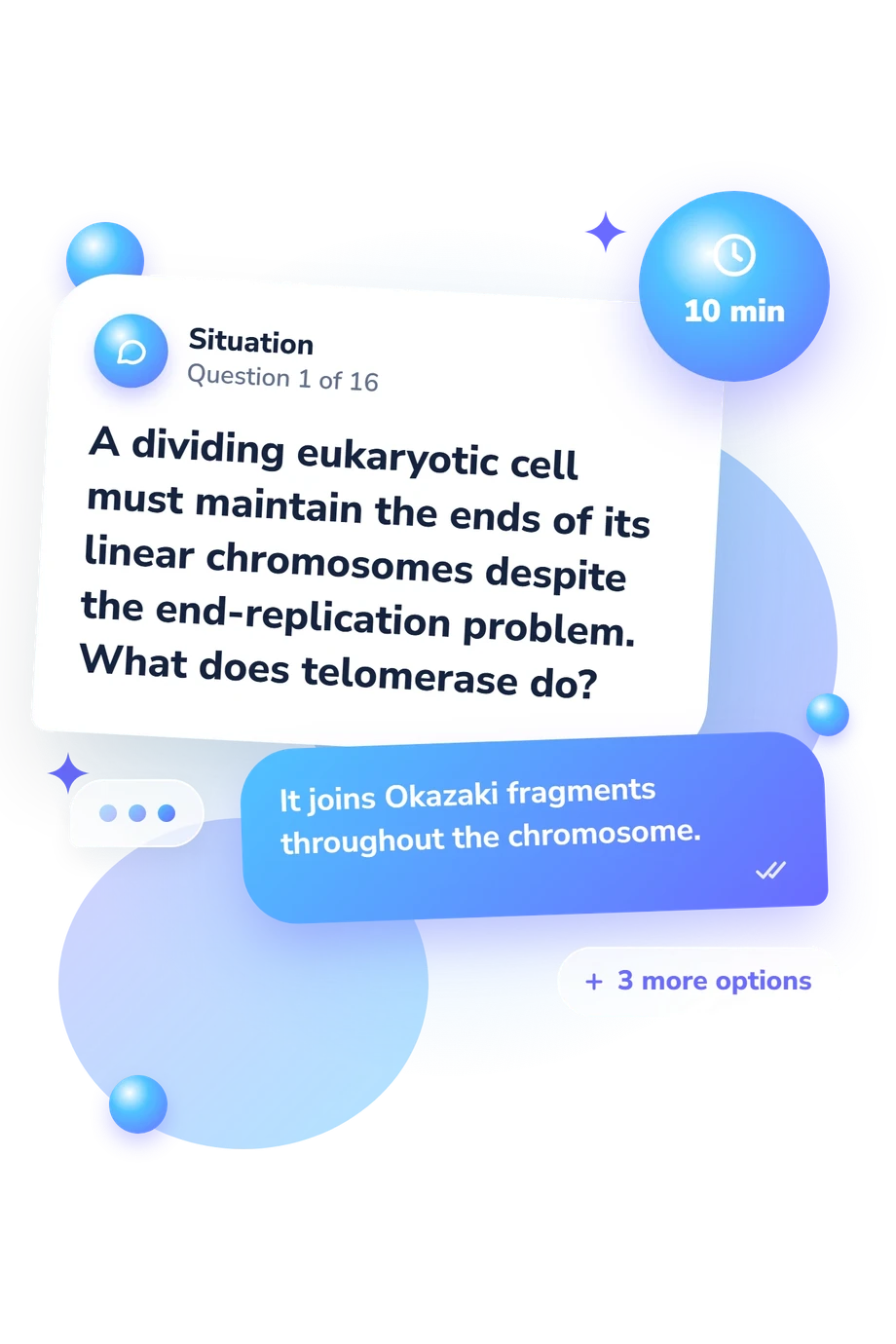
Example Questions From the Test
- M phase
- G1 phase of interphase
- G2 phase of interphase
- S phase of interphase
- RNA primers cannot be produced.
- Twisting strain and supercoiling build up ahead of the fork.
- Okazaki fragments are joined prematurely.
- New DNA is synthesized in the 3′-to-5′ direction.
- From 3′ to 5′ by adding nucleotides to the 5′ end
- From 3′ to 5′ by adding nucleotides to the 3′ end
- From 5′ to 3′ by adding nucleotides to the 5′ end
- From 5′ to 3′ by adding nucleotides to the 3′ end
DNA Replication Quiz - Description and methodology of the test
This DNA replication practice quiz suits learners preparing for coursework or an exam who want to identify which kinds of replication reasoning need more practice. The DNA Replication Quiz asks them to apply what they know to unfamiliar biological situations, helping them decide where additional review will be most useful.
What This Assessment Measures
DNA replication is treated as a coordinated process rather than a list of enzyme names. The questions connect polymerase directionality, complementary base pairing, proofreading, primers, helicase, ligase, topoisomerase, and telomerase with events at replication forks and chromosome ends. They move between bacterial and eukaryotic contexts and include direct principles alongside short experimental scenarios.
For learners using these DNA replication questions to locate study gaps, the displayed scale is DNA Replication Knowledge (0-16). One point is awarded for each correct answer, and the total falls into one of three bands:
- Foundations to Review (0-6) signals that base pairing, strand direction, or core enzymes need renewed attention.
- Developing Knowledge (7-12) shows that many principles are understood, while links between enzymes and strand mechanics may need practice.
- Strong Knowledge (13-16) indicates accurate explanation and application of major replication principles.
Methodology and Evidence Base
Each prompt presents a biological situation or principle with four answer choices; the respondent selects one. This DNA replication test samples recall and application: it asks not only what an enzyme does, but what would happen when a strand, fork, chromosome end, or experimental condition changes.
The concepts are consistent with the Meselson-Stahl experiment (1958), which established semiconservative replication, and with Okazaki and colleagues’ work on discontinuous synthesis and Okazaki fragments. Telomerase content is consistent with the terminal-transferase research of Greider and Blackburn (1985). These studies support the biology represented by the items; they do not make this online questionnaire a standardized adaptation of the original experiments.
Scoring comes from the number of correct selections and is interpreted through the displayed descriptive bands. Those studies describe the biological findings represented here, but they do not provide normative data or validation for this online questionnaire. Results can also shift with coursework, attention, guessing, and familiarity with terminology, so the outcome is best treated as a snapshot that helps direct review rather than as a complete measure of biology competence.
- Meselson, M., & Stahl, F. W. (1958). The replication of DNA in Escherichia coli. Proceedings of the National Academy of Sciences of the United States of America, 44(7), 671-682. 10.1073/pnas.44.7.671
- Okazaki, R., Okazaki, T., Sakabe, K., Sugimoto, K., & Sugino, A. (1968). Mechanism of DNA chain growth. I. Possible discontinuity and unusual secondary structure of newly synthesized chains. Proceedings of the National Academy of Sciences of the United States of America, 59(2), 598-605. 10.1073/pnas.59.2.598
- Greider, C. W., & Blackburn, E. H. (1985). Identification of a specific telomere terminal transferase activity in Tetrahymena extracts. Cell, 43(2 Pt 1), 405-413. 10.1016/0092-8674(85)90170-9
Updated: