
What Football Position Should I Play Quiz
How the Scales are Structured
Who Usually Takes This Test?
See How You Compare
Below is a preview of how scores are typically distributed across each scale.
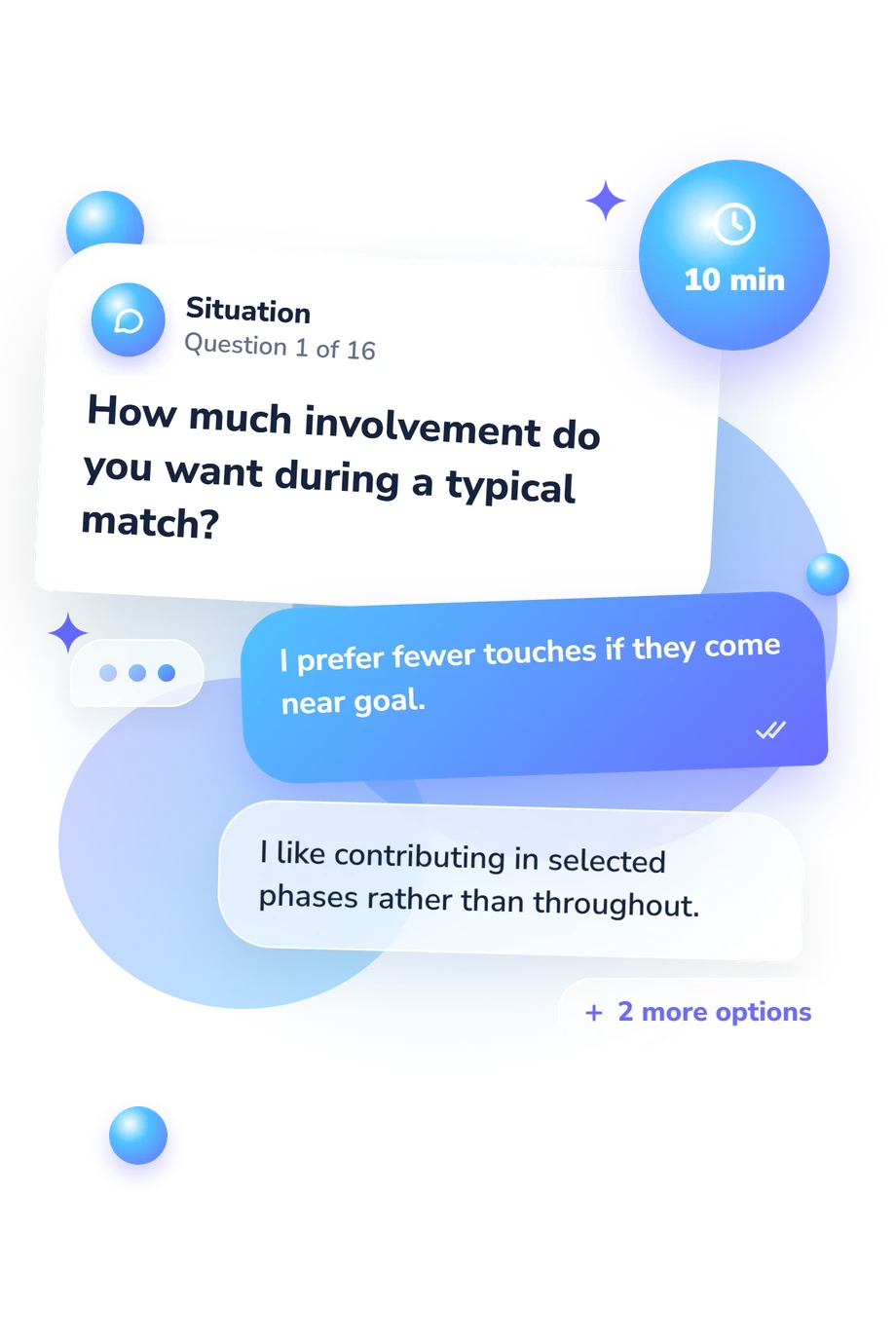
Example Questions From the Test
- Making a well-timed tackle that ends a dangerous attack.
- Starting a useful move after helping regain possession.
- Creating or finishing a clear scoring chance.
- Providing defensive cover without being the main marker.
- Hold a deeper position in case possession is lost.
- Move closer to support without committing beyond the defense.
- Offer a short option, then continue toward the penalty area.
- Time a run behind the defense and demand the pass.
- Finishing chances from crosses and through balls.
- A possession game requiring constant scanning and quick passing.
- A mixed passing drill followed by occasional shots.
- A focused defensive station with limited possession work.
What Football Position Should I Play Quiz - Description and methodology of the test
For players deciding where they may contribute most comfortably, the What Football Position Should I Play Quiz turns football preferences into a practical role profile. As a football position quiz, it suits beginners, recreational players, and experienced players considering a change of position. The result highlights the role demands that attract you, helping compare instinct with training opportunities rather than treating preference as proof of ability.
What This Assessment Explores
Rather than rate execution, the questionnaire maps preferred involvement and responsibility through scenarios about touches, finishing, marking, passing, positioning, transitions, cover, and mistakes. For a player asking what position should I play in football, the result organizes these preferences into four affinities.
The dimensions are:
- Defender (0-12) reflects positioning, duels, anticipation, and space protection; bands: Attacking Lean (0-4), Balanced Protector (5-8), Defender Affinity (9-12).
- Forward (0-12) reflects attacking movement, chance creation, finishing, and scoring responsibility; bands: Build-Up Lean (0-4), Supporting Attacker (5-8), Forward Affinity (9-12).
- Goalkeeper (0-12) reflects specialized skills, communication, and concentrated pressure; bands: Outfield Lean (0-4), Flexible Option (5-8), Goalkeeper Affinity (9-12).
- Midfielder (0-12) reflects scanning, passing connections, involvement, and transitions; bands: Role-Specific Lean (0-4), Linking Potential (5-8), Midfielder Affinity (9-12). This can help frame the question, which football position should I play, while you explore roles in training.
Methodology and Evidence Base
Each item presents a football situation, training choice, or pressure moment with four response options. The closest statement records preferred role demands, not current skill, fitness, statistics, or technical level; this is a preference-based self-report.
Scoring compares the four affinities: the highest is the strongest match, while scores within one point form a blended result. Bands describe preference strength, not guaranteed position. As a football position assessment, the output helps compare interests with available roles.
Conceptually, the questionnaire is consistent with Wiemeyer (2003), but it is not an adaptation of that study. Sarmento et al. (2024) show that positions carry different physical, physiological, and technical demands, supporting a multidimensional view of role choice. Spielmann et al. (2024) is relevant to goalkeeper preferences but does not establish one universal goalkeeper personality. These sources provide context, not validation of this online questionnaire.
No norms or independently documented reliability are stated. Answers may shift with confidence, coaching, experience, current form, self-awareness, and self-report bias. Compare the profile with observed performance, try roles in training, and reassess after playing experience.
- Josef Wiemeyer. (2003). Who should play in which position in soccer? Empirical evidence and unconventional modelling. International Journal of Performance Analysis in Sport, 3(1), 1-18. 10.1080/24748668.2003.11868269
- Hugo Sarmento, Diogo Vicente Martinho, Élvio R. Gouveia, José Afonso, Paweł Chmura, Adam Field, Nestor Ordoñez Savedra, Rafael Oliveira, Gibson Praça, Rui Silva, Joel Barrera-Díaz, and Filipe Manuel Clemente. (2024). The Influence of Playing Position on Physical, Physiological, and Technical Demands in Adult Male Soccer Matches: A Systematic Scoping Review with Evidence Gap Map. Sports Medicine, 54(11), 2841-2864. 10.1007/s40279-024-02088-z
- Jan Spielmann, Fabian Otte, Tom Schumacher, Jan Mayer, and Stefanie Klatt. (2024). Searching for the perfect goalkeeping personality. Myth or reality? Frontiers in Psychology, 15, 1418004. 10.3389/fpsyg.2024.1418004
Updated: