
Facial Bones Quiz
How the Scales are Structured
Who Usually Takes This Test?
See How You Compare
Below is a preview of how scores are typically distributed across each scale.
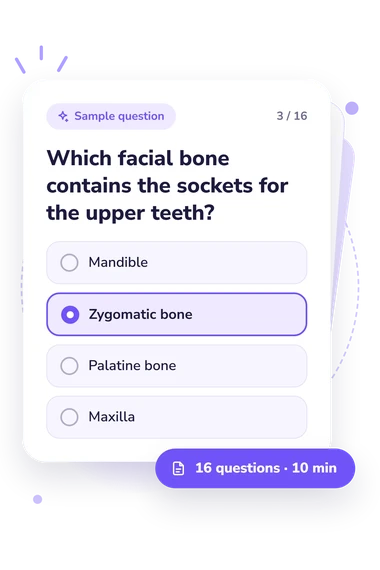
Example Questions From the Test
- Vomer
- Lacrimal bone
- Inferior nasal concha
- Ethmoid bone
- Mandible
- Zygomatic bone
- Palatine bone
- Maxilla
- Maxilla
- Palatine bone
- Zygomatic bone
- Mandible
Facial Bones Quiz - Description and methodology of the test
Students and trainees revising head and neck anatomy can use this facial bones quiz to test whether they identify structures from landmarks, locations, and functional clues. It is intended for readers seeking a focused facial anatomy quiz before orbital, nasal, palatal, or mandibular anatomy. The result gives an overall level of facial-bone knowledge, offering a broad readiness signal for further head and neck anatomy review rather than identifying specific structures.
What This Assessment Explores
The questions measure recognition of bones forming the orbit, nasal cavity, hard palate, cheek, upper jaw, and lower jaw. They also ask learners to connect a named landmark or clinical location with the structure responsible for it. As a quiz about the bones of the face, the assessment checks recall and the ability to distinguish neighboring structures.
The single displayed scale, Facial Bones Knowledge (0-16), summarizes performance across these tasks. Its bands are:
- Foundations to review (0-6) indicates that locations and major landmarks need reinforcement.
- Developing knowledge (7-12) indicates recognition of many structures, with closer relationships worth reviewing.
- Strong knowledge (13-16) indicates solid identification and applied craniofacial understanding.
Together, these bands point to a practical level of review.
Methodology and Scientific Basis
Each item presents an anatomical or clinical prompt with four answer choices. Some require direct identification; others use a landmark, movement, paired-versus-unpaired distinction, or regional relationship. Together, the prompts assess multiple-choice identification from landmarks, locations, movements, and regional relationships rather than diagram labeling.
Scoring produces one displayed total and its corresponding band, with no regional subscores shown. The covered regions include orbital, nasal, palatal, cheek, maxillary, and mandibular anatomy, so this facial bone identification test brings them together in one result. Interpretation follows the total and band shown after completion.
The content is conceptually consistent with Junn and Som (2022), whose anatomical discussion supports the facial-bone relationships and clinical landmarks covered here. Brand et al. (2023) and Drake et al. (2023) provide complementary descriptions of the bones, articulations, and regional anatomy. This online questionnaire is not a standardized adaptation of those works, so its bands are educational guideposts rather than measures of clinical competence.
Performance can vary with recent study, anatomical vocabulary, wording, and guessing. Reviewing relevant landmarks afterward can turn the result into a focused study plan.
- Junn, Jacqueline C., and Peter M. Som. "Maxillofacial Skeleton and Facial Anatomy." Neuroimaging Clinics of North America 32, no. 4 (2022): 735-748. 10.1016/j.nic.2022.07.008.
- Brand, Richard W., Donald E. Isselhard, and Amy Smith. Anatomy of Orofacial Structures: A Comprehensive Approach. 9th ed. Elsevier, 2023.
- Drake, Richard L., A. Wayne Vogl, and Adam W. M. Mitchell. Gray's Anatomy for Students. 5th ed. Elsevier, 2023.