
Which President Are You Quiz
How the Scales are Structured
Who Usually Takes This Test?
See How You Compare
Below is a preview of how scores are typically distributed across each scale.
Example Questions From the Test
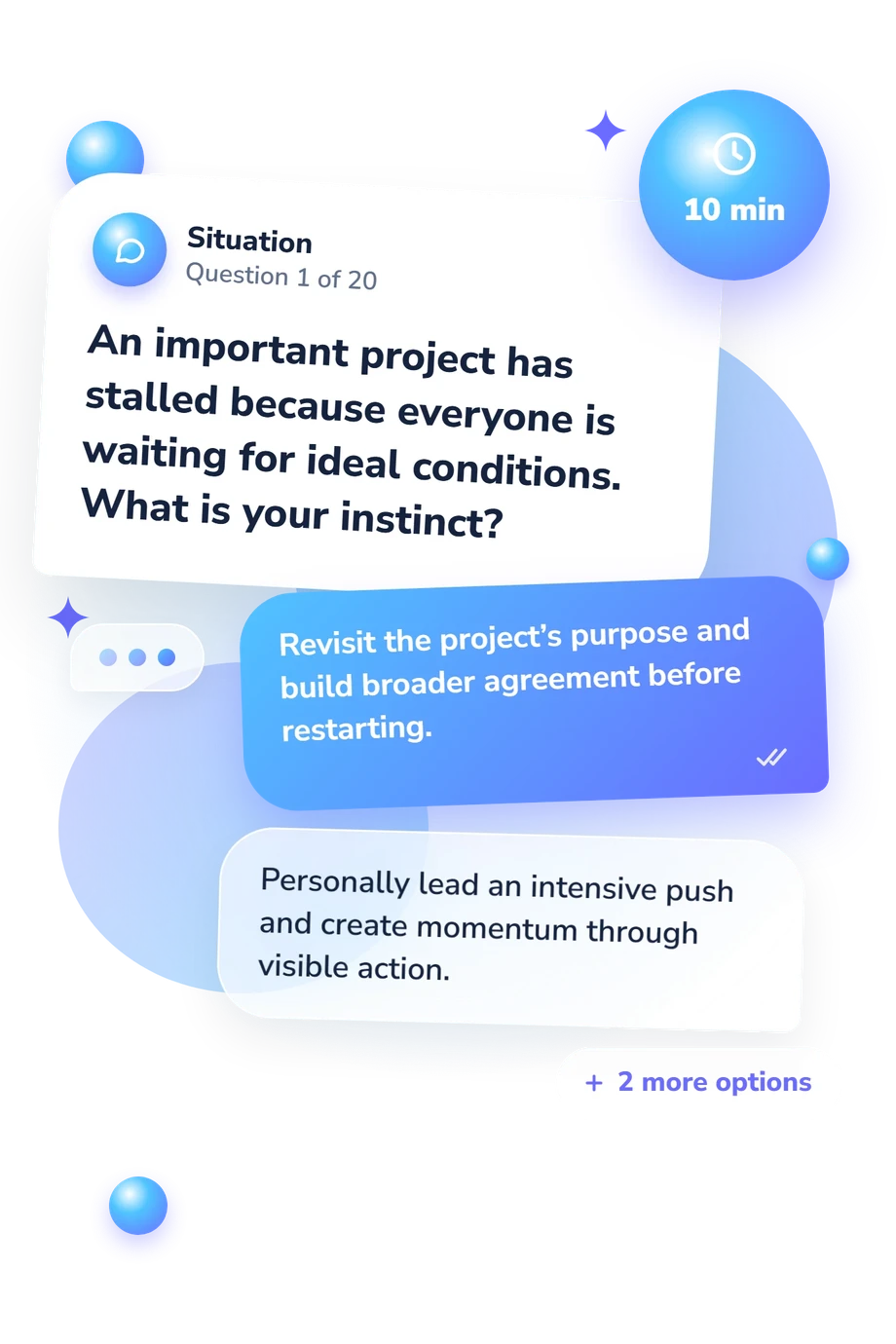
- Revisit the project’s purpose and build broader agreement before restarting.
- Personally lead an intensive push and create momentum through visible action.
- Develop several small trials so the team can proceed without a large commitment.
- Protect the original timetable and wait until the missing conditions are resolved.
- Defend the original logic and give the plan more time to work.
- Replace it with one decisive alternative and commit fully.
- Ask the group to reconsider the values the plan was meant to serve.
- Test several practical adjustments, communicate confidence, and keep what proves effective.
- Step aside as planned and demonstrate that the institution does not depend on one person.
- Remain until several important reforms are firmly established.
- Move directly into a fresh challenge with greater energy and scope.
- Mentor a successor while keeping an influential role during the transition.
Which President Are You Quiz - Description and methodology of the test
People curious about their own leadership instincts can use the Which President Are You Quiz to examine how they respond to hypothetical leadership dilemmas. It suits readers who want a what president am I quiz focused on preferred approaches to reconciliation, coalition-building, stewardship, vision, and reform rather than rank presidents. Readers wondering which president they are most like can use those responses to reflect on pressure, setbacks, coalitions, and responsibility.
What This Assessment Explores
Here, the which president am I quiz compares five leadership styles rather than presidential identities:
- Abraham Lincoln - Humane Unifier (0-12) measures empathy, perseverance, reasoning, and unity: Direct Problem-Solver (0-4), Thoughtful Bridge-Builder (5-8), Humane Unifier (9-12).
- Franklin D. Roosevelt - Adaptive Optimist (0-12) measures experimentation, confidence, coalition-building, and persistence: Consistent Planner (0-4), Practical Adapter (5-8), Adaptive Optimist (9-12).
- George Washington - Steady Steward (0-12) measures duty, restraint, precedent, and orderly structure: Independent Path (0-4), Grounded Organizer (5-8), Steady Steward (9-12).
- John F. Kennedy - Visionary Communicator (0-12) measures ambition, curiosity, communication, and optimism: Practical Realist (0-4), Engaging Explorer (5-8), Visionary Communicator (9-12).
- Theodore Roosevelt - Energetic Reformer (0-12) measures bold action, effort, competition, and visible reform: Measured Contributor (0-4), Purposeful Challenger (5-8), Energetic Reformer (9-12).
Methodology and Evidence Base
Each scenario offers four choices contrasting approaches to agreement, structure, experimentation, communication, or reform. In a what president are you quiz format, the choices are not right or wrong; their pattern estimates affinity across scales.
Rubenzer et al. (2000) is the closest conceptual reference because it examines presidential leadership through personality assessment. This questionnaire is not an adaptation of that inventory; it is an online style exercise conceptually consistent with that work. Rubenzer's NEO-based presidential study supplies conceptual context, while books by Greenstein and Goodwin provide historical leadership context; none supplies or validates this quiz's score bands.
To consider which US president they most resemble, someone can read this as a which US president are you quiz: the highest score indicates the strongest affinity; any score within one point of it forms a blended result. That comparison shows which qualities are most salient in the respondent's choices. The displayed bands are descriptive categories, not population norms or clinical cutoffs. The result addresses what president you are most like through style comparison rather than historical classification.
Self-report answers can shift with current circumstances, self-awareness, or impression management, so the result is best read as a reflection prompt rather than a diagnosis.
- Rubenzer, Steven J., Thomas R. Faschingbauer, and Deniz S. Ones. (2000). Assessing the U.S. presidents using the revised NEO Personality Inventory. Assessment, 7(4), 403-419. 10.1177/107319110000700408
- Rubenzer, Steven J., and Thomas R. Faschingbauer. (2004). Personality, Character, and Leadership in the White House: Psychologists Assess the Presidents. Brassey's.
- Greenstein, Fred I. (2009). The Presidential Difference: Leadership Style from FDR to Barack Obama (3rd ed.). Princeton University Press. 10.1515/9781400833696
- Goodwin, Doris Kearns. (2018). Leadership in Turbulent Times. Simon & Schuster.
Updated: