
Fetal Pig Anatomy Quiz
How the Scales are Structured
Who Usually Takes This Test?
See How You Compare
Below is a preview of how scores are typically distributed across each scale.
Example Questions From the Test
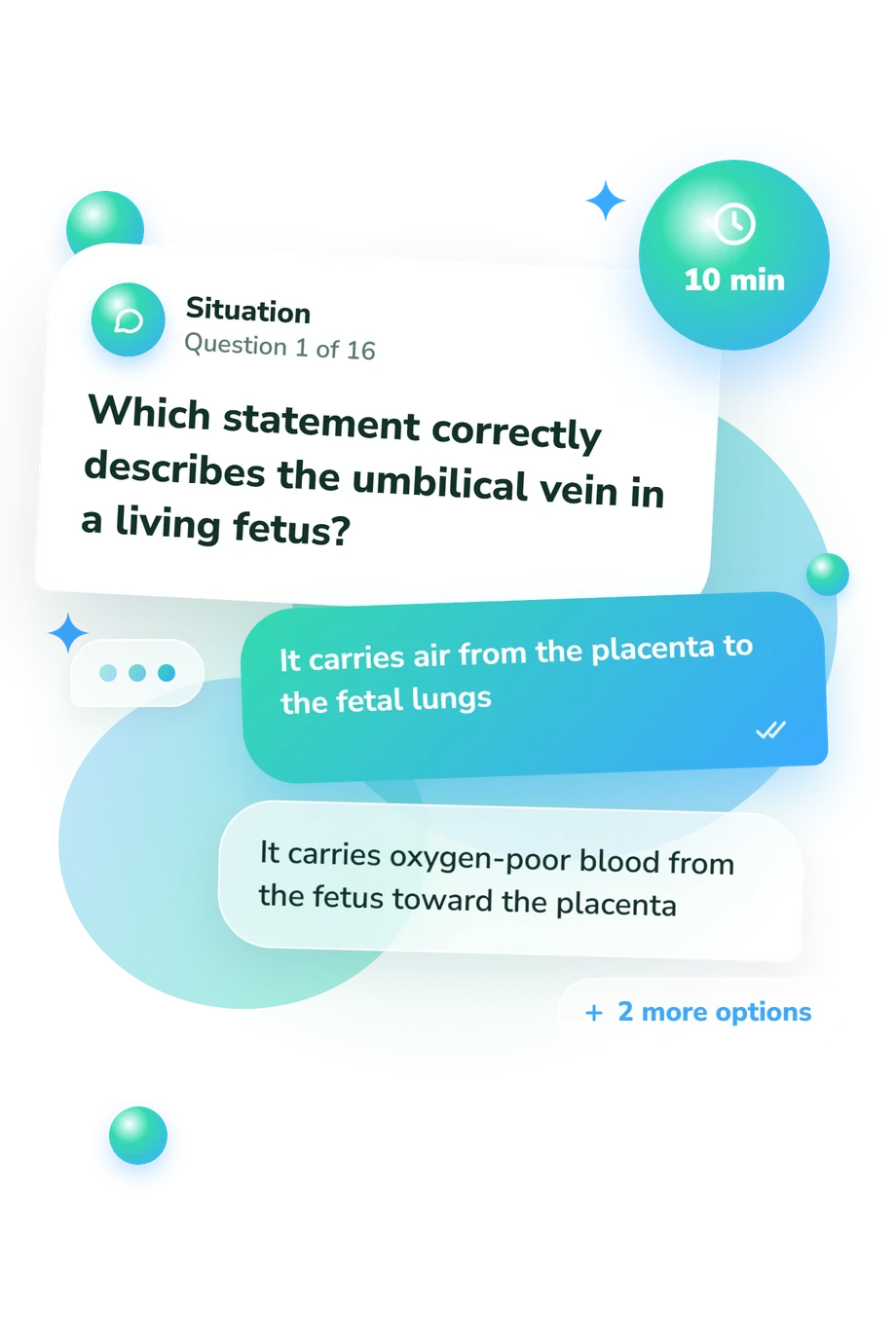
- It carries air from the placenta to the fetal lungs
- It carries oxygen-poor blood from the fetus toward the placenta
- It carries urine from the fetus into the placenta
- It carries oxygen-rich blood from the placenta toward the fetus
- Duodenum
- Cecum
- Esophagus
- Jejunum
- A genital opening just behind the umbilical cord
- A urogenital papilla just ventral to the anus
- Paired umbilical arteries within the cord
- A scrotal sac near the anus
Fetal Pig Anatomy Quiz - Description and methodology of the test
Students in biology courses, and others reviewing fetal anatomy, can use this assessment to gauge their performance on the question set. The result from this fetal pig dissection quiz summarizes how well the respondent handled the questions. The fetal pig anatomy quiz gives an overall indication of knowledge rather than separate topic scores. The overall result from this fetal pig quiz shows whether broader review is timely.
What This Assessment Explores
For learners reviewing fetal anatomy, the questionnaire tests recognition from location, appearance, and function. It asks whether structures can be traced through digestive, respiratory, urinary, and circulatory routes. This pig anatomy quiz summarizes performance across the set; if responses are available for review, they may suggest subjects for study.
The question themes are:
- External landmarks indicate recognition of visible features, including the umbilical cord and genital structures.
- Organ identification distinguishes structures by position, shape, color, or function.
- Anatomical pathways show whether connected routes can be traced through the body.
- Fetal circulation and supporting tissues reflect understanding of vessels, membranes, cavities, and developmental roles.
The Fetal Pig Anatomy Knowledge scale (0-16) gives one point for each correct answer: Foundation Building, 0-6; Developing Knowledge, 7-12; Strong Knowledge, 13-16. These bands describe performance on this question set, not general laboratory ability.
Methodology and Evidence Base
Each item uses a four-option multiple-choice format, combining direct identification with brief anatomical scenarios. A respondent may trace a route, interpret a vessel’s role, or match a structure to its appearance. One point is awarded for each correct response, and the total is matched to the displayed bands.
Its content is conceptually consistent with anatomical relationships in Walker and Homberger (1997), Smith and Schenk (2011), and Marieb and Smith (2018). These books function as conceptual and content references for the anatomical relationships represented in the questions. Maloney (2005) adds a learning-context reference for virtual fetal-pig dissection.
In this pig dissection quiz, the result is a snapshot of recognition under multiple-choice conditions. It can help a learner judge readiness for broader review before laboratory work, but cannot verify instrument handling, tissue manipulation, or recognition of variation in an actual specimen. Terminology familiarity and distractor wording may also affect performance, so the score is best used as study guidance.
- Walker, Warren F., and Dominique G. Homberger. Anatomy and Dissection of the Fetal Pig. 5th revised ed. W.H. Freeman & Co., 1997. ISBN 9780716726371.
- Smith, David G., and Michael P. Schenk. A Dissection Guide and Atlas to the Fetal Pig. 3rd ed. Morton Publishing Company, 2011. ISBN 9780895828798.
- Marieb, Elaine N., and Lori A. Smith. Human Anatomy & Physiology Laboratory Manual, Fetal Pig Version. 13th ed. Pearson, 2018. ISBN 9780134806365.
- Maloney, Rebecca S. Exploring virtual fetal pig dissection as a learning tool for female high school biology students. Educational Research and Evaluation, 11(6), 591-603, 2005. 10.1080/13803610500264823
Updated: