
Preterite vs Imperfect Quiz
How the Scales are Structured
Who Usually Takes This Test?
See How You Compare
Below is a preview of how scores are typically distributed across each scale.
Example Questions From the Test
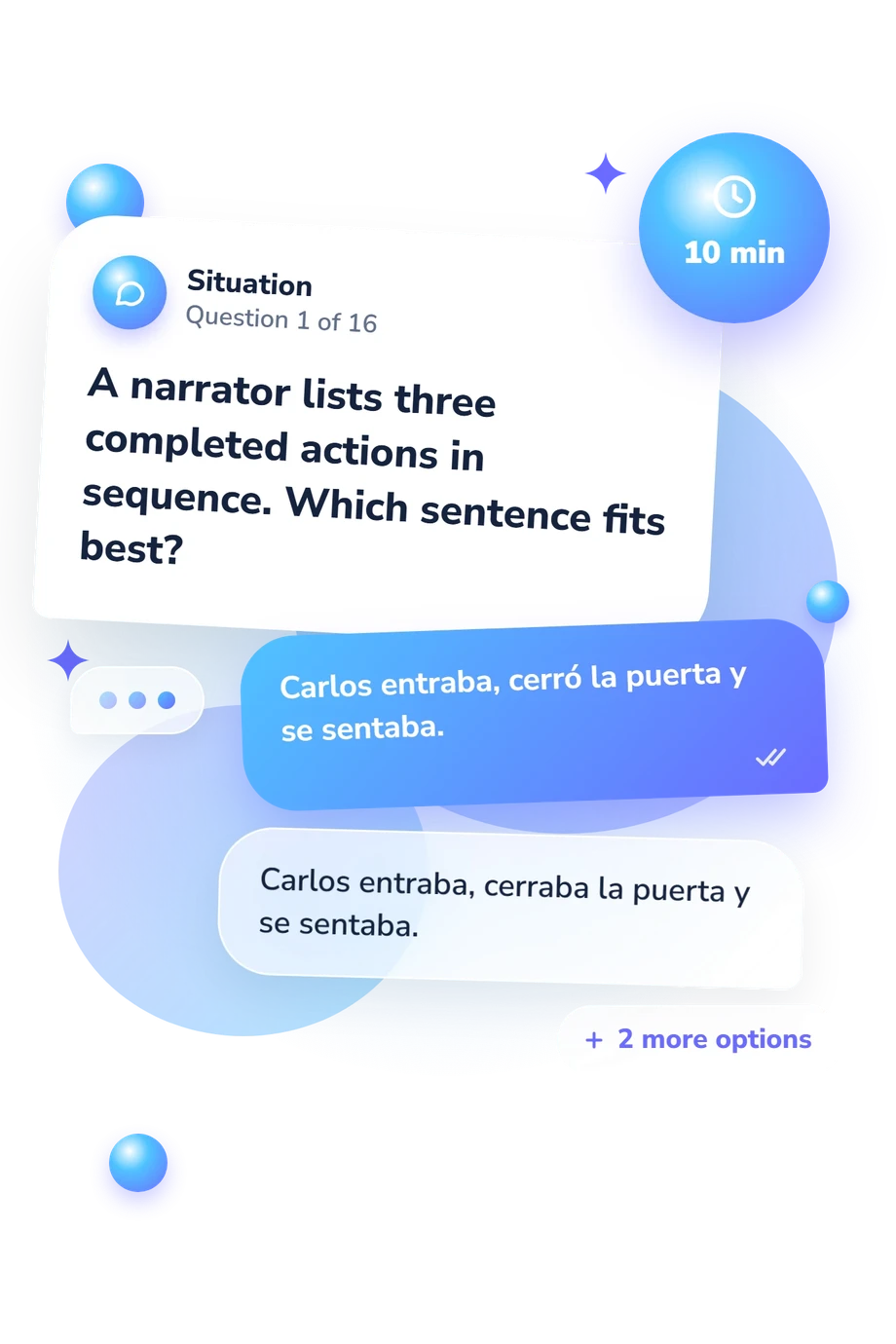
- Carlos entraba, cerró la puerta y se sentaba.
- Carlos entraba, cerraba la puerta y se sentaba.
- Carlos entró, cerró la puerta y se sentó.
- Carlos entró, cerraba la puerta y se sentó.
- Elena estudió cuando sonaba el teléfono.
- Elena estudió cuando sonaba el teléfono cada noche.
- Elena estudiaba cuando sonaba el teléfono una vez.
- Elena estudiaba cuando sonó el teléfono.
- Fueron; llovió
- Eran; llovió
- Eran; llovía
- Fueron; llovía
Preterite vs Imperfect Quiz - Description and methodology of the test
Students and independent learners who want to sharpen Spanish past narration can use this preterite vs imperfect quiz to see whether their tense choices match meaning in context. This preterite and imperfect quiz suits learners who become uncertain when familiar rules appear inside a sentence. The result identifies current command and points toward contrasts that deserve focused review.
What This Assessment Measures
Past-tense selection depends on how a speaker frames an event, not only on translation. The items contrast completed sequences with habits, ongoing actions, background conditions, repeated activity, duration, familiarity, and sudden realization. Some verbs change meaning with tense.
This preterite vs imperfect Spanish quiz suits learners checking form-and-meaning choices in context. The result is a snapshot of command across this contrast, not fluency, vocabulary, pronunciation, or writing ability.
The displayed scale is Preterite vs Imperfect Knowledge (0-16). These bands describe the result:
- Foundations to strengthen (0-6) indicates that contrasts need review, especially completed or bounded events, habits, ongoing actions, and background.
- Developing command (7-12) indicates recognition of common uses but a need for practice with interruptions, time limits, and meaning-changing verbs.
- Strong command (13-16) indicates consistent application across descriptions, narratives, habits, and completed events.
Methodology and Evidence Base
Each item presents a Spanish sentence or narrative cue with four answer choices. The alternatives ask the learner to select the form that fits a sequence, interruption, setting, habit, duration, bounded period, or sudden realization. In this preterite vs imperfect practice quiz, each choice tests interpretation in context rather than conjugation recall alone.
Answers are aggregated into one displayed knowledge total; no separate weighting or penalty system is stated. Reviewing why an option fits an event boundary, background frame, habitual reading, or speaker’s perspective turns the result into a study plan.
The rationale is conceptually consistent with Salaberry (2013), which examines aspectual contrasts involving iteration and habituality. Fábregas (2015) provides a tense-aspect account, while Domínguez, Arche, and Myles (2017) examine how learners map imperfective meanings onto Spanish forms. This questionnaire is not an adaptation of those works.
For study planning, the preterite versus imperfect quiz can highlight choices needing examples and production practice. Scores may vary with instruction, context, attention, or guessing; this online version has no stated norms or reliability data, so its bands guide review priorities rather than measure Spanish ability.
- M. Rafael Salaberry. "Contrasting Preterite and Imperfect use among advanced L2 learners: Judgments of iterated eventualities in Spanish." International Review of Applied Linguistics in Language Teaching, 51(3), 243-270, 2013. 10.1515/iral-2013-0011
- Antonio Fábregas. "'Imperfecto' and 'indefinido' in Spanish: what, where and how." Borealis - An International Journal of Hispanic Linguistics, 4(2), 1-70, 2015. 10.7557/1.4.2.3534
- Laura Domínguez, María J. Arche, and Florence Myles. "Spanish Imperfect revisited: Exploring L1 influence in the reassembly of imperfective features onto new L2 forms." Second Language Research, 33(4), 431-457, 2017. 10.1177/0267658317701991
Updated: