
Should I Be a Teacher Quiz
How the Scales are Structured
Who Usually Takes This Test?
See How You Compare
Below is a preview of how scores are typically distributed across each scale.
Example Questions From the Test
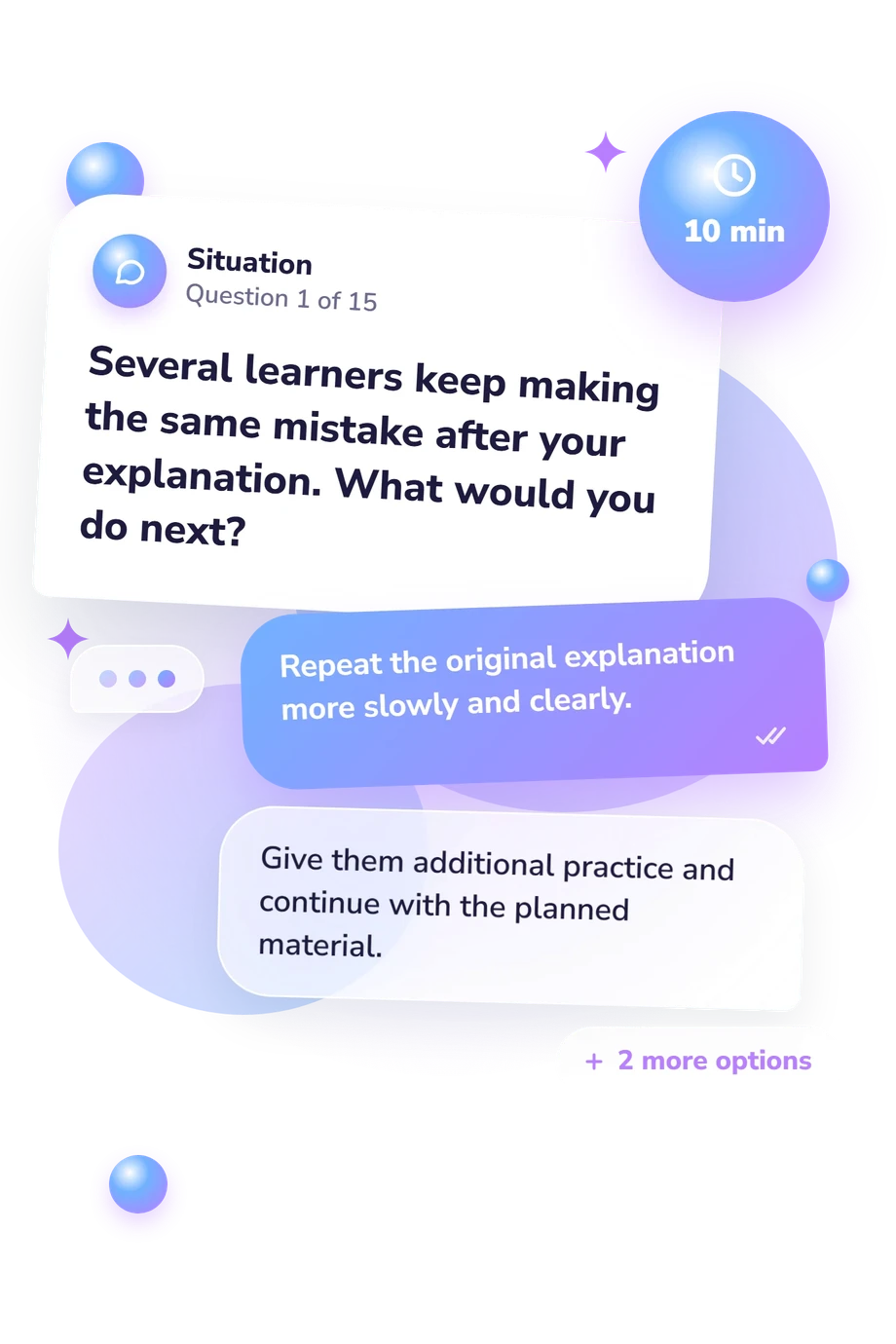
- Repeat the original explanation more slowly and clearly.
- Give them additional practice and continue with the planned material.
- Ask an experienced colleague for another approach, then use it in a revised explanation.
- Compare their attempts, work out what they may be misunderstanding, and teach the idea in a different way.
- I do my best work with long, uninterrupted periods and limited social demands.
- I prefer a predictable sequence of tasks with few unexpected changes.
- I can handle a varied day if there are some dependable routines and quiet periods.
- I am energized by switching between people, problems, and planned activities while keeping the day on track.
- I would rather work one-to-one than be responsible for resetting a whole group.
- I would pause and remind everyone that they need to settle down.
- I would use a familiar attention routine, restate the task, and set a short checkpoint.
- I would reset the group, identify whether the instructions or structure caused the problem, and adjust the activity.
Should I Be a Teacher Quiz - Description and methodology of the test
People considering teaching can use this questionnaire to examine how their instincts fit everyday classroom demands, whether they are exploring a career change or testing a long-held interest. The Should I Be a Teacher Quiz gives that reflection a structured focus, highlighting strengths, pressure points, and practical tradeoffs. That makes it a practical should i become a teacher quiz for weighing strengths, pressure points, and tradeoffs.
What This Assessment Explores
Teaching combines explanation, group leadership, emotional attunement, adaptation, and sustained work under institutional constraints.
The questions place those demands in realistic situations, so the questionnaire works as a teacher quiz for people considering teaching without predicting performance in one particular school.
The three result dimensions are:
- Classroom Relationships and Leadership (0-15) reflects empathy, boundaries, adaptability, and group leadership: Early exploration (0-5), Developing foundation (6-10), Strong foundation (11-15).
- Instructional Readiness (0-15) reflects explanation, checking understanding, and adjustment: Early exploration (0-5), Developing foundation (6-10), Strong foundation (11-15).
- Sustainable Professional Fit (0-15) reflects workload, recovery, training, finances, and constraints: Significant questions (0-5), Conditional fit (6-10), Realistic fit (11-15).
Together, these scores form a profile, showing where teaching may feel promising and where observation, tutoring, mentoring, or financial planning could clarify your next step.
Methodology and Evidence Base
Each item presents a classroom or career situation with four ordered responses, moving from lower preparation toward more adaptive choices. Select the statement closest to your usual instinct. Rather than treating this questionnaire as only a would i be a good teacher quiz, the result focuses on current teaching-related tendencies and developable skills, not a fixed label.
Scoring produces three domain totals rather than a pass/fail verdict. This online questionnaire has no established population norms or validation evidence; its bands are descriptive categories, not certification thresholds or guarantees. Local credentials, pay, workload, support, and recovery time still require checking.
The questionnaire is conceptually consistent with the 2001 TSES work by Tschannen-Moran and Woolfolk Hoy, which frames teacher efficacy through instruction, classroom management, and student engagement. It is not an adaptation of TSES. Emmer and Hickman’s 1991 work addresses management efficacy, while Skaalvik and Skaalvik’s 2017 research links self-efficacy with workload and exhaustion.
These sources provide context, not provenance for the questionnaire. Self-reported answers can shift with current context, experience, social desirability, and self-knowledge. The profile helps you examine whether teaching fits your interests, capacities, priorities, and circumstances; observation or tutoring adds evidence.
- Tschannen-Moran, Megan, and Anita Woolfolk Hoy. "Teacher efficacy: Capturing an elusive construct." Teaching and Teacher Education, 17(7), 783-805, 2001. 10.1016/S0742-051X(01)00036-1
- Emmer, Edmund T., and Julia Hickman. "Teacher Efficacy in Classroom Management and Discipline." Educational and Psychological Measurement, 51(3), 755-765, 1991. 10.1177/0013164491513027
- Skaalvik, Einar M., and Sidsel Skaalvik. "Motivated for teaching? Associations with school goal structure, teacher self-efficacy, job satisfaction and emotional exhaustion." Teaching and Teacher Education, 67, 152-160, 2017. 10.1016/j.tate.2017.06.006
Updated: