
DNA Quiz
How the Scales are Structured
Who Usually Takes This Test?
See How You Compare
Below is a preview of how scores are typically distributed across each scale.
Example Questions From the Test
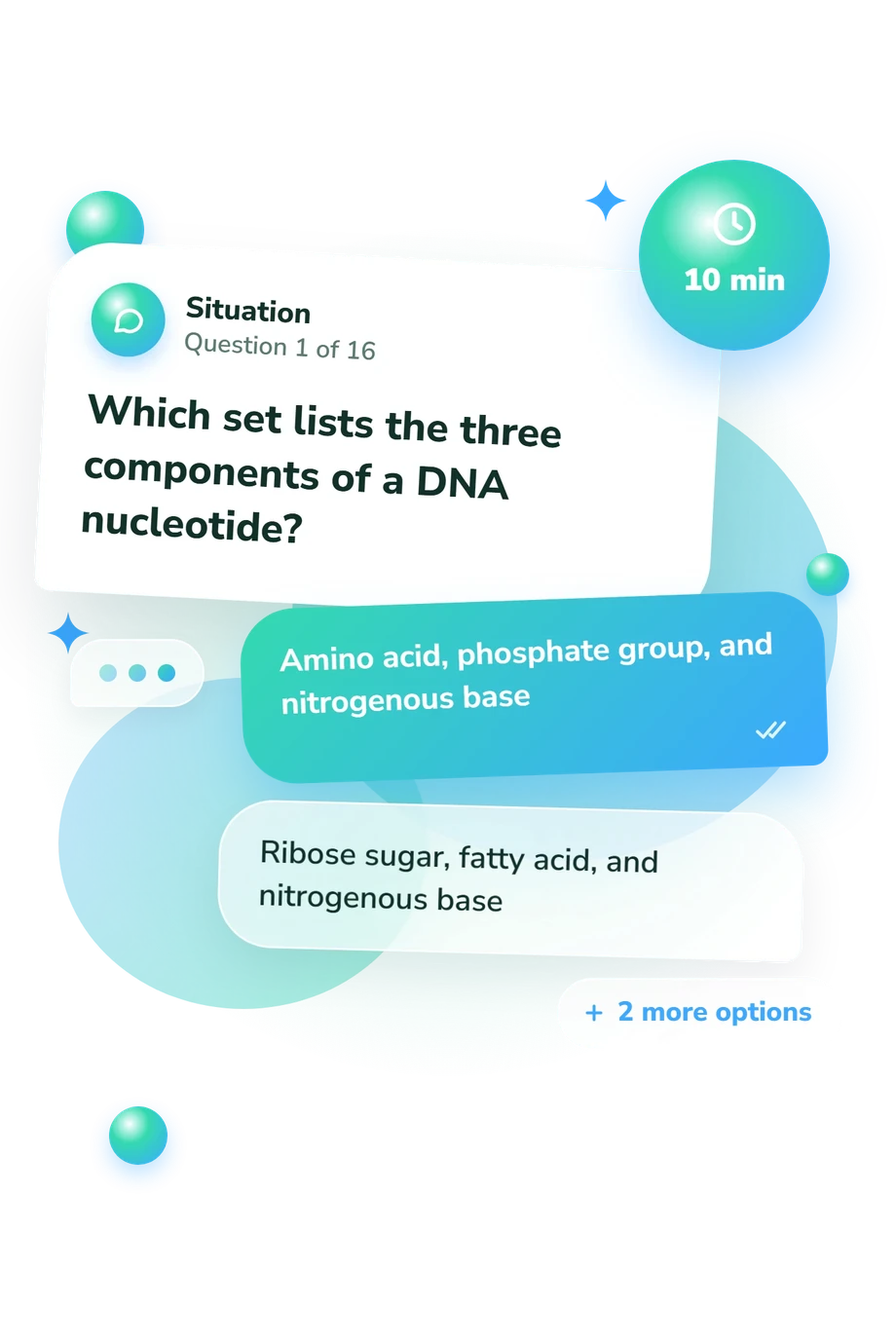
- Amino acid, phosphate group, and nitrogenous base
- Ribose sugar, fatty acid, and nitrogenous base
- Deoxyribose sugar, phosphate group, and nitrogenous base
- Deoxyribose sugar, amino acid, and glycerol
- Guanine
- Thymine
- Adenine
- Uracil
- Two newly synthesized strands
- Two original strands joined to a new chromosome
- One DNA strand and one RNA strand
- One original strand and one newly synthesized strand
DNA Quiz - Description and methodology of the test
For learners reviewing biology or checking their command of core concepts, this assessment turns familiar DNA topics into a focused knowledge check. The DNA Quiz indicates your general level across the covered DNA concepts and can help organize study. Its DNA online quiz format suits independent study before a class, lab discussion, or revision session.
What This Assessment Explores
The assessment suits anyone seeking a structured look at foundational DNA knowledge. Questions in this DNA biology quiz include both vocabulary recall and applying principles in new contexts; both contribute to the single overall score.
The questions cover these areas:
- Molecular structure and pairing show whether you identify nucleotide parts and complementary bases.
- Replication, mutation, and repair connect copying, damage, and biological effects.
- Inheritance and variation explain how meiosis and gene activity create differences between cells or siblings.
- Laboratory context covers PCR, gel movement, profiling, and bacterial DNA location.
DNA Knowledge (0-16) counts correct answers. Foundation to build (0-6) means core ideas need review; Developing knowledge (7-12) reflects understanding with room to strengthen application; Strong knowledge (13-16) indicates consistent grasp across common biological scenarios. This educational score is not a genetic or medical assessment.
Methodology and Evidence Base
Each item presents a question or scenario with four answer choices, and the respondent selects the best option. Scoring is direct: the result is the number of correct responses, so it describes performance on these concepts rather than a personality profile. As a DNA practice quiz, this questionnaire can indicate whether general review of the covered material may be useful.
Items range from base pairing and replication to inheritance and laboratory methods.
The content is conceptually consistent with the Genetics Concept Assessment (Smith et al., 2008), a concept inventory addressing relationships within genetics. It also overlaps conceptually with the genetics-literacy instrument described by Bowling et al. (2008), a separate comparator. Neither instrument validates, standardizes, or provides norms for this questionnaire, which is not a reproduction or validated adaptation of either one.
The result can guide study choices and clarify what this DNA assessment measures in practice: performance on selected concepts involving structure, inheritance, molecular processes, and laboratory reasoning. It does not establish overall genetics literacy or laboratory competence. Scores may vary with prior coursework, wording comprehension, attention, and current knowledge.
- Smith MK, Wood WB, Knight JK. The Genetics Concept Assessment: A New Concept Inventory for Gauging Student Understanding of Genetics. CBE-Life Sciences Education. 2008;7(4):422-430. 10.1187/cbe.08-08-0045
- Bowling BV, Acra EE, Wang L, Myers MF, Dean GE, Markle GC, Moskalik CL, Huether CA. Development and Evaluation of a Genetics Literacy Assessment Instrument for Undergraduates. Genetics. 2008;178(1):15-22. 10.1534/genetics.107.079533
Updated: